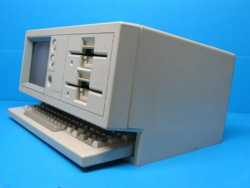
Dynalogic Hyperion
~ the goodbye ~
Dynalogic Corporation was incorporated in Ottawa in 1973 by C. Murray Bell to build floppy-disk systems. Ten years later it shipped a machine the American market wanted, and shipped it ahead of the Americans. The Hyperion went out in January 1983 at C$4,995, a boxy luggable with a seven-inch amber screen on the left, two floppy drives stacked beside it, and a keyboard that clipped onto the front for carrying. It weighed eighteen pounds, roughly two thirds of what the Compaq Portable weighed, and it beat the Compaq to market by two months.
I was born the year it was withdrawn, which is as close as I get to this machine. What makes it readable from here is that the mistake is still a live one. A product can be first and lighter and still lose to the one that is merely compatible, which is what happened here in under two years.
Bytec Management Corp. bought Dynalogic in January 1983, and Bytec itself merged into Comterm of Montreal later that year, under the chairmanship of Michael Cowpland, who had co-founded Mitel. By March 1984 twelve thousand Hyperions had been sold, ComputerLand was carrying it across North America and Europe, 47th Street Photo in Manhattan had it on the shelf, and the company was telling the Christian Science Monitor it expected to sell forty thousand that year and turn over $234.9 million.
~ the chronicle ~
| Born | January 1983, shipped from Ottawa at C$4,995 |
|---|---|
| Peak | 12,000 sold in the first year, against a US$25 million order backlog |
| Killed | late 1984, withdrawn from marketing at a $48 million loss |
| Lifespan | under 2 years |
| Made by | Dynalogic Corporation, absorbed by Bytec and then by Comterm |
| Killed by | the IBM compatibility it did not quite have |
~ two months ~
The two-month lead over Compaq is the claim the Hyperion is remembered for, and it holds up with a qualification. Compaq announced its Portable in November 1982; the Hyperion had already been shown that year at Comdex in Atlantic City, two prototypes on the stand. Compaq then shipped in March 1983 against the Hyperion's January. So the Canadians were first to ship.
They were also first to find out what being first was worth. Software of that era routinely called straight into the IBM ROM, and the Hyperion's ROM was not IBM's. Its video board handled both CGA and Hercules, which was clever, and its serial port used a Zilog Z80-SIO where the IBM PC used a National Semiconductor 8250, which was not, because that is exactly the sort of difference communications software notices. Buyers who had been told the machine was compatible kept finding programs that disagreed.
Compaq had spent its money on the one thing Dynalogic economized on, which was a cleanly reimplemented ROM that behaved like IBM's in every way a program could observe. That is most of the difference between the two companies. Compaq was still trading in 2002, when Hewlett-Packard absorbed it. The Hyperion was off the market inside two years.
~ the soft keys ~
The part of the Hyperion worth stealing was the interface. Five function keys sat directly under the seven-inch screen and lined up with five menu items printed along the bottom of the display, and the menu changed with context. Almost every DOS command you would actually use was reachable without typing it, and the same soft keys drove the bundled word processor and database. DOS shells existed, but hardly any of them tied the labels to physical keys in the right place on the case. Anyone who has used a cash register or a bank machine has used this idea since.
~ huntsville ~
The order backlog reached US$25 million and the company made plans to build most units in the United States. The plant was in Huntsville, Alabama, and the drives that came out of it were faulty often enough to generate warranty claims on machines already sold. That damage landed on top of the compatibility complaints rather than instead of them, and a portable whose drives fail has no weight advantage left to sell.
Commodore International licensed the design in 1984. Analysts called it a radical shift of position and a sign that Commodore was about to take the PC-compatible market; units hand-assembled from kits that Bytec supplied were shown at a German trade fair next to the Commodore 900 as the company's coming first portable. Commodore never sold a single one. The Hyperion was withdrawn from marketing in late 1984 at a loss of $48 million, in the same year its own marketing department had put the company's sales at $234.9 million.
~ leave a rose ~
an anonymous tribute. one rose per visitor per day.
@}-->-- ... roses left here
~ leave a wreath ~
a rose fades by morning. a wreath stays on this grave for good, with your name on it.
paid once through stripe. payments are handled by OÜ Lakeview, the small company that keeps rip.so running. the money pays for the hosting and the nightly digging. adopt it and the headstone reads "maintained in memory by" you. the groundskeeper plants new wreaths at the next tending, usually within a day.
» one email a week: new graves and the anniversaries of the dead. subscribe
other gadgets: Logitech Harmony Express, Everyday Robots, Olympia-Werke, Microsoft Lumia
also died in the 1980s: PlayNET, Gavilan SC, Grundy NewBrain
~ leave a note ~
visitors before you have left these graveside notes. anonymous welcome.