Erwise
~ the goodbye ~
In April 1992 I was a child in Turkey, six years away from my first modem and a good deal further than that from anything with a hypertext link in it. Erwise sits in the part of internet history I can read about but have no memory of. What makes it worth a grave is that almost nobody has a memory of it, including people who were online at the time.
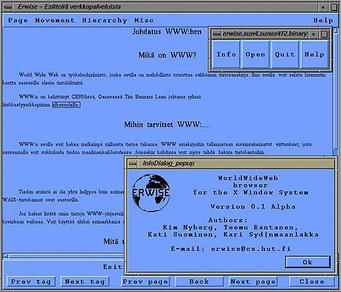
It was a masters project. Four students at Helsinki University of Technology, Kim Nyberg, Teemu Rantanen, Kati Suominen and Kari Sydänmaanlakka, built a web browser with a graphical interface for Unix machines running the X Window System, and released it on 15 April 1992. It rendered multiple fonts on a page. It showed links as underlined text that you opened by double clicking them. Before it, using the web meant a browser that ran in a terminal, or Berners-Lee's own program that only ran on a NeXT.
The project came out of a suggestion from CERN, carried to Helsinki during a visit and taken up under an instructor at the university. The people who wrote it were finishing a degree, not starting a company, and the software was put into the public domain. There was no plan for a version two because there was no organization behind it that could have wanted one.
~ the chronicle ~
| Born | 15 april 1992, a masters project at helsinki university of technology |
|---|---|
| Peak | the first graphical web browser in general circulation, roughly a year ahead of mosaic |
| Killed | 25 april 1994, the date on the last release and the only ending anyone can point at |
| Lifespan | two years and ten days |
| Made by | four masters students in Helsinki, working under an instructor at the university |
| Killed by | graduation, and no funding for anyone to keep going |
~ april 1992 ~
The date matters more than the software does. Mosaic, which is the browser everybody credits with making the web visible, came out of NCSA in 1993. Erwise was already running a year before that, doing the same fundamental thing, from a university in Finland with no publicity operation attached to it. The W3C still hosts a status page for it from late 1992, which is one of the few primary traces left.
It was not better than what came after. It was slow and it was rough, and it never got the finishing work a funded team would have given it. But the argument about which browser first put the web behind a graphical window is not really close, and the answer is a student project that nobody has heard of.
~ why it stopped ~
Tim Berners-Lee got on a plane to Finland to try to keep it alive. He looked at the code and hit a wall that had nothing to do with the quality of it. The documentation and the comments were written in Finnish, which meant that he could not take the project forward himself and neither could anyone else outside the four people who wrote it. Language, not licensing, is what closed the door.
The rest was ordinary. The students graduated and went to jobs. None of them could afford to work unpaid on a browser for a network that in 1992 had no money in it whatsoever, and no institution stepped in to pay them. The version number never moved either. The about box in the surviving screenshot reads 0.1 Alpha, and that is the number it still carried on the final release, dated 25 April 1994. Nothing was announced. A project simply stopped having anybody attached to it, which is how most software actually ends and almost never how it gets written up.
~ the long tail ~
Everything Erwise did got absorbed so completely that describing it now sounds like describing a window. Underlined links you click, and a page that can carry more than one typeface without a computer scientist standing next to it. Every browser since has shipped both of these and none of them credit anybody for them.
The thing I keep turning over is how narrowly the credit went elsewhere. Four people did the work first and got neither funding nor a place in the story, because their documentation was in the wrong language and their degrees finished on schedule. Mosaic had NCSA behind it and then Netscape after that, and it took the decade. Erwise got a status page on a W3C server and a screenshot. Being first is worth considerably less than being first with somebody willing to pay for the second year.
~ leave a rose ~
an anonymous tribute. one rose per visitor per day.
@}-->-- ... roses left here
~ leave a wreath ~
a rose fades by morning. a wreath stays on this grave for good, with your name on it.
from $1, paid once through stripe. it keeps the graveyard running: the hosting and the nightly digging. adopt it and the headstone reads "maintained in memory by" you. the groundskeeper plants new wreaths at the next tending, usually within a day.
» one email a week: new graves and the anniversaries of the dead. subscribe
other browsers: DoDots, Timberwolf, NPAPI, DR-WebSpyder
also died in the 1990s: HotWired, RocketMail, Mercury Center
~ leave a note ~
visitors before you have left these graveside notes. anonymous welcome.