CYCLADES
~ the last words ~
There was an argument in the 1970s about where the intelligence in a network belongs. I have used the winning answer every day since 1998 without ever touching the machines that proved it, because those machines were in France and they were unplugged before I could read.
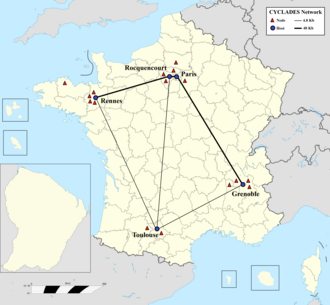
CYCLADES was a French research network run by Louis Pouzin at IRIA from 1972. The first demonstration in November 1973 had three hosts and a single packet switch in it. By 1976 there were about twenty nodes, the core of them strung between Rocquencourt outside Paris and Toulouse, on links of 4.8 and 48 kilobits. By the standards of what it was arguing about, the network was tiny.
The part that outlived it was a design decision. CIGALE, the layer that actually moved things, made no promise to deliver them. Pouzin named each packet a datagram, out of data and telegram, and pushed the work of noticing loss and asking again onto the hosts at either end. The network was to be simple and the edges were to be smart. Vint Cerf and Bob Kahn were designing TCP in the same years and Gérard Le Lann came over from the CYCLADES team to work with them, so the idea crossed while the network that produced it was still running.
~ the record ~
| Born | 1972 at IRIA, with a first demonstration in November 1973 |
|---|---|
| Peak | about twenty nodes by 1976, on links of 4.8 and 48 kilobits |
| Killed | funding stopped in 1978, formally finished by 1981 |
| Lifespan | nine years |
| Made by | Louis Pouzin's team at IRIA, funded by the French government |
| Killed by | Transpac, and the state monopoly that owned data transmission |
~ the other answer ~
France's telephone administration was building something else. Transpac was a virtual circuit network on the X.25 standard, where the network sets up a path, holds it open and guarantees what crosses it. That is how a telephone company thinks about a call, and it is also how a telephone company thinks about billing for one. Data transmission in France was a state monopoly.
So a research project proposing that the network should be a dumb pipe with the value sitting at the customer's end was not a technical disagreement. It was a proposal about who gets to own the middle. The people who owned the middle were in a position to answer it, and they did.
~ how it was closed ~
After the 1974 election the decision came down to backing one of the two projects, and the one with the monopoly behind it won. Funding was squeezed from about 1975 and stopped for good in 1978, on the stated grounds that the network was competing with Transpac. The formal end came in 1981. Transpac went on to carry Minitel, which put a working terminal in millions of French homes years before anybody else had one, so it is not as though the winning side built nothing.
~ where it survived ~
Everywhere. Every packet I have sent in my life has been an unreliable one that something at my end had to check up on, and that is the CYCLADES answer rather than the Transpac one. France ran the experiment first and then defunded it for competing with the national plan. The finding went into TCP and came back thirty years later as the way the entire world got wired.
Pouzin was one of five engineers given the first Queen Elizabeth Prize for Engineering in 2013, sharing it with Cerf and Kahn among others. The prize was for the internet, and part of what that recognized is that a piece of it had been built in France and thrown away there.
~ leave a rose ~
an anonymous tribute. one rose per visitor per day.
@}-->-- ... roses left here
~ leave a wreath ~
a rose fades by morning. a wreath stays on this grave for good, with your name on it.
from $1, paid once through stripe. it keeps the graveyard running: the hosting and the nightly digging. adopt it and the headstone reads "maintained in memory by" you. the groundskeeper plants new wreaths at the next tending, usually within a day.
» one email a week: new graves and the anniversaries of the dead. subscribe
other protocols: Mozilla Persona, InterNIC, HyTelnet, Teletext (UK)
~ leave a note ~
visitors before you have left these graveside notes. anonymous welcome.