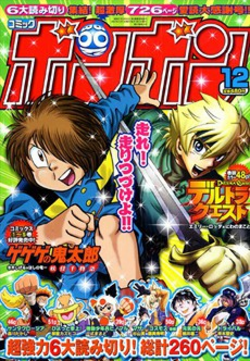
Comic BomBom
~ the obituary ~
Comic BomBom went on sale on 15 October 1981 as a Kodansha monthly for children, aimed squarely at Shogakukan's CoroCoro Comic, four years old by then and in full possession of that readership. Its second issue came two months later and only then did it settle into a monthly rhythm, on the fifteenth, which it kept for twenty-six years. The first editor-in-chief was Toshio Tanaka.
The business was tie-ins, and they ran down the spine of the thing rather than along its edges. A plastic model kit or a Famicom cartridge arrived, and BomBom turned it into a serialized comic that children read while saving up for the product itself. Plamo Kyoshiro started in February 1982, written by a studio credited as Kraft-dan with art by Niji'ichi Yamato, and ran to November 1986. Japanese Wikipedia credits it directly with setting off the gunpla boom, which is a large claim for a comic about a boy and his model kits, and is also roughly what happened.
Then came the Gundam strips that mattered more commercially than the series they came from. Bakushō Senshi! SD Gundam by Gen Sato ran from March 1987, the Knight Gundam serial from August 1989, and the Musha Gundam line carried the magazine through the nineties in two long runs. Circulation went from 300,000 in 1988 to 630,000 in 1990, and for about three years from 1991 BomBom was outselling CoroCoro, which had been the point of the exercise since 1981.
I can claim one thread of this, and only at a slant: Rockman. Capcom's games reached me the way most things reached a Turkish kid with a secondhand machine, through cartridges and later emulators, with the character called Mega Man because that is what the West renamed him. The comics that gave him a personality in Japan were printed in a magazine I could not have bought, read or understood at the time, and I only learned they existed while looking up why the magazine closed.
~ the case file ~
| Born | on sale 15 October 1981, built to take on Shogakukan's CoroCoro Comic |
|---|---|
| Peak | 630,000 copies in 1990, outselling CoroCoro for about three years from 1991 |
| Killed | 15 November 2007, the December issue |
| Lifespan | 26 years, on sale the fifteenth of the month |
| Made by | Kodansha |
| Killed by | circulation falling from 630,000 to 98,000, and the loss of Rockman to the rival |
~ what a tie-in magazine actually does ~
Shigeto Ikehara started drawing Rockman in January 1992 and did not put it down until August 1996, working through the numbered games in order, each one a serial of a few months. Yoshihiro Iwamoto had Rockman X running from January 1994 to August 1998. Kazuki Motoyama did the Nintendo side, with Super Mario Bros. 3 from December 1988 and Super Mario World from November 1990, and Koji Izuki's Metroid serial ran from December 2002 to April 2005.
Read as a list it looks like advertising, and some of it was. But a child in 1992 who had finished a game had nowhere else to go, and these strips are what filled that space: an authorized guess at what the characters were like between levels. Cyborg Kuro-chan and Jing, King of Bandits were born in the magazine itself with no game attached, and both were animated for television afterwards.
~ losing rockman ~
The thing that did the damage was not a reader deciding to stop. When Capcom built the Rockman EXE line in the early 2000s with a television series behind it, the manga went to CoroCoro instead, and the last asset BomBom could not replace walked out in a licensing meeting. The editor-in-chief, Ikeda, has said the magazine let Rockman go over anime sponsorship money. Circulation was 220,000 at that point and kept going: 186,666 by the 2004 measurement year, 136,417 by 2005, 98,000 by 2006.
~ four months of notice ~
In late June 2007 the artist Jun Ishikawa hinted on mixi and on his own site that something was coming. Kodansha confirmed it on 17 July: the magazine would end with the issue on sale 15 November, and the November issue carried the notice in print. The stated reason was the circulation slump. Japanese Wikipedia files it in the lead as 廃刊 with 休刊 in brackets, abolition qualified by suspension, which is a small bibliographic shrug about whether a thing like this is ever formally dead.
The December 2007 issue went on sale on the fifteenth at 480 yen and carried a new serial called Delta Quest, which is a strange decision for a last issue. Four of its series moved to a Television Magazine spin-off called Tele-manga Heroes, first issued on 15 March 2008 and described in Japanese sources as the effective successor. When Monthly Shonen Rival launched later, its editor-in-chief went out of his way to say his magazine was not that.
~ the index the readers built ~
bombom.jp is still up. It calls itself a backward-looking site that goes over BomBom's history, and it holds year-by-year issue listings from 1990 to the end, plus the sister magazine Deluxe BomBom from 1990 to 1995, all of it in Shift-JIS, all of it assembled by readers rather than by the publisher. Kodansha's own afterlife is a reissue line started in 2012, an ebook archive from 2022, and a YouTube channel that borrowed the name in 2015 for videos made for children who will never see a copy. The index somebody built for free is the better monument.
~ leave a rose ~
an anonymous tribute. one rose per visitor per day.
@}-->-- ... roses left here
~ leave a wreath ~
a rose fades by morning. a wreath stays on this grave for good, with your name on it.
paid once through stripe. payments are handled by OÜ Lakeview, the small company that keeps rip.so running. the money pays for the hosting and the nightly digging. adopt it and the headstone reads "maintained in memory by" you. the groundskeeper plants new wreaths at the next tending, usually within a day.
» one email a week: new graves and the anniversaries of the dead. subscribe
other gaming: Sanctuary Woods, SINoALICE, Ace of Spades, GameShark
also died in the 2000s: Casema, Nando Times, Windows 95
~ leave a note ~
visitors before you have left these graveside notes. anonymous welcome.