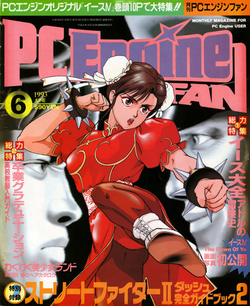
PC Engine FAN
~ the obit ~
NEC Home Electronics and Hudson put the PC Engine on sale in Japan on 30 October 1987. One year later to the day, on 30 October 1988, Tokuma Shoten Intermedia put the first issue of PC Engine FAN in shops, a month ahead of Shogakukan's Gekkan PC Engine and Kadokawa's Marukatsu PC Engine. The staff came ready-made. Tokuma had cut the PC Engine software pages out of its Family Computer Magazine and given them a title of their own, and the editor's note in the first issue said the Famimaga people had simply walked over.
The house style put the name in Latin letters with the last word shouting: PC Engine FAN, and under the masthead the English line "MONTHLY MAGAZINE FOR PC Engine USER". Readers shortened it to P-Fan. By June 1993 it cost 590 yen and came with a bound Street Fighter II Dash guide, which is roughly what a Japanese games monthly was in that decade: a thick stack of screenshots with a strategy book stapled into the middle of it.
What separated it from the rest of the shelf was who wrote the scores. Rival magazines ran the cross-review format, where four named editors each gave a game a mark out of ten and the sum became the verdict. PC Engine FAN tallied points submitted by readers. A publisher who disliked a score had nobody to telephone about it, because the number came back off a pile of postcards. From the August 1990 issue the reader section expanded into READER'S LAND, which carried fan art and buyer impressions, frequently running a positive and a negative read of the same game side by side.
The PC Engine was a Japanese success and almost nothing else. It was sold in North America as the TurboGrafx-16 and lost there. Turkey got neither version, legally or otherwise. The hardware around me at twelve years old was PCs with the occasional Amiga, running software that came in on copied floppies, and a Japanese console monthly that scored games by postcard sat outside anything I could reach. So did the console.
~ the rap sheet ~
| Born | on sale 30 October 1988, a year to the day after the console |
|---|---|
| Peak | 590 yen monthly, reader-scored game charts, Akemi Takada covers |
| Killed | the October 1996 issue, which promised another one |
| Lifespan | eight years, against a platform that shipped 5.84 million units in Japan |
| Made by | Tokuma Shoten Intermedia |
| Killed by | NEC moving to the PC-FX and leaving the magazine nothing to cover |
~ scoops and reprints ~
In the early years the magazine ran a near-weekly drip of Super Darius information fed by NEC Avenue, while Gekkan PC Engine, sitting closer to Hudson through Shogakukan, had the Tengai Makyo ZIRIA material. Access in the Japanese games press ran along those corporate lines, and a reader who wanted both sets of screenshots bought both magazines.
For its fifth anniversary in 1993 the magazine did something a magazine does not usually do. Magical Chase had sold badly and gone scarce, so PC Engine FAN took direct orders for a reprint run itself, the publisher rather than the maker handling the mail. The idea had come in as a reader letter. The seventh anniversary brought a limited Tokimeki Memorial package sold the same way. Hisashi Yamamori was editor-in-chief through that stretch.
~ mana ~
Akemi Takada drew the covers from the first issue. In 1993 the magazine gave its cover girl a name, Mana, chosen by reader vote, and she became the mascot. Three years later the editors decided she needed a voice and ran the casting as a reader exercise: the May 1996 issue shortlisted five actresses, among them Wakana Yamazaki and Akiko Yajima, and the August 1996 cover disc carried all five readings so the audience could judge. Yamazaki won the vote.
That was four months before the end, which is the detail I keep turning over. A magazine four issues from the end was still running a reader ballot on the voice of a drawing, and the readers were still filling it in. The artwork was later collected as a digital book of covers.
The girl-game direction had already escaped the mothership. From the November 1994 issue PC Engine FAN carried an occasional supplement called Virtual IDOL, which went independent with the September 1996 number, sold around 150,000 in 1997 and outlived its parent by a year.
~ the issue that never came ~
NEC had moved on. The PC-FX arrived at the end of 1994 and the last HuCard game, 21 Emon, came out on 16 December that year. Tokuma had no PC-FX magazine to fold the staff into, and it could not pivot the title toward girl games because Virtual IDOL already held that ground. The October 1996 issue carried the notice: the magazine was leaving monthly publication and would come out when enough software news had accumulated, with the next issue expected late October or early November. Two Super PC Engine FAN DELUXE mooks appeared in 1997 and that was the whole estate. The Japanese word for this is kyūkan, suspended rather than ended, and thirty years on it has never been formally anything else.
The family it belonged to went the same way. MSX・FAN ran from March 1987 to July 1995. Mega Drive FAN became SATURN FAN in December 1994 and Dreamcast FAN in November 1998, then shut in 1999 when Tokuma Shoten Intermedia was absorbed back into its parent. Every one of them was named after a machine, which is a fine business while the machine sells and a death sentence the moment it stops. The last PC Engine game, Dead of the Brain 1&2, went on sale in June 1999 through two retailers and nowhere else, almost three years after the only magazine that would have reviewed it had promised to be back in a few weeks.
~ leave a rose ~
an anonymous tribute. one rose per visitor per day.
@}-->-- ... roses left here
~ leave a wreath ~
a rose fades by morning. a wreath stays on this grave for good, with your name on it.
paid once through stripe. payments are handled by OÜ Lakeview, the small company that keeps rip.so running. the money pays for the hosting and the nightly digging. adopt it and the headstone reads "maintained in memory by" you. the groundskeeper plants new wreaths at the next tending, usually within a day.
» one email a week: new graves and the anniversaries of the dead. subscribe
other gaming: Trauma Studios, CyberFlix, Dust 514, Bots!!
also died in the 1990s: CyberFlix, Autodesk Animator, Yggdrasil Linux/GNU/X
~ leave a note ~
visitors before you have left these graveside notes. anonymous welcome.