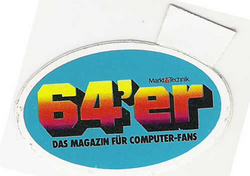
64'er
~ the goodbye ~
64'er was German, printed, and ran as its own title until December 1996. My own first machine was a PC clone and my first real connection a 33.6k modem, so the C64 listings culture reached me as other people's nostalgia and never as a thing I did. Copying a program out of a printed page is a kind of patience I was never required to develop.
The full title was 64'er, Das Magazin für Computer-Fans, published by Markt+Technik, and the first issue went on sale at the Hannover Messe in April 1984. The editor in chief of the early years, Michael M. Pauly, was also running Computer Persönlich and Happy Computer at the same publisher, a fair sign of how small the German computer press still was in 1984.
For the rest of the eighties it was, along with the blue-spined Data Becker books, where German-speaking C64 owners went to learn their machine. Courses for beginners sat next to listings that ran for pages.
~ the chronicle ~
| Born | April 1984, launched at the Hannover Messe |
|---|---|
| Peak | The main German-language source for C64 owners, alongside the Data Becker books |
| Killed | December 1996, with issue 12/96 |
| Lifespan | Twelve years as a magazine of its own |
| Made by | Markt+Technik Verlag, under Michael M. Pauly in the early years |
| Killed by | the Commodore 64 audience aging out while the publisher moved to PC titles |
~ typing it in by hand ~
Every issue carried a Listing of the Month and an Application of the Month, and the magazine paid for them: 2,000 marks for the listing, 500 for the application, raised to 3,000 and 1,000 from issue 9/1987. For a reader submission in 1987 that is serious money, and it pulled in people who went on to do this professionally. Chris Hülsbeck and Manfred Trenz, both of whom ended up with careers in German game development, entered those competitions.
The other thing it gave its readers was a way to survive its own listings. In early 1985 it introduced MSE, a machine language editor for entering assembler listings, and a Checksummer that verified the BASIC you had typed against a checksum printed with the program. Other computer magazines copied the idea. If you have ever wondered how anyone successfully typed in six pages of hex without going mad, the answer is that somebody wrote a tool for it and gave it away in issue 2.
~ what the magazine made ~
It also worked as an incubator for the publisher. The Amiga-Magazin came out of it in 1987, and PCgo followed in October 1993, both of them 64'er spin-offs aimed at the machines readers were migrating to. The special issues got a program diskette from number 46 onward, and the last of the monthly specials was number 97, on games, in 1993.
~ the diskette with no label ~
Issue 12/1996 was the last one you could buy by itself. Subscribers were switched to PCgo or Power Play and received a 64'er leaflet with a program diskette alongside it. After issue 1/1999 the leaflet stopped too, so what arrived was a diskette with nothing written on it, and from late 1999 a CD-ROM twice a year did that job instead. Production of even that ended in 2009.
Meanwhile a group of C64 fans who could see the end coming started their own title. GO64! printed its first issue in March 1997, merged into the newer RETRO magazine from the 2006 spring issue, ran for a while as the same contents under its own cover and numbering, and finished around the beginning of 2008.
~ forty years late ~
Since March 2024 a fan has been republishing the whole run at 64er-magazin.de on a forty-year delay, one issue a month, and heise wrote it up as an art project. The pages keep the original layout and typeface. The listings sit there with copy buttons beside them.
~ leave a rose ~
an anonymous tribute. one rose per visitor per day.
@}-->-- ... roses left here
~ leave a wreath ~
a rose fades by morning. a wreath stays on this grave for good, with your name on it.
paid once through stripe. payments are handled by OÜ Lakeview, the small company that keeps rip.so running. the money pays for the hosting and the nightly digging. adopt it and the headstone reads "maintained in memory by" you. the groundskeeper plants new wreaths at the next tending, usually within a day.
» one email a week: new graves and the anniversaries of the dead. subscribe
other news: TV by the Numbers, The Inquirer, Television Without Pity, ABCnews.com.co
also died in the 1990s: Elastic Reality, Sega 32X, Line Mode Browser
~ leave a note ~
visitors before you have left these graveside notes. anonymous welcome.