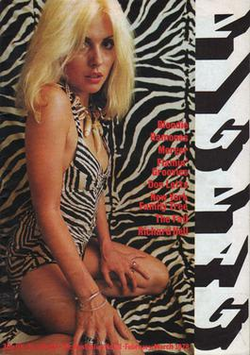
ZigZag
~ the obituary ~
Pete Frame started ZigZag because the British music papers were writing about the wrong records. His own account of it is plain: none of them covered the music he liked, they all concentrated on popular acts, and he was interested in the underground, so he made a magazine for people who liked what he liked. The first issue reached the streets on 16 April 1969 with Sandy Denny on the cover and a long piece on Fairport Convention inside. John Peel gave it a plug on Top Gear. Frame quit his day job on 23 May, five weeks after publication, and ZigZag was produced out of Caddington, a place between Harpenden and Luton with nothing special about it unless you lived there.
The name came from two directions at once. Frame took it from the Captain Beefheart track "Zigzag Wanderer" and from the cigarette papers, which were used for rolling joints, and he called his own editorial column the ZigZag Wanderer after the song. Issue 3, with Zappa on the cover, cost two shillings. The magazine was easy enough to find for the first couple of years if you went to underground shops or outdoor festivals, where according to one reader its other virtue was that it was good to sit on and absorbed the mud.
By the autumn of 1971 it was suddenly hard to find at all. Moore Harness, its distributor, went under owing money to ZigZag and to most of the other underground papers in Britain, and Frame had to take a day job again. What saved it was Tony Stratton Smith, who ran Charisma Records and ended up bankrolling the magazine. Issue 27 came with a Monty Python flexi disc called Teach Yourself Heath, which is a clue about who was paying, since Charisma was the Pythons' label. From January 1974 it came out as a proper monthly with some color inside, and Stratton Smith paid for The Amazing ZigZag Concert on 28 April that year to mark the fifth birthday.
Frame edited the first 29 issues, up to February 1973, and used his column in number 30 to announce that he was finished. Connor McKnight took issues 30 to 40, Frame came back for the fifth anniversary issue at 41, Andy Childs came in at 42 and stayed about eighteen months, and Frame himself returned for issues 58 to 74 between March 1976 and July 1977. Then he stopped being the story.
~ the case file ~
| Born | 16 April 1969, Sandy Denny on the cover, Fairport Convention inside |
|---|---|
| Peak | the punk years under Kris Needs, from August 1977 |
| Killed | January 1986, at roughly issue 140 |
| Lifespan | 16 years and 9 months, across four runs |
| Made by | Pete Frame, then Charisma Records, then a succession of owners |
| Killed by | nothing anybody recorded, after two collapses it had survived |
~ the trees ~
The rock family tree was a ZigZag invention and the magazine's single largest export. Very basic versions ran in issue 14 on the Byrds in August 1970 and issue 17 on John Mayall that December. The first one drawn in the form Frame became known for was issue 21, July 1971, on Al Kooper: a hand-lettered genealogy of who left which band for which other band, with dates, drawn in a style that looked like it had been done at a kitchen table because it had been.
Frame distanced himself from the magazine in the late seventies and published the first book of trees instead, which turned into a long series of them and eventually into a BBC television series in the 1990s. The format escaped the magazine completely. Anyone who has ever read a sleeve note tracing a lineup change through four bands is reading something that started as filler in a rock magazine run out of an English village.
~ punk takes the desk ~
Kris Needs was appointed editor in August 1977 and turned the whole magazine over to punk, which counts as ZigZag's third life. The reader polls from those years read like a listings page for what was about to happen: the Sex Pistols and the Buzzcocks came up through them alongside names nobody remembers. Needs stayed until the end of 1981.
There was also a record label, briefly. ZigZag Records managed exactly one release, an album by Mike Wilhelm, the guitarist out of the Charlatans, a band it had put in issue 26.
In April 1982 the magazine opened a live venue, the ZigZag Club, at 22 to 24 Great Western Road in London W9. It did not last the year. Mick Mercer had taken over the editing by then, and publication itself stopped for a stretch of 1983.
~ the fourth one ~
It came back in October 1983 with Mercer still editing, now covering post-punk and the early goth bands, and that version ran until the final issue in January 1986. Nobody filed a reason. Around 140 issues exist in total, which for a magazine that had already been killed by its distributor once and rescued by a record label once is a respectable number.
ZigZag stopped while I was a toddler in Turkey. Nothing it printed ever reached me in its own format. The trees did, years later, inside other people's books, and that is the only route a 1969 British underground magazine has to a reader in Turkey.
~ one more issue ~
The title did not sit still after 1986. Northern and Shell, Richard Desmond's company, ended up with it and amalgamated it into a music equipment magazine called One Two Testing, so the name spent a while on somebody else's masthead. In July 1988 Jim Maguire, who had been ZigZag's business manager back in the seventies, talked Desmond into selling it to him, and Maguire had a publishing deal with EMAP.
EMAP put out one issue, dated May 1990, and closed it. The rock monthly the company actually wanted turned out to be Mojo, launched in 1993 and still on the shelves thirty-three years later.
~ leave a rose ~
an anonymous tribute. one rose per visitor per day.
@}-->-- ... roses left here
~ leave a wreath ~
a rose fades by morning. a wreath stays on this grave for good, with your name on it.
paid once through stripe. payments are handled by OÜ Lakeview, the small company that keeps rip.so running. the money pays for the hosting and the nightly digging. adopt it and the headstone reads "maintained in memory by" you. the groundskeeper plants new wreaths at the next tending, usually within a day.
» one email a week: new graves and the anniversaries of the dead. subscribe
other media music: HitQuarters, gogoyoko, The Blue Ribbon SoundWorks, MP3Lizard
also died in the 1980s: Bubble Bus Software, Grundy NewBrain, Tongyang Broadcasting
~ leave a note ~
visitors before you have left these graveside notes. anonymous welcome.