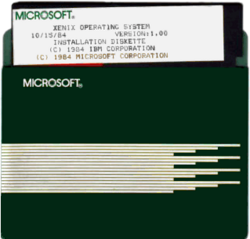
Xenix
~ the goodbye ~
Microsoft sold Unix for seven years, and the sentence reads today like a typographical error. It is not. Microsoft licensed Seventh Edition Unix from AT&T in 1978, announced its own version for 16-bit microcomputers on 25 august 1980, and could not call it Unix because AT&T owned the word. So it became Xenix, which is one letter of difference and a lawyer's compromise.
The business model is the part people get wrong. Microsoft never sold Xenix to anybody who wanted to use it. It licensed the software to hardware manufacturers at roughly five hundred dollars per single-user copy, and the manufacturers put it on their machines and sold those. The customer list is a list of computer companies: IBM, Intel, Tandy, Altos, Siemens, Management Systems Development, and the Santa Cruz Operation. That is how Xenix reached the world, with somebody else's badge on the front of the box.
It ran on almost everything with a 16-bit part in it. PDP-11, Z8001, Motorola 68000, Intel 8086 and 80286. In early 1983 Tandy made TRS-Xenix the default operating system on the TRS-80 Model 16 and more than doubled the installed base in one product decision, which is how a company best known for a retail chain of electronics stores ended up as the largest Unix vendor on earth in 1984.
i missed this by roughly fifteen years. The Unix i eventually met was Linux, on university machines in the early 2000s, arriving free and installing itself off a disc. The idea that Unix had once been a licensed product you bought from Microsoft, bundled with a Radio Shack computer, belongs to a market that had already finished before my first modem was plugged in.
~ the chronicle ~
| Born | 25 August 1980, announced for the 16-bit microcomputer market |
|---|---|
| Peak | Tandy the largest Unix vendor in the world in 1984, shipping Xenix by default |
| Killed | 1991, last release System V R2.3.4 from SCO |
| Lifespan | eleven years, seven of them under Microsoft |
| Made by | Microsoft, under license from AT&T, then the Santa Cruz Operation |
| Killed by | AT&T deciding to sell Unix directly, and Microsoft choosing OS/2 |
~ the deal that ended it ~
The Bell System breakup in 1984 removed the reason Microsoft was in this business. AT&T had been barred from selling computer products, which is why it licensed Unix out to other people in the first place. Once the restriction lifted, AT&T started selling System V itself, with the source and the trademark and the authority to define what Unix meant. Nobody was going to buy an imitation from Redmond when the original was available.
Microsoft turned to OS/2 with IBM instead, which was going to be the serious operating system and was not. In 1987 it transferred ownership of Xenix to SCO in an agreement that left Microsoft holding slightly under twenty percent of the Santa Cruz Operation. SCO kept publishing it, shipped SCO Unix on the 386 in 1989, and put out the last Xenix release, System V R2.3.4, in august 1991.
~ what got buried with it ~
Xenix is the reason SCO existed at the scale it later did, and SCO is the reason the 2003 lawsuits against Linux happened at all. A licensing chain that starts with AT&T handing Unix to Microsoft in 1978 ends up, twenty five years later, with a company in Utah claiming ownership of code in the kernel. Every step in that chain was an ordinary commercial transaction and the sum of them was a decade of litigation.
The detail that stays with me is domestic. All of Microsoft's internal email ran on Xenix machines until 1996, five years after the last release and nine years after the company gave the product away. They only stopped when Exchange Server was ready to replace it. The company that spent the nineties arguing that Unix was the past was reading its own mail off a Unix box the entire time.
~ leave a rose ~
an anonymous tribute. one rose per visitor per day.
@}-->-- ... roses left here
~ leave a wreath ~
a rose fades by morning. a wreath stays on this grave for good, with your name on it.
from $1, paid once through stripe. it keeps the graveyard running: the hosting and the nightly digging. adopt it and the headstone reads "maintained in memory by" you. the groundskeeper plants new wreaths at the next tending, usually within a day.
» one email a week: new graves and the anniversaries of the dead. subscribe
other software: Stikkit, Quarterdeck DESQview, Mozilla Thimble, Adobe Ultra
also died in the 1990s: Quarterdeck DESQview, Micropolis, Delrina
~ leave a note ~
visitors before you have left these graveside notes. anonymous welcome.