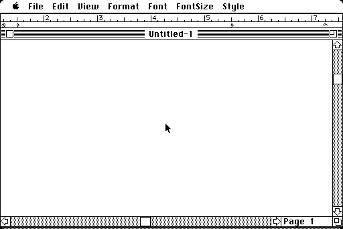
WriteNow
~ the last words ~
writenow had a strange origin story. apple wanted a word processor ready for the macintosh launch in 1984 in case microsoft word slipped or refused to ship. apple paid two seattle programmers, john anderson and bill tschumy, to write one. they wrote it entirely in 68000 assembly, which made it small and fast in a way no other mac word processor of the era could match. microsoft did ship word on time, so apple did not need writenow as a launch product, and the rights were handed to t/maker, which published it commercially starting in 1985.
by 1988 writenow 2.0 was on the shelves and developed a following among people who wanted a word processor that opened instantly and did not eat a full floppy. it was bundled with the next computer for a stretch after steve jobs left apple, which gave it a second small audience in academic and unix-adjacent workstation rooms. for a brief window it was the lightweight word processor on the mac, with macwrite as the apple house default above it and microsoft word eating the heavy end.
i was an elementary-school kid in turkey in this era, nowhere near a mac. writenow's whole life happened before i had even seen a computer in person. it sits in the part of internet history i can read about but cannot personally remember. the closest thing in my eventual orbit was wordperfect on dos in the mid-1990s, which is a different lineage entirely.
~ the record ~
| Born | 1985, written for Apple by John Anderson and Bill Tschumy in Seattle |
|---|---|
| Peak | WriteNow 2.0, October 1988, sub-megabyte fast word processor on the Mac |
| Killed | 1994, after the SoftKey buyout of WordStar |
| Lifespan | about 9 years |
| Made by | T/Maker Company, with Apple financing |
| Killed by | the PowerPC transition exposing the cost of pure-assembly software, and a quiet corporate sale chain |
~ what killed it ~
the assembly that made writenow fast also pinned it to the 68000 instruction set. when apple announced the move to powerpc in 1991 and started shipping power macs in 1994, every assembly-language mac app was facing a full rewrite. for software written in c, the compiler did most of the work. for software hand-written in 68000 assembly, the human had to do it line by line. that was an unaffordable rewrite for a niche word processor.
the corporate chain finished the job. t/maker sold the rights to wordstar in 1993. wordstar itself merged into softkey not long after, and softkey was on the way to becoming the learning company by 1995. writenow was not a strategic asset to any of those owners. it was quietly shelved without ceremony, somewhere in the 1993 to 1994 window. there was no shutdown announcement because there was no live service to shut down, only a SKU that stopped being reordered.
~ the legacy ~
writenow is a clean case of a software product killed by an architecture transition rather than by a competitor. it lost to powerpc more than it lost to microsoft word. the lesson it left behind is the one every developer of the era already knew: assembly code is a hostage to its instruction set, and hand-tuned performance becomes a liability the moment the hardware changes underneath you.
the smaller inheritance is the next bundle. for a few years, writenow shipped on next workstations alongside lighthouse design's diagram and other titles in the next bundle. people who lived through that era still mention writenow as a way to mark which year they were on next, which is an unusual fate for a word processor.
~ leave a rose ~
an anonymous tribute. one rose per visitor per day.
@}-->-- ... roses left here
~ leave a wreath ~
a rose fades by morning. a wreath stays on this grave for good, with your name on it.
paid once through stripe. payments are handled by OÜ Lakeview, the small company that keeps rip.so running. the money pays for the hosting and the nightly digging. adopt it and the headstone reads "maintained in memory by" you. the groundskeeper plants new wreaths at the next tending, usually within a day.
» one email a week: new graves and the anniversaries of the dead. subscribe
other software: Audion, Sun Microsystems, Tinycards, CherryOS
also died in the 1990s: Ensoniq, Inmos, Power Computing
~ leave a note ~
visitors before you have left these graveside notes. anonymous welcome.