WiBro
~ the obit ~
Mobile broadband had a fork in it around 2006 and my country was never asked which way to go. Turkey got 3G in 2009 and that was the entire decision as far as anyone here experienced it, a thing that arrived already chosen. Korea had been running something else for three years by then, on spectrum its own government had set aside, to a standard its own engineers had written.
That is the interesting part of WiBro and it is not the radio. It is what it looks like when a country decides to have its own answer. The Ministry allocated a hundred megahertz in the 2.3 to 2.4 gigahertz band in february 2002. The TTA finished phase one of the standard in late 2004 and the ITU folded it into IEEE 802.16e, mobile WiMAX, the year after.
KT and SK Telecom launched commercial service in june 2006 at somewhere around thirty dollars a month. A base station carried thirty to fifty megabits aggregate across a cell of one to five kilometers. It also held the connection in a vehicle moving at a hundred and twenty an hour, which is the harder half. In 2006 that was not a modest thing to be selling to the public.
i was twenty two and on TTNet ADSL at the time, which is to say i had a line that stopped at the wall. still, the idea that broadband could be something you carried was not yet ordinary anywhere. Korea had it early and did not get much credit for it.
~ the rap sheet ~
| Born | june 2006, KT and SK Telecom, around 30 dollars a month |
|---|---|
| Peak | close to a million subscribers around 2012 |
| Killed | 31 december 2018 |
| Lifespan | twelve years of commercial service |
| Made by | the South Korean telecoms industry, standardized by the TTA |
| Killed by | LTE, and the handset market that came with it |
~ the rise ~
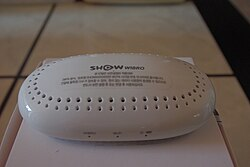
KT passed a hundred thousand subscribers by the end of 2007 and doubled that inside eight months. for whatever reason, the object most people actually associate with WiBro is not a phone at all. It was the egg, a pocket hotspot that took the WiBro signal and handed it back out over wifi so a laptop never had to know what carried it.
That device is the tell. honestly, it is what a network looks like when it is good at data and cannot get itself into handsets. Subscribers climbed toward a million by around 2012 on well over two trillion won of investment, and Korea kept talking about a fourth WiBro operator right up until the argument stopped making sense.
~ why it lost ~
It did not lose on engineering. LTE was not obviously better in 2010, and in places WiBro was ahead. What LTE had was that every chipset vendor and every handset maker on earth was building for it, because it was where the incumbent carriers of the whole world were going.
WiBro had Korea. this happened in a market i was never in, but the shape is familiar enough from the outside. A standard is a market before it is a technology. Trials and deployments turned up in Brazil and Venezuela, in Croatia and in Michigan, and none of them changed the volume question. by then a Korean subscriber could look at the LTE phone they were being sold and see no reason to carry a second device.
~ what got buried with it ~
Service ended on 31 december 2018, twelve years after launch. About sixteen thousand people were still on KT and about eighteen hundred on SK Telecom, and the carriers spent the following two years helping those roughly eighteen thousand move onto LTE. That is the size of the funeral.
What went with it was a real attempt at a national technology policy that produced working hardware and a live network on time. still, the thing nobody in 2002 could allocate spectrum for was the supply chain. Korea built the standard it wanted and then had to buy phones from a world that had picked a different one.
~ leave a rose ~
an anonymous tribute. one rose per visitor per day.
@}-->-- ... roses left here
~ leave a wreath ~
a rose fades by morning. a wreath stays on this grave for good, with your name on it.
from $1, paid once through stripe. it keeps the graveyard running: the hosting and the nightly digging. adopt it and the headstone reads "maintained in memory by" you. the groundskeeper plants new wreaths at the next tending, usually within a day.
» one email a week: new graves and the anniversaries of the dead. subscribe
~ leave a note ~
visitors before you have left these graveside notes. anonymous welcome.