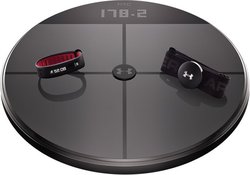
UA HealthBox
~ the obituary ~
Under Armour paid $475 million for MyFitnessPal in 2015 and $85 million for Endomondo in the same stretch of that year. It had already bought MapMyFitness in 2013 for $150 million. By the opening of 2016 a company that made shirts owned one of the largest collections of fitness software on earth, and the thing it decided was missing was hardware to put data into it.
HealthBox arrived at CES in January 2016 as a $400 carton. Inside were a wristband called UA Band and a WiFi bathroom scale called UA Scale, with a UA Heart Rate chest strap packed alongside them. HTC engineered the hardware under contract. Sold separately the band and the scale were $180 each, with the strap at $80, so the bundle saved you forty dollars in exchange for committing to the whole worldview at once.
The worldview was that your morning weight and your workout intensity should land in one app and be read against each other. The app was UA Record. Reviewers were not persuaded. Trusted Reviews gave it two out of five and PCMag two and a half; Wareable's verdict line called it a dysfunctional family of connected kit, Pocket-lint titled its review Under Whelming, and Ars Technica settled on decent together, weak individually. Lauren Goode at The Verge declined to score it at all and wrote that she would not recommend it until she saw it working properly, having watched a three mile route log as three and a half and the scale disagree with itself by several pounds inside a few minutes.
Under Armour stopped making it in late 2017, under two years from launch, and stated plainly that it was leaving connected hardware to concentrate on apps and on tech built into shoes and clothing. That is the normal end of a gadget. What makes HealthBox worth a page is that it kept working for another two years and five months after the company had publicly walked away from it.
~ the case file ~
| Born | unveiled at CES on 5 January 2016, $400 for the bundle |
|---|---|
| Peak | Under Armour's second best-selling e-commerce item of Q1 2016, behind the Curry 2 |
| Killed | 31 March 2020, when the app stopped syncing with the devices |
| Lifespan | four years, two of them after the hardware had already been discontinued |
| Made by | Under Armour, with the hardware engineered by HTC |
| Killed by | a sportswear company deciding it was not a gadget company |
~ notice over christmas ~
On 20 and 21 December 2019 Under Armour emailed registered UA Record users to say the app was going away. It came off the app stores on 31 December. That is eleven days of notice over a holiday period, for the single piece of software capable of reading anything off three devices people had paid up to $400 to own.
The app itself kept functioning on phones that already had it until 31 March 2020, when it stopped syncing and the hardware lost its purpose in a single step. Users were pointed at MapMyFitness instead. The migration did not carry across the step history or the weight history, so the record of four years of wearing a band was the specific thing that did not survive the move.
~ the part that was never sold here ~
HealthBox was priced in dollars, stocked on American shelves and supported by an American app, and it was never meaningfully distributed in Turkey. My age in 2016 put me squarely inside the demographic the marketing was drawn for, and the product still only ever reached me as a name in coverage. The nearest equivalent in my own life those years was a phone counting steps badly and charging nothing for it.
The bricking is the part that travels, though, and it travels because it does not need the product. Anyone who has bought a connected device understands on sight what happened here: the company that sold you an object kept the part that made it an object useful on a server, and then stopped paying for the server.
~ what is left in the drawer ~
The chest strap outlived the rest of it, because a Bluetooth heart rate strap speaks a standard profile and any fitness app will still read one. The band and the scale had no such fallback. They were built to talk to UA Record and nothing else, so when UA Record stopped answering they became a bracelet and a pair of bathroom scales with WiFi radios inside them that no longer have anywhere to call.
HTC never took its half of the storefront down. The UA HealthBox page on htc.com answers today, with the bundle listed at $179.99 against a struck-through $400, a price it dropped to in late 2017 and has not moved since. The support pages are still up too, and they still instruct owners to pair the band by syncing it with UA Record, which came off the app stores at the end of 2019 and stopped operating in March 2020. Nobody at HTC ever posted a notice, so the marketing simply kept running after the product it describes stopped being able to work.
~ leave a rose ~
an anonymous tribute. one rose per visitor per day.
@}-->-- ... roses left here
~ leave a wreath ~
a rose fades by morning. a wreath stays on this grave for good, with your name on it.
from $1, paid once through stripe. it keeps the graveyard running: the hosting and the nightly digging. adopt it and the headstone reads "maintained in memory by" you. the groundskeeper plants new wreaths at the next tending, usually within a day.
» one email a week: new graves and the anniversaries of the dead. subscribe
other gadgets: Microsoft HoloLens (1st Gen), Azure Kinect DK, Apple Time Capsule, Mac Pro
also died in the 2020s: Concord, Audm, r/The_Donald
~ leave a note ~
visitors before you have left these graveside notes. anonymous welcome.