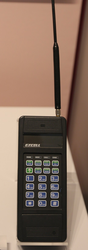
Technophone
~ the goodbye ~
Nils Mårtensson paid the Stanford Research Institute thirty thousand dollars in 1983 to tell him whether portable cellular telephones had a future. The report came back estimating that the American market might reach about thirty thousand handsets by the year 2000. He used it to raise money anyway, roughly 3.3 million pounds from ten or twelve investors plus a grant from the Department of Trade and Industry, and worked on the design at night. North America sold around seventy-eight million handsets in 2000.
Companies House holds the paperwork. A shelf company called Acornlight Limited was incorporated on 31 January 1984 and became Technophone Limited on 21 March. Mårtensson's own account puts the date at 2 April, pushed back from the first of the month because his investors would not sign on April Fool's Day, which is a better story than the register's and two weeks later than it. He hired eighty-four engineers in the first nine months, in a year when the oil crisis had cut government military spending and engineers were looking for alternatives.
The phone passed type approval in the United States on 25 July 1985 and in the United Kingdom on 8 August. The PC105T went on sale in 1986 at 1,990 pounds, seven inches tall and an inch deep, and the claim printed on the advertising was that it fit a standard shirt pocket. At home it was sold through Excell Communications as the Excell M1. Elsewhere it wore whichever badge sold best in the country, Olivetti in Italy and Audiovox in the United States.
~ the chronicle ~
| Born | 21 March 1984, when a shelf company was renamed Technophone Limited |
|---|---|
| Peak | selling in 40 countries by 1991, above 50 percent share in Germany and Sweden |
| Killed | 4 January 1993, renamed Nokia Mobile Phones (U.K.) Limited |
| Lifespan | nearly 9 years under its own name |
| Made by | Nils Mårtensson, a Swedish radio engineer out of Ericsson |
| Killed by | an R&D budget he could not match, and a buyer with one brand |
~ the chips nobody would make ~
The reason it was smaller than a Motorola is that very little inside it came off a shelf. Mårtensson designed the two integrated circuits himself in an office in Woking and took the blueprints around the semiconductor industry. The big makers he showed them to, Motorola and Texas Instruments among them, told him to come back in two years when the technology would have caught up with the drawing.
A startup called California Devices took the job because it wanted the business. Four sample chips arrived in August 1986, two of each type, and they were among the largest mixed-technology integrated circuits anyone had built. The team assembled test boards and then rang California Devices on a handset running their own samples to tell them it worked. The rest of the design went the same way: an eight-layer printed circuit board where rivals were mounting onto heavy ceramic substrates, and a soft membrane keypad borrowed from the Sinclair ZX81. The battery cells were built into the case with Sanyo and Panasonic so they could be made thinner than a removable pack allowed.
~ the forty countries ~
By 1991 the phones sold in forty countries. In Germany and Sweden the company held more than half the market, and Italy was the same. Rivals bought the handset in order to take it apart, and Mårtensson once caught someone going through the company's bins on his way out of the office late at night. A product is doing well when the competition has to steal the garbage.
None of this was a consumer object. It was a 1,990-pound purchase in 1986, sold on contract to one of the two British networks, and the people photographed holding one were television actors. The phones went to small professional classes in forty separate markets rather than to households in any of them. A two-thousand-pound pocket telephone had no market in Turkey in 1986 at any volume worth naming. By the time a handset in Turkey was something an engineering student could own, this name had been off the company for most of a decade.
~ what nokia kept ~
Mårtensson sold to Nokia in 1991 and the price does not agree across the sources. The Mobile Phone Museum's interview with him says 34 million pounds, the Wikipedia article says around 50 million, and RCR Wireless reported in 1994 that Nokia had paid 66 million dollars. His reason is consistent in every account: he no longer had the research budget to stay ahead of Motorola and of Nokia itself. The purchase is credited with helping push Nokia into second place worldwide behind Motorola in 1992. What Nokia wanted from Camberley in the longer run turned out to be the building, and the Surrey plant was turned over to developing and manufacturing base stations, which is network equipment rather than anything sold to a person.
~ the badge in florida ~
The name survived the sale by more than a year. Companies House shows registration 01787336 trading as Technophone Limited until 4 January 1993, when it became Nokia Mobile Phones (U.K.) Limited. That is the day the company stopped being called Technophone. The same registration was finally dissolved on 8 October 2011 from a KPMG restructuring address in London, with its last accounts made up to the end of 2007.
In the American market the badge lasted nearly two years longer, and the trade press caught the end of it. RCR Wireless reported on 3 October 1994 that Nokia Mobile Phones Inc. had announced late the previous month that it would put its United States marketing behind a single brand, and that Technophone was the one going. A support center was built at Technophone Corp.'s existing headquarters in Melbourne, Florida, where about eighty people worked. The American business had turned over 81.5 million dollars in 1992 and 104 million in 1993. Larry Paulson, Technophone's president, was quoted being gracious about losing it: "Although we're disappointed about losing the Technophone brand after putting everything we've put into it here, it makes sense for Nokia to focus its energy under one name." Lauri Kivinen, the communications vice president at Nokia Mobile Phones, preferred a different phrasing. "It's not a phasing out," he said. "It's putting the forces in the right direction."
~ leave a rose ~
an anonymous tribute. one rose per visitor per day.
@}-->-- ... roses left here
~ leave a wreath ~
a rose fades by morning. a wreath stays on this grave for good, with your name on it.
paid once through stripe. payments are handled by OÜ Lakeview, the small company that keeps rip.so running. the money pays for the hosting and the nightly digging. adopt it and the headstone reads "maintained in memory by" you. the groundskeeper plants new wreaths at the next tending, usually within a day.
» one email a week: new graves and the anniversaries of the dead. subscribe
other gadgets: Hello Sense, Macintosh TV, Supertek Computers, Handy (Tink Labs)
also died in the 1990s: Macintosh TV, Hewson Consultants, Microsoft NetShow
~ leave a note ~
visitors before you have left these graveside notes. anonymous welcome.