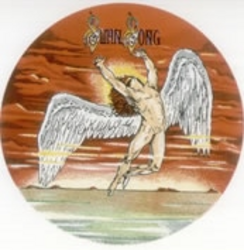
Swan Song Records
~ the eulogy ~
Everything Swan Song ever did happened before 1984, which is where I come in, so there is no part of this story I could have been present for. What I know about it arrived backward, off compilations and off other people's older brothers, and by then the records were just Atlantic catalog numbers with a strange winged man printed on them. Nobody my age ever had the experience the label was built to deliver, which was the feeling of a band being in charge of its own release schedule.
Led Zeppelin's five-year contract with Atlantic ran out at the end of 1973, and rather than sign another one they started their own imprint, formally opened on 7 May 1974 with a party at the Four Seasons in New York and a second one at the Hotel Bel-Air three days later. Peter Grant, their manager, was named president. Danny Goldberg was the first vice president and was later replaced by Alan Callan. Atlantic still did the distribution, so what the band had actually bought was the right to decide, not a factory.
Jimmy Page explained it in 1977 as getting out from under what he called an interference, or at least an aggravation, on the artistic side by record companies, and said he wanted artists to fulfill themselves without the hassle. In January 1975 he put it more generously: the label existed to bring in other groups and to promote acts that had been given raw deals in the past. The name came off an unreleased Led Zeppelin instrumental called Swan Song, which years later turned into Midnight Moonlight by Page's next band.
It worked immediately and then it stopped working. By April 1975 Swan Song had four albums on the Billboard 200 at once, which for a label eleven months old and run by a band's manager is a genuinely absurd result. The company lasted another eight years and never had a week like it again.
~ the dossier ~
| Born | 7 May 1974, launched with a party at the Four Seasons in New York |
|---|---|
| Peak | April 1975, four albums in the Billboard Top 200 at the same time |
| Killed | October 1983 |
| Lifespan | 9 years, 5 months |
| Made by | Led Zeppelin, with Peter Grant as president |
| Killed by | the band breaking up and Grant's health giving out |
~ the winged man ~
The logo was designed by Hipgnosis and illustrated by Joe Petagno, and it is lifted from an 1869 work by the American sculptor William Rimmer called Evening, also known as The Fall of Day. Rimmer is barely remembered for it, and his own encyclopedia entry notes the piece is his most famous work while not usually being associated with him.
The figure's identity is not actually settled, which is funny for an image that ended up embossed on millions of record sleeves. Wikipedia's page on the label states flatly that it is Icarus. Its page on the band hedges and says the winged man is read as either Apollo or Icarus. Rimmer's own page declines to name him at all. So the most recognizable rock label logo of the 1970s is a man falling or rising, depending on which article you open, and either reading suits a company founded by a band at the exact top of its arc.
~ who actually sold the records ~
The two things people remember are the Zeppelin albums and Bad Company, and only one of those was a signing. Physical Graffiti arrived on 24 February 1975 and went to number one in both countries on its way to a diamond certification. Presence followed in March 1976, The Song Remains the Same that October, In Through the Out Door in August 1979, and the posthumous Coda in November 1982. All but Coda reached number one in Britain.
Bad Company were the label's real commercial case and their records were only on Swan Song in America, since Island had them in Britain. The self-titled debut went to number one on the Billboard 200, sold five million copies in the United States and ended up ranked the forty-sixth best-selling album of the decade, with Can't Get Enough reaching number five. Straight Shooter came in March 1975, hit number three on both sides and went gold inside a month. Wikipedia cannot keep its own story straight about whether that debut was the label's first release or its second, or whether it came out in May or June 1974, which tells you how carefully anyone has gone back over this.
The rest of the roster never took. The Pretty Things got two albums and a launch party in Chislehurst Caves on Halloween 1974. Maggie Bell, Detective, Dave Edmunds, Sad Café, Midnight Flyer and Wildlife all passed through. Edmunds did the best of them. The label also put money into films, including a share of Monty Python and the Holy Grail in 1975, and leaned on the makers of Phantom of the Paradise hard enough that the fictional record company in it had to be renamed, though you can still read the old name in a few shots.
~ the demos in the cupboard ~
John Bonham died in September 1980 and the band ended within three months. Grant, who had been president of the thing since the first day, was in bad health. Swan Song put out Jimmy Page's Death Wish II soundtrack and Robert Plant's Pictures at Eleven in 1982, one more Bad Company album, Coda, and then a Wildlife record in 1983. It ceased operations that October.
When they cleared the offices they went through the archive and found demo tapes from Iron Maiden, Heart and the Q-Tips. A label set up specifically to sign the acts other companies had treated badly had three of them in a drawer and had not listened to the tapes. Swan Song survives now as a reissue imprint under Warner, which is to say as a logo printed on records it did not have to find.
~ leave a rose ~
an anonymous tribute. one rose per visitor per day.
@}-->-- ... roses left here
~ leave a wreath ~
a rose fades by morning. a wreath stays on this grave for good, with your name on it.
paid once through stripe. payments are handled by OÜ Lakeview, the small company that keeps rip.so running. the money pays for the hosting and the nightly digging. adopt it and the headstone reads "maintained in memory by" you. the groundskeeper plants new wreaths at the next tending, usually within a day.
» one email a week: new graves and the anniversaries of the dead. subscribe
other media music: Zingy, Twitch Soundtrack, tape.tv, Lala
also died in the 1980s: London Daily News, DJM Records, Acornsoft
~ leave a note ~
visitors before you have left these graveside notes. anonymous welcome.