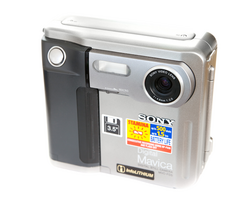
Sony Mavica
~ the obituary ~
Sony demonstrated the first Mavica on 25 August 1981, and it was not digital. The name stood for Magnetic Video Camera, and what it did was capture an analog NTSC frame from a CCD at 570 by 490 and write it to a 2 inch magnetic disk that Sony called a Mavipak, fifty frames to a disk. To look at the pictures you plugged a separate viewer unit into a television. Sony also built a companion thermal printer, the Mavigraph, which took five minutes to produce a single print. The prototype was never sold, but the disk format became the industry's Video Floppy standard and a run of professional ProMavica bodies followed through the late 1980s.
The version people remember came sixteen years later. The Digital Mavica MVC-FD5 and MVC-FD7 arrived in late 1997 with a 3.5 inch floppy drive built into the camera body, writing 640 by 480 JPEGs as ordinary FAT12 files. The sensor was 0.3 megapixels and the image quality was poor even by 1997 standards. It did not matter at all.
This is where I have to be honest about distance. A digital camera in Turkey in 1998 was an object you read about, not one anyone in my circle owned, and the Mavica was aimed squarely at the American consumer market where it did become the volume leader for a few years. I was on a 33.6k modem at home in those years, and the whole premise of the thing, which was that moving a photo file should be trivial, was a premise I would have appreciated and could not have paid for.
~ the case file ~
| Born | 25 August 1981, when Sony showed the analog Mavica prototype, the first still video camera |
|---|---|
| Peak | the FD Mavica run of 1997 to 2001, sold hard in North America on floppy convenience |
| Killed | 2003, with the MVC-CD500 as the last model |
| Lifespan | 22 years from prototype to discontinuation |
| Made by | Sony |
| Killed by | flash memory and USB, which made removable disks in a camera pointless |
~ the trick ~
Every rival camera of that era solved storage with a proprietary card and solved transfer with a serial cable and a driver disk you had to install first. Sony's competitors were shipping SmartMedia and CompactFlash into a market where almost nobody owned a reader. The Mavica's answer was that the storage and the transfer were the same object. You shot a disk full, you ejected it, you put it in the PC on the desk, and the files were sitting there in a folder with no software installed at all.
The cost of that trick was everything else. A floppy holds 1.44 megabytes, which caps how big a picture can be, so the resolution ceiling was set by the storage format rather than by the sensor. The drive also made the body large, and writing a frame to it took long enough that you noticed the wait every time. Sony spent the next four years fighting its own design, adding a Memory Stick slot alongside the floppy, then moving in 2000 to a CD Mavica line that burned 8 centimeter CD-R discs instead.
~ what it became ~
The CD models were the better cameras and the worse idea. The MVC-CD1000 had a ten times zoom and the later MVC-CD500 reached five megapixels behind a Carl Zeiss lens, but 8 centimeter recordable discs were awkward to buy anywhere outside Japan, and by 2002 the argument for removable media in a camera had collapsed. Flash cards had become large and cheap. USB mass storage meant the camera itself mounted as a drive, and the friction the Mavica existed to remove was gone.
Sony discontinued the line in 2003 and moved everything into Cyber-shot and later Alpha, both built around Memory Stick and then around ordinary flash cards. What survives is the sound. A camera that whirred and clicked a floppy drive after every shot is a specific artifact of the years when digital photography was still negotiating with the desktop PC, and there has been nothing like it since, because nothing since has needed to be.
~ leave a rose ~
an anonymous tribute. one rose per visitor per day.
@}-->-- ... roses left here
~ leave a wreath ~
a rose fades by morning. a wreath stays on this grave for good, with your name on it.
from $1, paid once through stripe. it keeps the graveyard running: the hosting and the nightly digging. adopt it and the headstone reads "maintained in memory by" you. the groundskeeper plants new wreaths at the next tending, usually within a day.
» one email a week: new graves and the anniversaries of the dead. subscribe
other gadgets: Sony Tablet S / Tablet P, Dash Express, Saturn Corporation, NexGen
also died in the 2000s: Iron Lore Entertainment, MSN Radio, Tekel
~ leave a note ~
visitors before you have left these graveside notes. anonymous welcome.