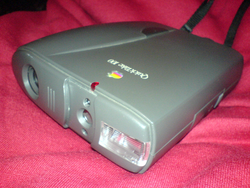
Apple QuickTake
» see apple.com/quicktake as it lived, on the wayback machine
~ the goodbye ~
i missed the quicktake by about four years. in '94 i was ten years old and the closest thing to a digital camera in my house was a halfway-broken kodak film point-and-shoot. by the time i got online in '98 the consumer-digital category had moved on to the early olympus and canon models that actually worked well enough to use, and the quicktake was already a curiosity in old macworld back issues. so this is a grave i write from the outside, about a product that lived its entire commercial life in the era before my internet started.
the quicktake 100 launched on june 20 '94 at $749. apple worked with kodak for the ccd sensor and chinon in japan for the optical assembly and manufacturing. the body looked like a black plastic camera with a flat handle and no viewfinder screen, connected to a mac through a serial cable. it captured eight 640-by-480 images at full resolution, or thirty-two at quarter resolution, with no removable storage. the price-to-quality ratio was bad by '97 standards and merely interesting by '94 ones, but it was the first consumer digital camera most americans had heard of with a major brand on the box.
the quicktake 150 followed in '95 with the same sensor and a slightly better optical system. the quicktake 200 in '96 was a fujifilm-built design with a color lcd on the back and removable smartmedia storage. it was the closest the line got to a competitive consumer camera. then steve jobs returned to apple in late '96, and the quicktake was on the kill list when he sat down to prune the consumer hardware lineup.
~ the chronicle ~
| Born | 20 June 1994 at $749, with prototype shown at Tokyo MacWorld on 17 February 1994 |
|---|---|
| Peak | 1995 to 1996, when the QuickTake 100 and 150 had a brief consumer-digital-camera lead |
| Killed | 14 March 1997 cancellation by Steve Jobs |
| Lifespan | 2 years 9 months from launch to cancellation |
| Made by | Apple with Kodak (sensor) and Chinon (manufacture); QuickTake 200 by Fujifilm |
| Killed by | Jobs cleanup; cheaper Canon and Olympus consumer digitals catching up |
~ how it landed ~
apple announced the quicktake at tokyo macworld on february 17 '94 and shipped it in june of the same year. the launch was widely written up as a first-of-its-kind moment, but the quicktake 100 only sold around 50,000 units across its life, mostly into north american education and small-business buyers. the consumer-photography market was still firmly film at this point, and a $749 camera that produced 640-by-480 jpegs was a research-budget purchase for most households.
the line found a real niche in classrooms and small business newsletters before the better follow-up models tried to push it consumer. the quicktake 200 in '96 was the only one with a preview screen, which made it the only one you could actually shoot with confidence outside a studio setup.
~ what got buried with it ~
the march 14 '97 cancellation killed the quicktake along with opendoc and cyberdog in jobs's first major cleanup after returning. the apple official line was that the company needed to focus on what would become the imac and powermac line. the quicktake brand sat unused for two decades before apple reused the name for an iphone camera-app feature in '20 that lets you start recording a video by holding the shutter, which is a strange kind of half-resurrection.
the cameras themselves became collector items in the small community of digital-camera historians. the kodak partnership that produced the sensor went on to become the dc series, and chinon kept manufacturing low-cost optical assemblies for other oem cameras through the late '90s. fujifilm, the partner on the quicktake 200, went on to dominate the early consumer-digital market with the finepix line that the quicktake had briefly hinted was possible.
~ leave a rose ~
an anonymous tribute. one rose per visitor per day.
@}-->-- ... roses left here
~ leave a wreath ~
a rose fades by morning. a wreath stays on this grave for good, with your name on it.
from $1, paid once through stripe. it keeps the graveyard running: the hosting and the nightly digging. adopt it and the headstone reads "maintained in memory by" you. the groundskeeper plants new wreaths at the next tending, usually within a day.
» one email a week: new graves and the anniversaries of the dead. subscribe
other gadgets: Vector Graphic, AT&T Sceptre, HT-1080Z, Mostek
also died in the 1990s: Sega Mega Drive, Amiga CD32, AppleLink
~ leave a note ~
visitors before you have left these graveside notes. anonymous welcome.