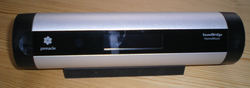
Roku SoundBridge
» see rokulabs.com as it lived, on the wayback machine
~ the obituary ~
i missed the roku soundbridge. its whole hardware arc, 2003 to 2008, sits inside my dial-up and early-broadband years in ankara where the home-network-audio category did not exist as a thing you set up. the pitch was that your desktop pc held the mp3 library and this small orange-text slab in the living room pulled it over ethernet or wifi to the amplifier. that assumed a persistent home LAN with the pc always on, which was a US enthusiast setup. by 2006 i had ttnet dsl at home but the machine that held the music was the machine that played the music. headphones out of the same box.
roku made this device in palo alto in 2003, a decade before the streaming stick made it a household brand. the m1000 shipped in august '03 at $249. the m2000, wider box with better dac, went at $499. the reader on the front was a vacuum fluorescent display, 280 pixels wide by 16 tall, orange text scrolling across at whatever speed you set. every 2004 review noted that the vfd was the whole personality of the thing, a warm little terminal for your music library in a corner of the living room.
the protocol layer was where it got interesting. the m1000 spoke daap to any itunes shared library on the LAN, and pulled from upnp media servers on the same network. it also had a windows media connect client for pcs running WMP. squeezebox slimserver was supported too, which is odd because slim devices was shipping a direct competitor. compatibility over hostility, at least in that direction.
~ the case file ~
| Born | August 2003 launch of the M1000 in Palo Alto by Roku Inc |
|---|---|
| Peak | M1000 and M2000 sold through Pinnacle Systems worldwide 2004-2007 |
| Killed | hardware discontinued 2008, Radio Roku streaming server off May 2018 |
| Lifespan | 5 years in market, 15 years of dwindling cloud dependence |
| Made by | Roku Inc, Palo Alto, later famous for the streaming stick |
| Killed by | Sonos taking the category and Roku pivoting to the streaming stick |
~ what it was ~
pinnacle systems licensed the design and shipped the same hardware worldwide from around 2004 forward, under branded skus like the pinnacle soundbridge homemusic. that is why any hifi forum thread from the era shows both roku-badged and pinnacle-badged m1000s and radio variants. the radio version added AM and FM tuners on top of the streaming so it worked as a living-room audio component even when the pc was off.
the ceiling on soundbridge was that the whole category assumed a home LAN and a pc kept powered on. sonos had the better idea, which was to put storage and playback into one wireless-mesh box with no pc dependency. by 2005-6 sonos was already selling the alternative that made soundbridge look like a hobbyist project. logitech acquired slim devices in december '06 and started shipping squeezebox boom and radio all-in-ones on the same self-contained model. soundbridge got squeezed from both sides.
~ the slide ~
anthony wood, roku's founder, had already started the second product line inside the company. netflix approached roku in 2007 asking if it could build a hardware box that would ship the streaming service into the living room. that project, the roku dvp, went to market in may '08. the same year, all soundbridge products stopped shipping. it was not a formal announcement so much as a quiet inventory-out. by january 2012 roku's own site had removed every trace of the audio line and rerouted the domain to the streaming-stick product pages.
~ the long tail ~
the interesting piece is what happened to the units in the field. soundbridges have 18 URL presets baked into firmware for internet radio stations. those presets pointed at radio.roku.com. roku kept that endpoint alive as a courtesy through a decade of hardware retirement. every device in every kitchen or spare bedroom that still had power was pulling stream URLs from the roku cloud through the 2010s, long after any of the hardware could be bought new.
in may 2018 roku turned that server off. the box still boots and the vfd still lights up. the DAAP client will still find your itunes library if you can find a mac old enough to still speak DAAP. the internet radio presets return nothing. it is one of the cleaner examples of a company keeping a courtesy service alive for a decade past commercial relevance and then cutting it at the point where the last of the audience aged out. the hardware community on audiosciencereview still runs m1000s in 2026, mostly as retro-fun vfd clocks that happen to also play music from a raspberry pi over UPnP.
~ leave a rose ~
an anonymous tribute. one rose per visitor per day.
@}-->-- ... roses left here
~ leave a wreath ~
a rose fades by morning. a wreath stays on this grave for good, with your name on it.
from $1, paid once through stripe. it keeps the graveyard running: the hosting and the nightly digging. adopt it and the headstone reads "maintained in memory by" you. the groundskeeper plants new wreaths at the next tending, usually within a day.
» one email a week: new graves and the anniversaries of the dead. subscribe
other gadgets: HitClips, Memorex Corporation, SAM Coupé, Chromecast Audio
also died in 2015-2019: Ghost Recon Phantoms, HTTP Public Key Pinning, Fuhu
~ leave a note ~
visitors before you have left these graveside notes. anonymous welcome.