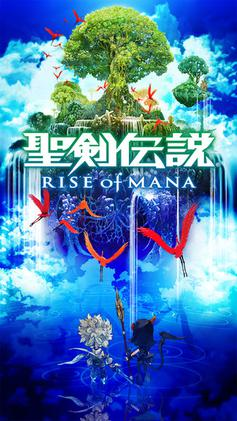
Rise of Mana
~ the goodbye ~
Rise of Mana began as an argument inside Square Enix. Masaru Oyamada told Koichi Ishii, who created the Mana series, that a legitimate entry in it could be made for phones, and the project started in 2012 on the strength of that. It was announced in February 2014 and released on iOS on 6 March, with Android arriving a few months later and a PlayStation Vita port on 14 May 2015. It was the eleventh game in the series and the first free-to-play one.
The story was built around a single idea: an angel and a demon get cast down to the mortal world mid-fight and have to share one body to survive. You could set the names and the genders of both before starting, and switching between the two forms changed what the characters around you were thinking and how they reacted to you. The combat was the real-time action system the series had used since the Super Famicom, and the multiplayer took its cues from Secret of Mana, running on Photon Server middleware.
It worked, for a while. By April 2015 the mobile version had passed two million active players, and the Vita port managed 150,000 downloads by that August. Critics mostly liked the art and the story while arguing about whether a free-to-play phone game deserved a Mana numeral, which is the argument every long-running Japanese series had in this decade.
Oyamada announced the end on 30 January 2016. Service stopped on every platform simultaneously on 31 March at 2:00pm JST, and his stated reason was that the balance between development and capital had never been right, so the team could not keep producing content good enough to justify asking people to stay.
~ the chronicle ~
| Born | 6 March 2014 on iOS, Android later the same year |
|---|---|
| Peak | April 2015, over two million active mobile players |
| Killed | 31 March 2016 at 2pm JST, every platform at once |
| Lifespan | two years and three weeks |
| Made by | Goshow, published by Square Enix |
| Killed by | a free-to-play economy that never covered what the game cost to run |
~ japanese only, at every layer ~
This never came out anywhere else. There was no English version and no regional release outside Japan, not even one of the quiet Southeast Asian soft launches that Japanese publishers were using as a test market all through this period. The SNES-era Squaresoft catalog did circulate in Turkey, heavily and late, through channels nobody was documenting, so a Mana game on a cartridge had a path here even without a publisher behind it.
A 2014 Japanese phone game is a different proposition. It wanted a Japanese App Store account and the language to go with it, which means it wanted you to work around the storefront to reach it. I did not, and almost nobody outside Japan did either.
~ the vita half ~
The Vita port is the stranger decision. It shipped in May 2015, by which point Sony had effectively stopped supporting the handheld in the West and was keeping it alive in Japan on the strength of exactly this kind of release. 150,000 downloads in three months is not a failure for a free game on a dying platform, but it is also not a reason to keep three versions of a live-service game running.
Every version went off at the same minute, which is what you would expect when one set of servers is holding up all of them.
~ the series kept going ~
Mana did not die with this. Adventures of Mana, a full remake of the first game, came out in February 2016 while Rise of Mana was being wound down, and the series has since produced Trials of Mana as a remake and Visions of Mana as a new entry. Square Enix also went back to the free-to-play well with Echoes of Mana in 2022, which lasted about a year.
So the pattern repeated almost immediately, and the thing Rise of Mana proved is narrower than it looks. Two million people will download a Mana game on a phone. That is not the same as two million people paying for one.
~ leave a rose ~
an anonymous tribute. one rose per visitor per day.
@}-->-- ... roses left here
~ leave a wreath ~
a rose fades by morning. a wreath stays on this grave for good, with your name on it.
from $1, paid once through stripe. it keeps the graveyard running: the hosting and the nightly digging. adopt it and the headstone reads "maintained in memory by" you. the groundskeeper plants new wreaths at the next tending, usually within a day.
» one email a week: new graves and the anniversaries of the dead. subscribe
other gaming: The Legend of Zelda: Four Swords Anniversary Edition, Final Fantasy XIV (1.0), Anyland, Tap Tap Revenge
also died in 2015-2019: Hyde Park (hydepark.co.il), Lumo Lift, Find My Friends
~ leave a note ~
visitors before you have left these graveside notes. anonymous welcome.