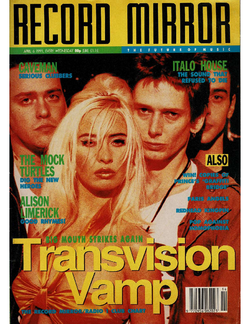
Record Mirror
~ the eulogy ~
The paper launched on 17 June 1954 with the pianist Winifred Atwell on the cover. It was founded by Isidore Green, who had been editing the Weekly Sporting Review and whose instincts ran to music hall and theater, a trade that was already dying when he started writing about it. The paper arrived two years after the New Musical Express and never caught it on circulation. What it had instead was the chart.
On 22 January 1955 it became the second British paper to publish a singles chart. Where the NME polled shops by telephone, Record Mirror had its retailers mail in their best-seller lists and paid for the postage itself, which is a slower method and a more honest one. It started as a Top 10 drawn from 24 shops, went to a Top 20 on 8 October that year, and by 1957 was taking returns from more than 60 stores out of a rotating pool of over 80.
Then, on 28 July 1956, it printed a Top 5 of long players. Nobody in Britain had published an album chart before. The format was almost an afterthought at the time, since the LP was expensive and the singles market was where the money sat, and the chart that grew out of that Top 5 is the one the industry still runs on.
The good run did not last the decade. A national printing strike took the paper out of circulation for two months in 1959, and Green brought it back renamed Record and Show Mirror with most of the space given to show business. Circulation was down to 18,000 by the end of 1960. Decca Records held the main shareholding by then and had lost patience, and in March 1961 it replaced Green with Jimmy Watson, one of its own former press officers.
~ the dossier ~
| Born | 17 June 1954, with Winifred Atwell on the cover |
|---|---|
| Peak | 120,000 for the color Beatles cover of November 1963 |
| Killed | 2 April 1991, last issue dated the 6th |
| Lifespan | 36 years, 9 months |
| Made by | Isidore Green, then a chain of owners ending at United Newspapers |
| Killed by | A publisher getting out of consumer music |
~ the color Beatles cover ~
Watson renamed it New Record Mirror, threw out the show business coverage and hired an editorial team around Peter Jones, Ian Dove and Norman Jopling. Circulation climbed back toward 70,000. The paper was the first national publication in Britain to run an article on the Beatles, and it got to the Rolling Stones and the Kinks before anybody else did, which for a paper permanently in third place is a record nobody can take off it.
In 1963 Decca's chairman sold a large share to John Junor of the Sunday Express, who wanted a title to test four-color printing on before it was used on the Sunday Express. In November 1963 the masthead went back to Record Mirror and the cover carried the Beatles in full color, the first British music paper to do it. The first run was 120,000 copies and it sold out. The next issue sold 60,000.
After that the ownership becomes a list. Record Retailer bought the paper in 1969 and moved it into its Carnaby Street offices, dropping the pin-ups and going to a bigger tabloid page. Disc was folded into it in 1975. By 1977 Record Retailer had become Music Week, and Billboard sold Record Mirror on to the Morgan-Grampian Group. In 1982 it dropped the newspaper format for glossy paper.
~ the only paper with the official charts ~
What most people picture is the 1980s magazine, which worked on a licensing position rather than on scoops. Record Mirror was the only consumer music paper printing the official UK singles and albums charts, the ones Radio 1 and Top of the Pops used, alongside the American Billboard charts with analysis by Alan Jones. When Gallup took over compilation in January 1983 the singles chart went to a Top 100, and Record Mirror printed all hundred positions, including the 25 that Music Week later decided were not hits worth listing.
The rest of the magazine was dance coverage and jokes. James Hamilton had been writing a weekly disco column since June 1975, which grew into the BPM section and a DJ directory with four separate club charts under it. The comedy pages ran things like a weekly picture of Phil Collins in a new novelty wig and a poem by Pete Waterman. I met the UK chart two decades later as a web page, already sorted, with no object behind it. For nine years it reached the British public through one glossy weekly that also ran a cheese column, and I cannot picture that arrangement at all.
~ after the sixth of April ~
United Newspapers had bought Morgan-Grampian in 1987 and decided in the spring of 1991 to leave consumer music and keep the trade papers. Record Mirror closed on 2 April along with its stablemate Sounds. The last issue carries the date 6 April 1991 and a cover price of 80p. Transvision Vamp is on the front under the strapline "The Future of Music", with cover lines for Italo house and the Mock Turtles. Eleanor Levy had been editing it for two years.
The last issue says nothing about being the last issue. The scan runs cover to cover with no closure notice and no editor's letter: the staff produced an ordinary number of a weekly magazine, and a 36-year-old title simply stopped. Levy said afterward that the decision was "taken by accountants rather than people who understand music," and gave the detail that makes the point: she told one of the management team that the magazine's strength was dance music, and he thought she meant Jive Bunny.
The following week Music Week ran a red banner across the front reading "INCLUDES FREE RECORD MIRROR UPDATE" and a headline announcing that Record Mirror had returned with the trade paper. The Update kept the Club Chart, Alan Jones's chart news and Hamilton's DJ directory. Hamilton wrote for it until he died in June 1996, and the supplement, by then called Record Mirror Dance Update, published its last edition on 13 February 1999. The name sat unused until 2010, when Giovanni di Stefano acquired it, and in 2011 it reappeared on an online gossip site. He was jailed for fourteen years for fraud in 2013 and the site stopped updating. Today recordmirror.com is a single page with a podcast embedded in it.
~ leave a rose ~
an anonymous tribute. one rose per visitor per day.
@}-->-- ... roses left here
~ leave a wreath ~
a rose fades by morning. a wreath stays on this grave for good, with your name on it.
paid once through stripe. payments are handled by OÜ Lakeview, the small company that keeps rip.so running. the money pays for the hosting and the nightly digging. adopt it and the headstone reads "maintained in memory by" you. the groundskeeper plants new wreaths at the next tending, usually within a day.
» one email a week: new graves and the anniversaries of the dead. subscribe
other media music: MXTabs, Farmclub.com, Goom Radio, GhostTunes
also died in the 1990s: Parallax Graphics, HCR Corporation, The Internet Bookshop
~ leave a note ~
visitors before you have left these graveside notes. anonymous welcome.