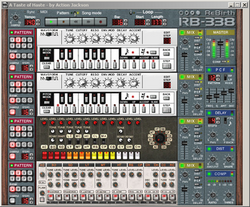
ReBirth RB-338
~ the obit ~
By the time ReBirth was free to download, in the autumn of 2005, it had already been abandoned by its makers for six years. That is the only version of it I could plausibly have had. A boxed Swedish music program in 1997 was not something a shop in Ankara stocked, and in 1997 I was thirteen and still a year away from my first modem. This grave is written from the outside of a scene I never joined.
Propellerhead Software was a small Stockholm company. It put a public alpha of ReBirth out in October 1996 for Mac OS and shipped the commercial version the following year, and what it shipped was a picture of two Roland TB-303 Bass Line synthesizers stacked above a TR-808 drum machine, all of them running together and locked to the same clock. Version 2.0 added a TR-909. You could see the knobs. You could turn them with a mouse.
The reason this mattered is the price of the originals. The TB-303 had been a commercial failure in 1982, discontinued after eighteen months, and then acid house made it the most wanted box in electronic music. By the mid nineties a working one cost more than a decent computer. ReBirth arrived and said the sound was available for the price of software, on a machine you already owned.
~ the rap sheet ~
| Born | 1997, after a public alpha in October 1996 |
|---|---|
| Peak | version 2.0 in 1998, which added the 909 and introduced ReWire |
| Killed | 15 June 2017, removed from the App Store |
| Lifespan | twenty years across two platforms |
| Made by | Propellerhead Software, Stockholm |
| Killed by | Roland, claiming its own machines back |
~ what it actually was ~
It was not a plugin and it was not a general purpose synthesizer. It was a closed instrument with a fixed layout, four devices and no way to add a fifth, and the constraint is most of why people got good at it. There was one screen, and everything you could ever do was on it.
Version 2.0 also introduced ReWire, developed with Steinberg, which let ReBirth stream its audio straight into a sequencer as if it were part of that program. That protocol went on to connect a generation of music software to a generation of other music software, and it was born inside a 303 emulator. ReBirth also shipped with mod support, so people replaced the drum samples and repainted the entire interface, and the mods circulated the way skins and demos circulated on the late nineties web.
~ the long tail ~
Propellerhead stopped developing it in January 1999 and put the effort into Reason instead, which became the company's real business for the next two decades. Official support for ReBirth ended in September 2005, and rather than let it disappear the company set up something it called the ReBirth Museum and offered the final desktop build as a free download. That is a rare and decent way to retire a product.
It came back in April 2010 as a paid iPhone app, then on iPad that November, which suited it well because the thing had always been a fixed panel of knobs and a touchscreen is a better mouse for that. Propellerhead disabled the iOS version on 1 June 2013 and left it in the store as an artifact until Roland formally objected. The app was withdrawn on 15 June 2017. Propellerhead did not contest the claim and said it preferred to keep its long relationship with Roland intact.
~ the funny part ~
Roland spent 2017 building Roland Cloud, a subscription that sells you official software recreations of the TB-303 and the TR-808 made by Roland. The same year it used its intellectual property to remove the twenty year old unofficial emulation from sale.
There is no scandal in that, it is just what a rights holder does once it decides to enter the market itself. But it does mean ReBirth was killed by the arrival of the exact product category it invented, sold by the company whose hardware it had spent two decades keeping culturally alive while that hardware sat discontinued.
~ leave a rose ~
an anonymous tribute. one rose per visitor per day.
@}-->-- ... roses left here
~ leave a wreath ~
a rose fades by morning. a wreath stays on this grave for good, with your name on it.
from $1, paid once through stripe. it keeps the graveyard running: the hosting and the nightly digging. adopt it and the headstone reads "maintained in memory by" you. the groundskeeper plants new wreaths at the next tending, usually within a day.
» one email a week: new graves and the anniversaries of the dead. subscribe
other software: BaconReader, Kurzweil Applied Intelligence, CU-SeeMe, CyanogenMod
also died in 2015-2019: NexTag, Minions Paradise, Apple Music Connect
~ leave a note ~
visitors before you have left these graveside notes. anonymous welcome.