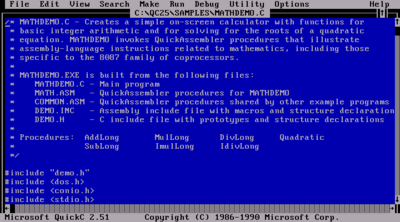
Microsoft QuickC
~ the obituary ~
Borland shipped Turbo C in 1987 with an integrated development environment, the first for C on the PC, and charged $99.95 for it. Microsoft had a C compiler already, a good one, and it cost $450. Borland's own advertising that summer was blunt about the gap: Turbo C is so much faster than Microsoft C and only $99.95 instead of their $450.00, we are technically ahead of them, but way behind them on price. QuickC shipped at the end of October 1987 at $99.00, five cents under, and the Microsoft advertisement in BYTE that February put the strategy in one line of copy: not bad, for a $99 compiler.
What you gave up for the price was the optimizer. Microsoft's expensive product was literally branded the C Optimizing Compiler, and QuickC was the one that was not. BYTE's reviewers said it plainly in 1989: QuickC favors ease of use over a full-fledged optimization and debugging capability. What you got instead is in the 1987 programmer's guide, which promises you can compile, run, debug, edit and recompile without ever leaving the programming environment, and that the compiler can create programs for in-memory execution. Most of the standard library was built into the environment, so a small program never needed a linker at all.
Version 2.0 in January 1989 was the high point. It brought incremental compiling and linking, which Microsoft advertised at 25,000 lines per minute, a built-in assembler, and support for every memory model inside the IDE rather than just the medium one that 1.0 had defaulted to. Dr. Dobb's ran it against Turbo C that August and could not separate them: Borland compiled and linked faster, Microsoft's incremental builds won it back on the second pass, and the review called the result too close to reveal any clear winner. Version 2.5 shipped in April 1990, still $99 on its own and $199 with the assembler bundled, and 2.51 was the last DOS release. QuickC for Windows 1.0 followed in September 1991 at $199, and it was the last release of any kind.
The end has a dateline on it. Microsoft's press release of 23 February 1993, out of Santa Clara, announced Visual C++ in two editions and said which products they were burying: the standard edition replaces the Microsoft QuickC development system for Windows, and the professional edition succeeds Microsoft C/C++ version 7.0. Shipping was scheduled for 1 March at $199 and $499. Existing QuickC for Windows licensees were offered the upgrade at $79. The dealer ads tell the same story faster: in the December 1992 BYTE you can still buy QuickC 2.5 for fifty pounds and QuickC for Windows for ninety-five, and in the January 1993 issue the name does not appear anywhere.
~ the case file ~
| Born | October 1987, at $99 against Microsoft C's $450 |
|---|---|
| Peak | version 2.0, January 1989, incremental compile and link |
| Killed | 23 February 1993 |
| Lifespan | five years and four months |
| Made by | Microsoft |
| Killed by | Visual C++ 1.0 Standard Edition |
~ Microsoft shipping a defection tool ~
The 1988 QuickC advertisement is worth reading as a document of how badly Microsoft wanted Borland's customers. It quotes Allen Holub in Dr. Dobb's saying QuickC is better than Turbo C, that it does everything Turbo C does and then some, with very good debugging support that is totally absent from Turbo C. It quotes a second magazine comparing the two directly. And then, at the bottom, it offers a Turbo Pascal to Microsoft QuickC translator program, which is Microsoft paying to convert your existing Borland source into its own.
The bundling worked in the other direction too. The setup program for Microsoft C 5.0 installed QuickC alongside the expensive compiler, and C 5.1 shipped it in the box. The cheap product was a feature of the costly one, which is a strange thing to do to your own pricing until you remember what it was for.
~ the undocumented calls ~
QuickC for Windows, the last release, was the first integrated C environment for Windows and it was built in a way that caused trouble. The compiler was a DLL that only the IDE could call, so there was no command-line compiler in the box at all, and it could not build static libraries. It also used undocumented Windows API calls in its own interface, which InfoWorld covered twice in late 1992, in September and again in November, while Microsoft was under sustained public accusation of giving its own applications division private access to the operating system.
It also has a strange afterlife. Rico Mariani, who worked on the Visual C++ team, wrote years later that the Visual C++ codebase began life as QuickC for Windows, written in C because the C++ compiler was not finished yet, and had to be ported to C++ before it could become the new shell. He called QuickC for Windows the first IDE for Windows with real debugging, and incomplete. So the product Microsoft retired in February 1993 is also the thing its replacement was built out of.
~ what reached me instead ~
I was three years old when QuickC shipped and eight when Visual C++ took its place, so this one is history I can read and not memory I have. By the time I was writing C at university in Ankara in the 2000s, the Microsoft side of this fight had become Visual Studio and the free side had become gcc, and the thing that survived from 1987 in Turkish classrooms was the Borland lineage rather than this one. QuickC won its argument and then got absorbed by the winner, which is a quieter ending than the one Turbo C got.
~ leave a rose ~
an anonymous tribute. one rose per visitor per day.
@}-->-- ... roses left here
~ leave a wreath ~
a rose fades by morning. a wreath stays on this grave for good, with your name on it.
from $1, paid once through stripe. it keeps the graveyard running: the hosting and the nightly digging. adopt it and the headstone reads "maintained in memory by" you. the groundskeeper plants new wreaths at the next tending, usually within a day.
» one email a week: new graves and the anniversaries of the dead. subscribe
other software: MacWrite, 3721 (Yahoo Assistant), Instagram Hyperlapse, Sun StarOffice
also died in the 1990s: MacWrite, Commodore 64, Copland
~ leave a note ~
visitors before you have left these graveside notes. anonymous welcome.