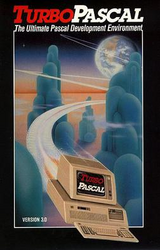
Turbo Pascal
~ the obit ~
I learned to program in this. Pascal was the teaching language in Turkish engineering education for most of the period I was in it, and the blue screen with the yellow text was where a whole generation of Turkish computer engineers found out whether they liked this work or not. By the time I sat in front of it the product was already historical and nobody mentioned that, because it ran fine and the university had the discs.
Turbo Pascal was released on 20 November 1983, targeting MS-DOS and both flavors of CP/M. The compiler core was licensed from Anders Hejlsberg, a Danish developer whose PolyPascal grew out of a compiler he had written for the Nascom microcomputer; Borland added the editor and the interface around it. The price was $49.95, which is the number people still quote first, because competing compilers of the period were priced in the hundreds and Borland sold this one by mail order out of the back of magazines.
The technical argument was the speed. It was the first widely used integrated development environment, holding the editor and the compiler in memory at once, so pressing a key took you from source to running program without a batch file or a wait. On hardware where a build was normally a coffee break, this felt less like an improvement than a category error in the user's favor. It made the edit-compile-run loop tight enough that beginners could actually learn from it.
~ the rap sheet ~
| Born | 20 November 1983, for CP/M, CP/M-86 and MS-DOS |
|---|---|
| Peak | $49.95 at launch, against compilers priced in the hundreds |
| Killed | 1995, dropped by Borland in favor of Delphi |
| Lifespan | about 12 years, 8 numbered releases |
| Made by | Borland, on a compiler core by Anders Hejlsberg |
| Killed by | Windows, and its own successor |
~ the rise ~
Eight numbered versions arrived over nine years. Version 3 in 1986 was the last of the single-file era, version 4 in 1987 brought separate compilation with units, version 5.5 in 1989 added objects, and version 7 landed on 27 October 1992 as the final release. A Macintosh version existed from around 1986 and was dropped by 1992. Alongside it Borland sold Borland Pascal, the fatter professional variant with the command line compiler and the source to the runtime library.
What it produced was a body of shared code. Turbo Pascal source moved on floppies and in printed magazine listings, and libraries like Turbo Vision let people build text-mode interfaces that all looked related. If a DOS program had a blue background and dialog boxes drawn in line characters, there was a decent chance of what it had been written in.
~ the cracks ~
Windows is what ended it. Turbo Pascal was a DOS product in its bones, and while Borland shipped versions targeting Windows 3.x, the thing customers wanted by 1993 was a way to build Windows applications by dragging them into existence. Microsoft's Visual Basic had shown what that looked like and was taking the low end of the market that Turbo Pascal had owned by price.
Borland's answer was Delphi, introduced in 1995: Object Pascal with a visual designer sitting on top of a compiler that stayed fast. It was a genuinely good product and it was also the end of the old one. By 1995 Borland had dropped the Turbo and Borland Pascal line, and the name survived only on later unrelated products and on the handful of old versions the company later released free for their historical interest.
~ what came after ~
Hejlsberg went to Microsoft in 1996 and designed J++, then C#. TypeScript came later. That is an unusual amount of influence for one person to have over how the world writes code, and all of it traces back to a compiler he wrote in Denmark for a machine almost nobody remembers.
The other inheritance is Free Pascal and Lazarus, which still compile Turbo Pascal source and still ship a text-mode IDE that looks like the original on purpose. Somebody with a 1990 textbook can type in the examples today and watch them run, which is more than most software from that decade can offer.
~ leave a rose ~
an anonymous tribute. one rose per visitor per day.
@}-->-- ... roses left here
~ leave a wreath ~
a rose fades by morning. a wreath stays on this grave for good, with your name on it.
from $1, paid once through stripe. it keeps the graveyard running: the hosting and the nightly digging. adopt it and the headstone reads "maintained in memory by" you. the groundskeeper plants new wreaths at the next tending, usually within a day.
» one email a week: new graves and the anniversaries of the dead. subscribe
other software: Microsoft Equation Editor, InterVideo, Pixlr Editor, GeoWorks Ensemble
also died in the 1990s: Greenpoint, MIDnet, MacWWW
~ leave a note ~
visitors before you have left these graveside notes. anonymous welcome.