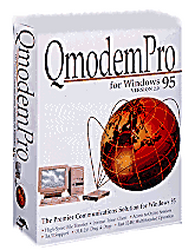
Qmodem
» see mustang.com as it lived, on the wayback machine
~ the obit ~
By the time I had a modem of my own, the thing at the other end of the phone line was an ISP. You dialed a number and a company answered, with the entire internet sitting behind it. Qmodem belongs to the arrangement before that one, where the number you dialed rang a single computer sitting in somebody's house, and whoever owned that computer had decided how many people were allowed inside at once.
John Friel III wrote it in 1984 in Borland Turbo Pascal and sold it as shareware through a company called The Forbin Project. The incumbent was PC-Talk, and Qmodem took the slot away from it mostly on speed. That was the whole competitive surface of a terminal program in 1984. How fast it moved characters, and how reliably it moved files.
It started with XMODEM and picked up protocols as they appeared, with ZMODEM eventually becoming the one everybody used. There were CompuServe-specific transfers in there too, because CompuServe was a place you dialed and it did things its own way. Later versions could host a small bulletin board themselves, which is the detail that dates it best: the line between calling a BBS and running one was thin enough that a single shareware program covered both sides.
Qmodem's entire peak happened while I was in primary school. My first modem came in 1998 and it dialed TTNet, which is a different activity wearing the same hardware.
~ the rap sheet ~
| Born | 1984, written by john friel iii and sold through the forbin project |
|---|---|
| Peak | the dominant dos shareware terminal of the bbs years, dvorak award in 1992 |
| Killed | 2000, rights sold to quintus corporation |
| Lifespan | sixteen years |
| Made by | john friel iii, then mustang software of bakersfield |
| Killed by | the web browser, which replaced the thing you were dialing |
~ the rise ~
Mustang Software bought Qmodem from The Forbin Project at the turn of the 1990s and announced version 5 in January 1992 under the Qmodem Pro name. Mustang was a Bakersfield company that Jim Harrer had started in a bedroom in 1986, and its main product was Wildcat!, the BBS software running on the other side of the call. Owning both ends of the conversation was a reasonable place to be standing in 1992.
Friel took a Dvorak Award for Qmodem that same year, and Mustang took another in 1994 for the Windows version. Awards for communications software were a real category then, because communications software was where the difficulty lived.
~ the sale ~
Mustang went public on NASDAQ in April 1995 under the ticker MSTG, which turned out to be the worst available timing. The company's own history records that its fortunes began eroding almost immediately after the offering, because bulletin board software was being made obsolete by web browsers while the stock was still new. Two attempts at building browser software in 1995 and 1996 went nowhere against Netscape and Internet Explorer. Headcount fell from around sixty people to thirty.
Wildcat! was sold off to Santronics in November 1998. QmodemPro 2.1 for Windows 95 and NT had shipped on 7 July 1997 and was the last version anyone released. Mustang kept selling it until 2000, when Quintus Corporation bought the rights along with the rest of what was left, and nothing further was ever done with them.
~ the long tail ~
Qmodem's afterlife is a public-domain re-implementation. Qodem started in 2003 for Unix-like systems and rebuilt the interface for a world with no phone lines in it, keeping the menus and the transfer protocols but pointing them at telnet and ssh. It was later ported back to Windows. There is no commercial reason for it to exist.
That is roughly what happened to the whole category. The transfer protocols survived as trivia and the terminal survived as a developer tool. The specific thing Qmodem was for, calling a computer that belonged to a person rather than a company, stopped being something anybody does.
~ leave a rose ~
an anonymous tribute. one rose per visitor per day.
@}-->-- ... roses left here
~ leave a wreath ~
a rose fades by morning. a wreath stays on this grave for good, with your name on it.
from $1, paid once through stripe. it keeps the graveyard running: the hosting and the nightly digging. adopt it and the headstone reads "maintained in memory by" you. the groundskeeper plants new wreaths at the next tending, usually within a day.
» one email a week: new graves and the anniversaries of the dead. subscribe
other software: Microsoft Music Central, Apple Front Row, Windows SideShow, Yahoo Livestand
also died in the 2000s: GameZnFlix, Cafesta, NetCaptor
~ leave a note ~
visitors before you have left these graveside notes. anonymous welcome.