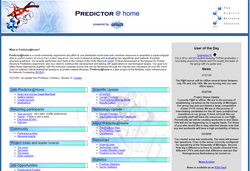
Predictor@home
» see predictor.scripps.edu as it lived, on the wayback machine
~ the obituary ~
By the time Predictor@home was formally dead it had been effectively dead for almost three years, and nothing about that gap was ever announced. The website and the forums went off on 10 June 2009, and the project had stopped sending out work in September 2006.
It launched on 9 June 2004 out of Michela Taufer's group at the Scripps Research Institute, and it was the first BOINC project that did not come from Berkeley. BOINC was new then. The framework existed to industrialize what SETI@home had built by hand, and Predictor@home was the demonstration that somebody else could pick the thing up and run their own science on it.
The science was protein structure prediction. You are handed a sequence of amino acids and asked what shape the finished molecule settles into, a question with an enormous space of wrong answers and no cheap way to check any of them. Predictor@home split that search across whatever machines volunteers were willing to lend. For the sixth CASP alone it collected more than twelve billion seconds of processor time from 6,786 people.
There is nothing here for me to claim and nothing I could have missed. A volunteer computing project has no front page you visit, only a client that either has work or does not. When Predictor@home stopped having work, the people who noticed were the ones with it attached, and they noticed by watching a number that had stopped moving. From another country, on another machine, there was simply nothing to see.
~ the case file ~
| Born | 9 june 2004, the first boinc project outside berkeley |
|---|---|
| Peak | 6,786 volunteers and over twelve billion seconds of compute during casp6 |
| Killed | 10 june 2009 |
| Lifespan | five years on the calendar, about two on the science |
| Made by | michela taufer's group at the scripps research institute |
| Killed by | a competition cycle that turned over and nobody entering the next one |
~ built for a deadline ~
CASP runs every two years. The organizers hand out the sequences of proteins whose structures have been solved in a lab but not yet published, then grade what the teams send back against an answer nobody outside that lab has seen. It is one of the few places in computational biology where you find out plainly whether your method works or whether you only believed it did.
That explains the shape of the project's life. Predictor@home was built to enter CASP6 in 2004 and it entered CASP6. A research effort with a competition date attached takes its funding and its urgency from the cycle, and when the cycle turns over somebody has to decide to enter again. The group kept trying for a while: the project went back to alpha in May 2008 to test new methods and the servers moved to the University of Michigan that summer. By December it had not sent work in months.
~ what silence looks like from the client side ~
The failure mode of volunteer computing is not a crash. Your machine keeps the project attached, keeps asking the server for work on schedule and keeps being told there is none, and the client is perfectly content with that. Nothing turns red. The project stops appearing in the part of your day where it used to appear, which for most people was never.
There is a real difference between a website that starts returning 404 and a background service that goes quiet, and the difference is that the second one has no moment in it. Predictor@home went offline on 6 September 2006 and the notice said it was temporary. It stayed temporary for the rest of the project's existence.
~ how a project like this dies ~
Two things had to hold for any of this to work and only one of them was technical. The technical half was already easy by 2004: BOINC handled the distribution and the credit accounting, so a lab could stand a project up without writing that machinery itself. The other half was a person whose job was to keep answering, on a forum, for years, about a science most of the volunteers had no training in. That is the half nobody budgets for.
Predictor@home lasted five years and one day on the calendar. It got what it was built for, which was a CASP entry backed by a machine no lab of that size could have afforded to buy. Then the people who built it had other work in front of them, and a BOINC server with nothing to hand out still costs somebody real money to keep in a rack until they stop paying.
~ leave a rose ~
an anonymous tribute. one rose per visitor per day.
@}-->-- ... roses left here
~ leave a wreath ~
a rose fades by morning. a wreath stays on this grave for good, with your name on it.
from $1, paid once through stripe. it keeps the graveyard running: the hosting and the nightly digging. adopt it and the headstone reads "maintained in memory by" you. the groundskeeper plants new wreaths at the next tending, usually within a day.
» one email a week: new graves and the anniversaries of the dead. subscribe
other software: OtterTune, Thai Chana, Baidu Yi, Endomondo
also died in the 2000s: U-matic, SegaNet, GoTrump.com
~ leave a note ~
visitors before you have left these graveside notes. anonymous welcome.