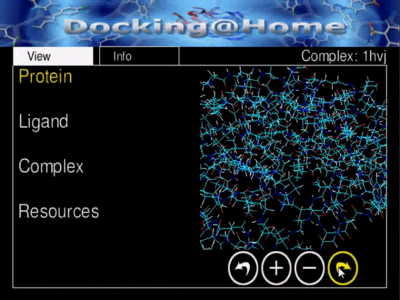
Docking@Home
» see docking.cis.udel.edu as it lived, on the wayback machine
~ the obituary ~
Docking@Home ran on BOINC, the Berkeley framework that turns a screensaver into a compute node, and it was hosted by the University of Delaware under Michela Taufer. You installed the client, it pulled down a job, and while the machine was otherwise idle it worked through the geometry of a protein and a small molecule looking for how the two fit together. The docking itself ran on CHARMM, the sort of code that normally lives on a cluster behind a queue and a waiting list.
The project started in 2006, in alpha, before Taufer's group landed at Delaware, and it was funded with public money from the NSF and the NIH. The headline target was HIV protease, the enzyme the virus needs in order to assemble new copies of itself. A molecule that jams it is a drug candidate, and finding one means testing an enormous number of possible shapes, which is exactly the kind of work that breaks into small independent pieces and mails out to strangers.
At its widest more than 6,000 volunteers were running it. The research that came out of it was real and published, including work on picking near-native conformations out of the pile automatically by clustering them. That is the unglamorous half of the problem. Generating candidate shapes is the easy part once you have thousands of machines; recognizing which of them deserve a chemist's attention is the part that needed a method.
The project opened while I was still at university and outlived my degree by four years, and volunteer computing was something I understood as a category well before that. The version of it that actually reached me, and reached almost everybody, was SETI@home, which had the advantage of a question a teenager could restate in one sentence. Docking@Home never got installed on anything of mine. Protein docking asks more of you before it becomes interesting, and no screensaver in the world was going to make that ask smaller.
~ the case file ~
| Born | 2006, in alpha before the group moved to Delaware |
|---|---|
| Peak | over 6,000 volunteers donating idle time |
| Killed | 23 May 2014 |
| Lifespan | eight years |
| Made by | the University of Delaware, led by Michela Taufer |
| Killed by | a lab with no resources left to maintain it |
~ what a work unit was ~
A BOINC job is a bargain struck with a stranger's electricity bill. The server hands out a package of work, the client computes it whenever the machine has nothing better to do, and the answer comes back to be checked against a second volunteer's copy of the same job, because a donated computer is not a trusted one. The Docking@Home package was one protein and one ligand and a search across the ways they could be arranged against each other.
Leaving a machine running overnight to do somebody else's arithmetic is a small decision with a real bill attached, and in Turkey it was a bill I noticed. That is the quiet cost underneath every one of these projects. The compute was described as free because the people spending it had already paid for the hardware, and the electricity was simply never mentioned in the pitch.
~ the retirement notice ~
The end was staged over a month and announced plainly. New jobs stopped going out on 30 April 2014. The server kept accepting results for another three weeks so that work already sitting on people's machines would not be wasted, and on 23 May it stopped taking anything at all. The stated reason was that the group no longer had the resources to maintain the project, and the notice pointed volunteers toward ExSciTecH, the successor effort out of the same lab.
On the BOINC forums the reaction from long-time volunteers was that this was overdue rather than sad. The application had been sitting at beta for years, the project forum had gone unadministered, and people attached to a dozen of these projects recognized the shape of a lab whose grant cycle had moved on. The most common note was that it was better this way.
~ what the donation was really for ~
Volunteer computing sold two things at once and only ever advertised one of them. The advertised one was throughput, a spare-cycle grid that could match a supercomputer on jobs that split cleanly. The other was public science, which is a much harder product. A lab that puts its work in front of 6,000 amateurs has to explain what it is doing in language that survives a screensaver, and then keep explaining it for years.
That is the part that fails first. Compute is easy to hold onto. Attention is not, and neither is the graduate student whose job it was to answer the forum. Once those go, the project is a server with a database on it and somebody eventually has to decide whether the rack is worth paying for. Docking@Home lasted eight years, which for this category is a long life.
~ leave a rose ~
an anonymous tribute. one rose per visitor per day.
@}-->-- ... roses left here
~ leave a wreath ~
a rose fades by morning. a wreath stays on this grave for good, with your name on it.
from $1, paid once through stripe. it keeps the graveyard running: the hosting and the nightly digging. adopt it and the headstone reads "maintained in memory by" you. the groundskeeper plants new wreaths at the next tending, usually within a day.
» one email a week: new graves and the anniversaries of the dead. subscribe
other software: Grendel, Positron, VisiCalc, Compatible Time-Sharing System
also died in 2010-2014: Microsoft Origami (UMPC), Yahoo! Chat, Age of Empires Online
~ leave a note ~
visitors before you have left these graveside notes. anonymous welcome.