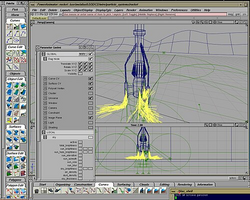
PowerAnimator
~ the obit ~
PowerAnimator ran on Silicon Graphics workstations, and the cheapest of those cost more than a car. That is the whole reason I never touched it. In Turkey in the late nineties the 3D software you actually met was 3D Studio on a PC, usually a copy of a copy, running on a machine somebody had assembled from parts. SGI hardware was something you read about in magazines, in articles about films.
Alias Research was a Toronto company and PowerAnimator was its modeling and animation system, shipping from 1988 on IRIX and later on IBM AIX. It was not a general-purpose tool for hobbyists. It was sold to studios and to car companies, and the price and the hardware requirement together meant that if you were using it, somebody had spent tens of thousands of dollars for you to be using it.
What it bought them was the ability to do things nobody had done. The water tentacle in The Abyss in 1989. The T-1000 in Terminator 2 in 1991, which is still the moment computer graphics stopped being a novelty and became a character. The dinosaurs in Jurassic Park in 1993. Both of those films took the visual effects Oscar, and in 1997 five of the developers took a Scientific and Engineering Award of their own.
~ the rap sheet ~
| Born | 1988, Alias Research in Toronto |
|---|---|
| Peak | the T-1000 in Terminator 2 and the dinosaurs in Jurassic Park, both Oscar winners for visual effects |
| Killed | 22 July 1999, final release 9.0.2 |
| Lifespan | eleven years |
| Made by | Alias Research, later Alias|Wavefront under Silicon Graphics |
| Killed by | Maya, which Alias built specifically to replace it |
~ what it made ~
The film credits are the famous part but games were the larger business. Crash Bandicoot was built in it. So were Wing Commander III and IV, Oddworld: Abe's Oddysee, and the models in Quake. South Park was produced in PowerAnimator until the show moved to Maya at season five. Independence Day used it in 1996 and Pokémon: The Movie 2000 used it in 1999, which is a spread that says something about how long the tool stayed useful.
Underneath the animation was a serious modeling system. The Academy citation described it as one of the best commercially available packages for digital geometric modeling, and the industrial design side of that lineage survived the animation side by a long way, eventually shipping as StudioTools and ending up in Autodesk's product line.
~ what got buried with it ~
Alias did not lose PowerAnimator to a competitor. It killed the product on purpose. Softimage had been bought by Microsoft in 1994, SGI answered by merging Alias and Wavefront into one company in 1995, and the pressure from studios for something more capable meant the sensible move was a rewrite rather than another version. Maya shipped in 1998 as that rewrite, and it went on to win its own Academy Award in 2003.
Version 9.0.2 went out on 22 July 1999 and that was the end of the line. The people who had spent a decade learning it retrained on Maya, which is the least dramatic ending a piece of software can have and also the most common. Nobody made a fuss because the replacement was better and came from the same building. The last thing PowerAnimator rendered for a wide audience was a Pokémon film.
~ leave a rose ~
an anonymous tribute. one rose per visitor per day.
@}-->-- ... roses left here
~ leave a wreath ~
a rose fades by morning. a wreath stays on this grave for good, with your name on it.
from $1, paid once through stripe. it keeps the graveyard running: the hosting and the nightly digging. adopt it and the headstone reads "maintained in memory by" you. the groundskeeper plants new wreaths at the next tending, usually within a day.
» one email a week: new graves and the anniversaries of the dead. subscribe
other software: Grasshopper (Google), Microsoft Mediaroom, Joli OS, Watcom
also died in the 1990s: Nazca Corporation, Electra, Watcom
~ leave a note ~
visitors before you have left these graveside notes. anonymous welcome.