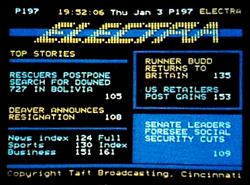
Electra
~ the last words ~
Teletext in Britain became furniture. Teletext in America reached a few dozen households. Electra was the closest thing the United States built to Ceefax, run out of WKRC-TV in Cincinnati by Taft Broadcasting with Satellite Syndicated Systems of Tulsa handling the other half, and it went out in the vertical blanking interval of Superstation WTBS from July 1983, after a year of test transmissions.
The pages sat at 100 through 199, with a companion service called Tempo Text occupying 201 to 212. Electra ran on World System Teletext, the British standard, so an American viewer needed a decoder built to a British specification. Zenith was the only US manufacturer making one and it listed at three hundred dollars. A few dozen sold.
There is a detail in the record that says more about the operation than the decoder count does. Staff transcribed ABC's closed captioning onto Electra pages by hand, because captioning and teletext used different parts of the vertical blanking interval and a deaf viewer would otherwise have needed two boxes instead of one. Somebody at WKRC sat and retyped a network's captions so that a handful of people would not have to buy a second decoder.
I was born in 1984 and my first modem was a 14.4k in 1998, which puts me on the wrong side of this by about a decade and an ocean. Teletext arrived for me as something to read about rather than pages to wait for. The part I recognize is the shape of the problem: a service whose entire value depended on hardware that somebody else had to decide to build.
~ the record ~
| Born | July 1983, after test transmissions from July 1982 |
|---|---|
| Peak | pages 100 to 199 on Superstation WTBS, plus SPN and the C-band satellite feeds |
| Killed | 1993 |
| Lifespan | ten years on air, eleven counting the tests |
| Made by | Taft Broadcasting at WKRC-TV with Satellite Syndicated Systems of Tulsa |
| Killed by | Zenith choosing the closed captioning decoder over the teletext decoder |
~ the decoder was the product ~
Zenith made the only teletext decoder sold in the United States, which put Electra's whole addressable market inside one manufacturer's product plan. In 1992 Zenith looked at its 1993 line and concluded it could not practically fit both a teletext decoder and a closed captioning decoder into the same set. Captioning won. Congress had passed the Television Decoder Circuitry Act in 1990, requiring caption decoding in sets thirteen inches and larger from July 1993, and that was a mandate with a constituency behind it.
Nobody set out to kill Electra. It was occupying silicon that a federal requirement wanted for something else, and it lost the slot.
~ how it got to you ~
The signal rode in the vertical blanking interval, the black bar between television frames that carries no picture, and it went up with WTBS to the Galaxy 1 and Satcom 3R satellites. A C-band dish owner in the early eighties could pull Electra straight down off the bird. SPN carried it as well, a satellite network later rebuilt into CNBC. For something almost nobody could decode, it had a startling amount of reach.
~ the north american pattern ~
Every American teletext attempt landed the same way. NBC ran one and closed it, CBS ran ExtraVision and closed it. Electra outlasted both and still finished with a few dozen decoders in the field.
The American television industry never settled on a standard early enough for a set manufacturer to commit to it, and a manufacturer who will not commit leaves you selling a service your customers cannot physically receive.
~ leave a rose ~
an anonymous tribute. one rose per visitor per day.
@}-->-- ... roses left here
~ leave a wreath ~
a rose fades by morning. a wreath stays on this grave for good, with your name on it.
paid once through stripe. payments are handled by OÜ Lakeview, the small company that keeps rip.so running. the money pays for the hosting and the nightly digging. adopt it and the headstone reads "maintained in memory by" you. the groundskeeper plants new wreaths at the next tending, usually within a day.
» one email a week: new graves and the anniversaries of the dead. subscribe
other news: Tencent Dajia, Jeuxvideo.fr, Think Secret, Fusion TV
also died in the 1990s: Nazca Corporation, PowerAnimator, Ungermann-Bass
~ leave a note ~
visitors before you have left these graveside notes. anonymous welcome.