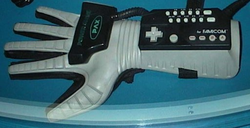
Power Glove
~ the obituary ~
The first time I saw the Power Glove it was already a joke about itself. Not a product by then, just a clip going around the internet with the line already attached to it, twenty years after the thing had been discontinued. I was five years old and in Ankara when it was actually for sale, which is another way of saying it was never going to be mine.
It came out in North America in October 1989 at seventy-five dollars. Mattel manufactured it and Nintendo licensed it without having designed any part of it. The underlying idea belonged to Abrams/Gentile Entertainment, who had looked at the VPL DataGlove and asked whether the same thing could be built for a hundredth of the price. The DataGlove people include Jaron Lanier, which is how a piece of serious virtual reality research ended up as a toy on a shelf next to Barbie.
The technical description still sounds impressive. Conductive ink along the fingers changed resistance as you bent them, so the glove knew roughly what shape your hand was in. Two ultrasonic transmitters on the glove talked to three microphones on a bar clipped to your television, and the difference in arrival times gave it your hand's position in the room. In 1989. On a console with two kilobytes of RAM.
It did not work. The ultrasonic tracking wanted a quiet room with a clear line of sight and lost you constantly, and the finger sensors drifted while you were using them. Before every game you had to punch a program code into a keypad on the wrist to tell the glove which movements meant which buttons. Two games ever supported it properly, Super Glove Ball and Bad Street Brawler, and both were more playable with the standard controller. Mattel dropped it in 1990.
~ the case file ~
| Born | October 1989, North America |
|---|---|
| Peak | close to a million units sold |
| Killed | 1990 |
| Lifespan | about a year |
| Made by | Mattel, from an Abrams/Gentile design |
| Killed by | controls nobody could actually use |
~ the funny part ~
Almost a million people bought one. That is not a failure by unit count, it is a failure by what happened after the box was opened, and the gap between those two numbers is entirely the marketing. The Wizard came out in December 1989, a Universal film that is ninety minutes of Nintendo advertising with a road trip stapled to it, and the villain puts the glove on and says the line that is the only reason you know the product exists.
So the most successful thing about the Power Glove is a sentence delivered by a character the audience was meant to dislike. It sold the accessory to a million children who then found out it could not track their hands. The movie never played in Turkish cinemas and the console it was attached to arrived here mostly as unlicensed clones, so both halves of that experience passed me by completely.
~ what got buried with it ~
The idea was not stupid, it was early by about thirty years. Reading a hand in free space and turning it into input is now a solved problem, and it got solved with cameras and software rather than with sensors strapped to the person. That is the part I find worth sitting with, given what I work on: the answer was to stop instrumenting the hand and start looking at it.
The glove itself refused to die. It is probably the most heavily modified dead peripheral in existence, wired into synthesizers and drone controllers and art projects by people who wanted the shape rather than the electronics. A device that failed at its one job has had a thirty-five year second career as a thing to take apart, which is a better ending than most accessories from that decade got.
~ leave a rose ~
an anonymous tribute. one rose per visitor per day.
@}-->-- ... roses left here
~ leave a wreath ~
a rose fades by morning. a wreath stays on this grave for good, with your name on it.
from $1, paid once through stripe. it keeps the graveyard running: the hosting and the nightly digging. adopt it and the headstone reads "maintained in memory by" you. the groundskeeper plants new wreaths at the next tending, usually within a day.
» one email a week: new graves and the anniversaries of the dead. subscribe
other gadgets: Commodore International, Netpliance i-Opener, Anki, Sony LocationFree
also died in the 1990s: Commodore International, Hercules Computer Technology, Sequent Computer Systems
~ leave a note ~
visitors before you have left these graveside notes. anonymous welcome.