Polar Studios
» see polarstudios.se as it lived, on the wayback machine
~ the last words ~
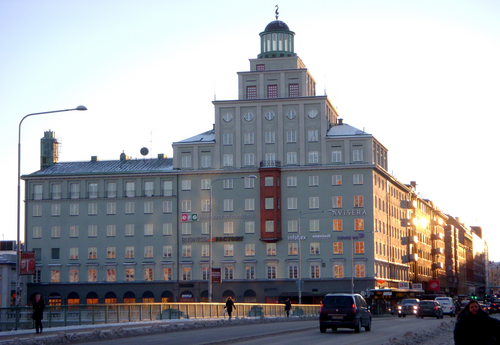
Michael B. Tretow, who engineered ABBA's records, dated the first conversation about building their own studio to May 1974. It took four years. The site they settled on was Sportpalatset on Sankt Eriksgatan in Kungsholmen, a building from the early 1930s that had held a swimming pool and tennis courts until 1956 and then a cinema, last trading under the name Riverside. Construction started in 1977. Polar Studios opened on 18 May 1978, paid for by Stig Anderson, who owned the Polar Music label, together with Benny Andersson and Björn Ulvaeus. The point was a room where ABBA could work at its own speed instead of booking time around other people, with the label's other artists filling the gaps.
The first session was not ABBA. A Swedish piano duo called Dubbelpianisterna cut the studio's first recording in early June 1978, and ABBA's own first known date there followed on 5 June. The first ABBA song finished in the building was Chiquitita. Three albums came out of it. Voulez-Vous and Super Trouper, then The Visitors in 1981, which was recorded on a 3M digital machine and put ABBA among the first mainstream pop acts released off digital tape. The last two ABBA singles, The Day Before You Came and Under Attack, were cut there as well, parts of the first one in the smaller upstairs room.
Ownership moved twice without the room changing. In 1984 Anderson bought out Andersson and Ulvaeus, then sold the studio on to his daughter Marie Ledin, her husband Tomas Ledin and their partner Lennart Östlund, who had been Polar's chief engineer since the opening. After ABBA split in 1982 all four members kept booking it for solo work, and the rest of the 1980s and 1990s belonged to whoever was paying.
I was born after this story finished. The Visitors came out in 1981 and the group was done the next year, so ABBA arrived in my life the way a standard arrives, already fixed, playing on Turkish radio and television with no information attached about where any of it was made. Studio credits are not something a listener encounters. You learn that a particular building did a particular job to a record much later, if you ever bother to look, and by then the building is usually an optician's.
~ the record ~
| Born | 18 May 1978, in a dead cinema at Sankt Eriksgatan 58-60, Stockholm |
|---|---|
| Peak | 1979 to 1981: three ABBA albums plus Led Zeppelin's last record with John Bonham |
| Killed | 1 May 2004 |
| Lifespan | 26 years at the original address |
| Made by | Polar Music, meaning Stig Anderson plus two of ABBA |
| Killed by | a rent demand of $184,000 a year from the building's housing cooperative |
~ the room ~
The owners paid Tom Hidley of Eastlake for a design and then did not use it as delivered. Tretow wrote in 1979 that Hidley helped and that the Swedish acoustician Jan Setterberg and architect Michael Borowski adapted the result. Setterberg, writing to a trade magazine the same year, put it more bluntly: the fee was paid, but ABBA wanted something more distinctive, so he and Borowski did the design work themselves. Both accounts are on the record and nobody has reconciled them.
What they built was unusual in a way you could feel through the floor. The recording rooms were constructed as separate boxes sitting on rubber blocks so that no sound or vibration passed between them. Rune Söderqvist, who did ABBA's sleeve art, made cloud panels for the walls and a large mechanical music machine for the entrance. The centerpiece was a 40-channel Harrison 32 Series console, serial number 045, delivered in January 1978 and one of the earliest 32-bus inline desks anywhere. The technician Leif Mases later modified it in a way that was said to give it something of a Neve character. By 1981 a second room upstairs ran a Harrison 32C against a 3M digital 32-track, which made Polar one of the first digital studios in the world.
~ who came through ~
Led Zeppelin recorded In Through the Out Door there in 1979, the last studio album the band made with John Bonham. Genesis did Duke in 1980. Anni-Frid Lyngstad cut Something's Going On with Phil Collins producing and Hugh Padgham engineering. The Chess concept album was mixed in the upstairs room in 1984.
After that the guest list stops being a story and becomes a list, which is what a working studio is supposed to produce: the Rolling Stones and Chic, the Ramones and Roxy Music, Rammstein, Backstreet Boys, Celine Dion, Roxette, Joan Armatrading, Entombed, The Hellacopters, plus most Swedish artists of any size. A room that opened to serve one band's schedule spent twenty-six years serving everyone else's.
~ the rent ~
The building ended up owned by a private housing cooperative, and in 2004 the cooperative set Polar's annual rent at about $184,000, roughly triple what other tenants in the same building were paying. No version of the business worked at that number. The studio vacated on 1 May 2004, twenty-six years and two weeks after it opened.
Attempts to keep the place failed on a technicality. An application to have it protected as a listed building was refused because the walls and floors of the studio were not fixed parts of the structure, which is a consequence of building the rooms on rubber blocks in the first place. A museum proposal came to nothing. The premises went to a gym and then became the head office of the optician chain Synsam.
The former owners reopened at a place called Kingside, then moved more than once again before finishing at an address in Hammarby Sjöstad. In the fall of 2015 the business was scaled down and the equipment went into a warehouse. The Harrison desk had a better retirement: it sits in ABBA The Museum in Stockholm, in a room the museum built to approximate the one it came from.
~ leave a rose ~
an anonymous tribute. one rose per visitor per day.
@}-->-- ... roses left here
~ leave a wreath ~
a rose fades by morning. a wreath stays on this grave for good, with your name on it.
paid once through stripe. payments are handled by OÜ Lakeview, the small company that keeps rip.so running. the money pays for the hosting and the nightly digging. adopt it and the headstone reads "maintained in memory by" you. the groundskeeper plants new wreaths at the next tending, usually within a day.
» one email a week: new graves and the anniversaries of the dead. subscribe
~ leave a note ~
visitors before you have left these graveside notes. anonymous welcome.