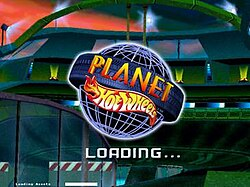
Planet Hot Wheels
» see planethotwheels.com as it lived, on the wayback machine
~ the obituary ~
In 2001 a code started appearing inside certain Hot Wheels packages. You typed it into a website and the die-cast car in your hand turned up on the screen, or the code gave you a paint job or a set of decals instead. A one dollar toy from a supermarket rack had become a key to something on the internet, which in 2001 was a genuinely odd sentence.
Planet Hot Wheels was Mattel's answer to the question of what a toy brand does with the web, and the answer was a racing world with an economy in it. It ran on Windows and Mac. You raced head to head or entered longer rally events, and between races there were minigames, including a cops-and-robbers mode and a set of hill climbs. Everything paid out in credits, which was the currency, and credits bought cars and the parts to modify them. The upgrades ran to weapons, which tells you the game was not aiming at realism.
Mattel pushed hard for the first two years. When Hot Wheels: World Race arrived as an animated film in 2003, its cars and its tracks were folded into the site, so the film sold the game and the game sold the toys. Six specially branded cars even shipped with CDs carrying content for a different Hot Wheels game entirely.
Then the promotion stopped. The site went down and put up a message saying it would be back soon, which stayed there for a long time without anything happening behind it. At some point in 2004 Mattel took the link off its website and Planet Hot Wheels was over, with no announcement recorded anywhere and no date anyone can point to.
~ the case file ~
| Born | 2001, on windows and mac |
|---|---|
| Peak | heavy television advertising across its first two years |
| Killed | 2004, removed after months of a holding page |
| Lifespan | about three years |
| Made by | mattel |
| Killed by | a toy company that stopped paying for a game |
~ the code on the card ~
The code mechanic is why this grave is worth digging. In 2001 the standard relationship between a physical toy and a screen was licensing: the game had the same characters on the box. Planet Hot Wheels went further and made the specific object you bought into an authentication token, so the car on the shelf and the car in your garage were the same purchase.
Webkinz did this in 2005 with plush animals and made a great deal of money doing it. Club Penguin ran unlock codes. Skylanders put a chip in the figure in 2011 and built a billion dollar business on the idea, followed by Disney Infinity and Amiibo. Mattel got there first with a piece of cardboard and a text box, and then failed to keep the website that gave the cardboard its meaning.
~ what the toy aisle learned ~
Toy companies are not software companies and Planet Hot Wheels is what that difference looks like in practice. Mattel could design the mechanic and fund the marketing, and it could get the codes into distribution across an entire retail chain. What it could not do was treat an online world as a thing requiring permanent staffing, because a toy line has a season and a website does not.
So the pattern here is not really failure through lack of interest. It is a product built on a promotional calendar. The advertising budget arrived with the launch and with the film tie-in, and when the campaign cycle moved on there was no department left whose job was the servers. The same fate caught Barbie Girls a few years later at the same company.
~ the last screen ~
By 2002 I was eighteen and the online part of my life was happening in Turkish internet cafes, which meant Counter-Strike on every machine in the room and MSN open behind it. An American toy company's racing site for ten year olds was not on any screen I sat in front of. Hot Wheels cars themselves were everywhere here, then and now, but the code program and the site behind it belonged to a North American retail campaign that never crossed over.
What survives is thin. There are loading screens preserved by collectors and a client sitting on abandonware download sites. On Mattel's own community boards there are threads where adults ask whether anybody else remembers it. Nothing playable. The children who typed those codes in are around forty now, and the cars are still in boxes in their parents' houses, carrying passwords to a server that stopped answering before most of them finished school.
~ leave a rose ~
an anonymous tribute. one rose per visitor per day.
@}-->-- ... roses left here
~ leave a wreath ~
a rose fades by morning. a wreath stays on this grave for good, with your name on it.
from $1, paid once through stripe. it keeps the graveyard running: the hosting and the nightly digging. adopt it and the headstone reads "maintained in memory by" you. the groundskeeper plants new wreaths at the next tending, usually within a day.
» one email a week: new graves and the anniversaries of the dead. subscribe
other kids: Himabu, Adventure Rock, Trinket, Kindernet
also died in the 2000s: Blazer, Gobe Software, Connexion by Boeing
~ leave a note ~
visitors before you have left these graveside notes. anonymous welcome.