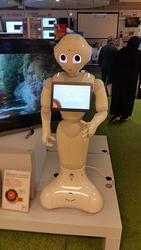
Pepper
» see softbankrobotics.com as it lived, on the wayback machine
~ the obit ~
Pepper stood 1.2 meters tall, weighed 28 kilos, rolled on a wheeled base rather than legs and had a tablet bolted to its chest. The claim underneath the product was emotion recognition. Cameras and a microphone array fed a classifier that guessed at your facial expression and the tone of your voice, and the robot was supposed to change what it said based on the answer.
The hardware came out of Aldebaran Robotics in Paris, which SoftBank bought for around $100 million in 2012 and which had already shipped the small NAO robot into research labs and classrooms. Masayoshi Son introduced Pepper in Tokyo on 5 June 2014. Foxconn assembled them. Consumer sales opened in Japan in June 2015 at 198,000 yen for the machine, with a 14,800 yen monthly plan for the cloud and the app store and a 9,800 yen monthly insurance pack on top, both running thirty six months, which put the real cost of owning one at roughly 1.09 million yen over three years.
The first batch of a thousand sold out in sixty seconds. SoftBank released a thousand a month afterward and kept selling them out. Pepper turned up in SoftBank's own phone stores first, then in Japanese banks and a conveyor belt sushi chain, and twelve thousand had shipped into European retail by May 2018.
I work on vision models that run on the device instead of in a data center, which is the same problem Pepper was handed in 2014 with a decade less silicon to solve it with. Reading a face is the easy half of that problem. Deciding what the face means and what to say back is the part nobody had, and it is the part the marketing sold first.
~ the rap sheet ~
| Born | 5 June 2014, introduced in Tokyo by Masayoshi Son |
|---|---|
| Peak | first 1,000 consumer units sold out in 60 seconds, June 2015 |
| Killed | August 2020 |
| Lifespan | about 6 years in production |
| Made by | SoftBank Robotics and Aldebaran, assembled by Foxconn |
| Killed by | no demand at any price that covered the build |
~ the emotion engine ~
The emotion claim was thin the whole way down. Pepper sorted facial expressions into a small set of buckets and pulled a rough read out of the microphone array, then chose a reply from whatever the developer had written for that bucket. There was no model of you underneath any of it. What you had was a scripted conversational front end with a mood label attached, and once you had watched it attach the wrong label twice, the label stopped meaning anything.
SoftBank kept using the word anyway. The launch material called Pepper the first robot able to read human emotions and the press repeated that line for years, which set an expectation that a machine standing in a shop lobby was never going to meet.
~ what it did in the stores ~
The working deployment was narrower than the pitch. Pepper greeted people and ran a script on its chest tablet: it took a survey, showed a menu, pointed you at a counter. Businesses mostly rented rather than bought, and the American enterprise package ran about $440 a month on a three year term with software and support included.
That is a defensible price for a novelty that pulls people in off the street and an indefensible one for a member of staff. Pepper was priced as the first thing while being demonstrated as the second, and the gap between those two readings is where the repeat orders should have come from.
~ the receivership ~
Production stopped in August 2020 and there was no announcement of any kind. Reuters got it on 28 June 2021 from unnamed sources, who put the total build at about 27,000 units since 2014 and said restarting the line would cost more than it was worth. SoftBank Robotics Europe had lost roughly $38 million in its 2019 to 2020 financial year, and more than $119 million across the three years before that.
SoftBank sold the French business to Germany's United Robotics Group in 2022 and it took the Aldebaran name back. United Robotics stopped funding it in 2024 against an operating loss near $29 million. Aldebaran filed a safeguard procedure in January 2025 and was in receivership by February. Judicial liquidation followed on 2 June 2025, with debts over 60 million euros. Maxvision, a Chinese buyer, took the assets and stood up a French subsidiary to keep NAO in production with some of the former staff. Nobody picked up Pepper, so the robot that was sold on knowing how you felt is now a line item in a French insolvency file.
~ leave a rose ~
an anonymous tribute. one rose per visitor per day.
@}-->-- ... roses left here
~ leave a wreath ~
a rose fades by morning. a wreath stays on this grave for good, with your name on it.
paid once through stripe. payments are handled by OÜ Lakeview, the small company that keeps rip.so running. the money pays for the hosting and the nightly digging. adopt it and the headstone reads "maintained in memory by" you. the groundskeeper plants new wreaths at the next tending, usually within a day.
» one email a week: new graves and the anniversaries of the dead. subscribe
other gadgets: Wileyfox, CueCat, Symbolics, Myo
also died in the 2020s: Asian Correspondent, MetroCard, OpenAI Sora 1
~ leave a note ~
visitors before you have left these graveside notes. anonymous welcome.