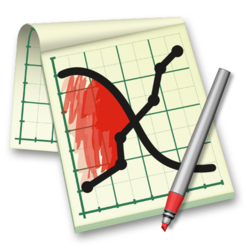
OmniGraphSketcher
» see omnigroup.com/omnigraphsketcher as it lived, on the wayback machine
~ the eulogy ~
Every charting program works the same way. You bring numbers, it draws a picture of them, and if you want the picture to look like something other than what the numbers say, you are out of luck. OmniGraphSketcher inverted that. You drew the curve you had in your head with the mouse, freehand, and the application snapped it into a real plot with real axes, after which you could attach actual values if you had any. It was built for the case nobody else served: a person who knows what the graph should look like before the data exists.
The Omni Group announced it on 25 March 2009, in beta, at $29.95 for a license, and described it as a tool combining the data plotting of a charting application with the ease of a drawing program. An iPad version arrived in April 2010, early enough in that device's life that drawing a graph with a finger still felt like an argument for the hardware. Both versions were well reviewed by the small number of people who needed them, which turned out to be the problem.
Omni removed it from sale on 4 July 2013, announced on the company's Twitter account rather than in a blog post, four years and three months after launch. The support page stayed up with its email address still answering, and in January 2014 the source code went out under an open-source license as GraphSketcher, where the Mac build still sits on GitHub.
~ the dossier ~
| Born | 25 March 2009, announced in beta at $29.95 |
|---|---|
| Peak | two platforms from April 2010, when the iPad version shipped |
| Killed | 4 July 2013 |
| Lifespan | four years and three months, or ten counting the college project |
| Made by | The Omni Group, out of Robin Stewart's Graph Sketcher |
| Killed by | not enough buyers, stated plainly by the company |
~ the thesis ~
This one has an unusually clean paper trail, because it started as academic work. Robin Stewart designed the original Graph Sketcher in 2003 as an undergraduate at Williams College, carried it to MIT, and made it the basis of his master's thesis on joining data plotting to freehand illustration. It was commercially released on its own in 2006. In 2008 the Omni Group bought the application and hired its author, which is the version of an acqui-hire where the product actually ships afterward.
The research angle explains why the app felt so specific. It was not a feature somebody added to a spreadsheet. It was somebody's thesis question made clickable, and the question was whether the interface for illustrating data could be the same interface as the one for plotting it.
~ how an engineer makes a chart ~
I was in exactly the demographic this should have sold to and I would not have bought it either, which is worth being honest about. The charts I make come out of the data because the data is the point, written by whatever is nearest: gnuplot in the university years, matplotlib since. When I need a diagram of a shape rather than a plot of a measurement, I draw it badly in a drawing program and move on. The gap OmniGraphSketcher aimed at is real, it is just a gap most technical people have learned to live in.
~ the epitaph omni wrote ~
Omni's support page carries one of the more honest sentences a software company has written about its own product: OmniGraphSketcher was unable to attract enough customers to make it a viable commercial product. No pivot language, and no claim that the technology lives on inside something bigger. The company said the thing out loud and left the page up.
The same page has a second note that has nothing to do with Omni's decision and everything to do with the platform: the iPad version was built for iOS 3 through 7 and stopped running on iOS 9 and 10, and Omni points out that the app did not change, the operating system did. So the Mac version is open source and buildable today, and the iPad version is unreachable on any current device. A finger-drawn graph is the part that could not be saved.
~ leave a rose ~
an anonymous tribute. one rose per visitor per day.
@}-->-- ... roses left here
~ leave a wreath ~
a rose fades by morning. a wreath stays on this grave for good, with your name on it.
from $1, paid once through stripe. it keeps the graveyard running: the hosting and the nightly digging. adopt it and the headstone reads "maintained in memory by" you. the groundskeeper plants new wreaths at the next tending, usually within a day.
» one email a week: new graves and the anniversaries of the dead. subscribe
other utilities: CoolWebSearch, Filterset.G, X-Ray Goggles, Crocodoc
also died in 2010-2014: Scitopia, Grazr, LEGO Design byME
~ leave a note ~
visitors before you have left these graveside notes. anonymous welcome.