Neofetch
» see github.com/dylanaraps/neofetch as it lived, on the wayback machine
~ the goodbye ~
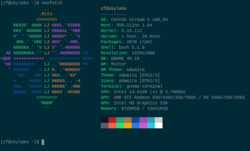
the first time you see neofetch output you assume it is a system tool. it is not. it is a screenshot generator. you type one word into a terminal and it prints your distribution's logo in colored ascii on the left, with a column on the right listing the os, the kernel, the uptime, the package count, the shell, the resolution, the desktop environment, the window manager, the terminal, the cpu, the gpu and the memory in use. then you take a picture of it and put it on the internet.
dylan araps published it on 31 december 2015. it was written entirely in bash 3.2, which is a deliberate constraint: bash 3.2 is what ships on macos, so a script that stays inside it runs everywhere without asking for a dependency. by the end it was one shell file large enough that reading through it had become its own small hobby, and it identified hundreds of distributions by poking at their release files.
it was not the first. screenfetch had been doing the same job since 2010 and said so plainly in its own repository description, calling itself the bash screenshot information tool. neofetch won on coverage and on configuration. it supported more systems than anyone needed, reaching past linux and macos and the bsds into haiku, minix, irix and solaris, and it let you replace the ascii art with an actual image if your terminal could handle w3m-img or sixel.
i have run neofetch. everyone who sets up linux machines has run neofetch. what i never had was the culture around it, the screenshot economy where the point of a desktop is the picture of the desktop. that arrived when i was already in my thirties and using computers as tools rather than as something to display. for me it was a fast way to confirm what a box was. for a lot of people it was the entire reason the box looked like that.
~ the chronicle ~
| Born | 31 December 2015, as a bash script on GitHub |
|---|---|
| Peak | packaged in nearly every Linux distribution, 23,700 stars on GitHub |
| Killed | 26 April 2024, repository archived |
| Lifespan | eight years and four months |
| Made by | Dylan Araps |
| Killed by | the author walking away, four years after the last release |
~ the screenshot ritual ~
there is a reason a tool with no function became standard equipment. if you spend two evenings configuring a tiling window manager and a color scheme, the result is invisible to anyone not sitting at your desk. neofetch made it transferable. the ascii logo identified the distribution instantly and the spec column gave the picture a caption, all of it inside a terminal window you were going to photograph anyway.
so it ended up in every distribution's repository and in every help thread where somebody was asked to post their system details, and it opened thousands of installation videos. it was the closest thing linux had to a business card.
~ the archive button ~
the last release was version 7.1.0 in 2020. after that the repository sat there, still working and still being packaged, with issues and pull requests piling up that nobody merged. this went on for close to four years. the tool was finished in the sense that it did what it did, and unfinished in the sense that new distributions kept appearing and their logos never got added.
on 26 april 2024 araps archived the repository. archiving on github is not deletion. the code stays readable and the issues stay visible, with the whole thing locked permanently read-only. it is the most honest ending an open source project can have, and it is rarer than it should be, because the usual ending is a repository that looks alive and is not.
araps did the same to the rest of his work. pfetch, the smaller sibling, was already discontinued. there was no statement and no handover to a successor maintainer. a person stopped.
~ what replaced it ~
fastfetch had already been doing the work for a while. it is a rewrite in c, much faster than a bash script that shells out dozens of times to gather its facts, and it is what the major distributions now ship in neofetch's place. the ecosystem also filled with jokes. there is a fetch tool written in perl, one in rust, one built for freedos because its author was unhappy with the existing dos option, and enough others that wikipedia keeps a table of them.
none of that is the interesting part. the interesting part is that a bash script whose only output was a picture of itself collected twenty three thousand stars and then outlived its own development by four years. it did not solve a problem. it gave people a way to show each other what they had built.
~ leave a rose ~
an anonymous tribute. one rose per visitor per day.
@}-->-- ... roses left here
~ leave a wreath ~
a rose fades by morning. a wreath stays on this grave for good, with your name on it.
from $1, paid once through stripe. it keeps the graveyard running: the hosting and the nightly digging. adopt it and the headstone reads "maintained in memory by" you. the groundskeeper plants new wreaths at the next tending, usually within a day.
» one email a week: new graves and the anniversaries of the dead. subscribe
other software: Opcode Systems, Claris HomePage, iPlanet, Google Poly
also died in the 2020s: AppHarvest, Best Gore, Pokémon TV
~ leave a note ~
visitors before you have left these graveside notes. anonymous welcome.