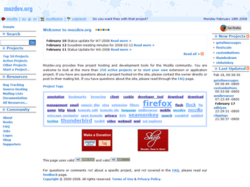
mozdev.org
» see mozdev.org as it lived, on the wayback machine
~ the obituary ~
In January 2000 Pete Collins joined David Boswell and the Alphanumerica people around an argument that sounded reasonable at the time and turned out to be mostly wrong. The argument was that Mozilla was not a browser, it was an application platform, and that XUL and JavaScript would let anyone write desktop software the way they wrote web pages. If that was true, the thing missing was somewhere for those applications to live. mozdev.org went up in September 2000.
What it gave you was unglamorous and exactly what you needed. A subdomain of the form yourproject.mozdev.org, CVS for the code, mailing lists, a Bugzilla account once they upgraded to Bugzilla 3.0, and web space to explain yourself in. The one rule was that the license had to be approved by the OSI. It was non-commercial and took no cut of anything, and at its height the site claimed over two hundred and fifty active projects.
I ran Firefox from around the 1.0 days on a TTNet line and I installed extensions the way everyone did, off a list, clicking through a warning I did not read. It never once occurred to me to wonder who was paying for the server the file came off. That is the honest position most of us were in. Someone was hosting the code, and for a great many of the extensions in that era the someone was two volunteers and a domain name.
~ the case file ~
| Born | September 2000, launched by David Boswell and Pete Collins |
|---|---|
| Peak | over 250 active projects, including Enigmail from 2001 to 2012 |
| Killed | July 2020, site offline and domain redirected |
| Lifespan | just under twenty years |
| Made by | David Boswell and Pete Collins, with the Alphanumerica team |
| Killed by | addons.mozilla.org first, then GitHub |
~ the climb ~
The clearest example of what mozdev was for is Enigmail, the OpenPGP extension for Thunderbird. If you wanted encrypted mail in a mail client anyone could actually use, that was the piece that did it, and its home address for eleven years was enigmail.mozdev.org. A serious security tool with a real user base ran off free hosting provided by a community project, and nobody thought that was strange, because in 2001 there was no other obvious place to put it.
The Mozilla-as-a-platform bet also produced standalone applications built on the same runtime, which mozdev hosted alongside the extensions. Some of them were good. Almost none of them found an audience, because the platform argument had a hole in it that only became visible later. People did not want desktop applications written in XUL. They wanted the browser, and then they wanted the browser to do more.
~ the slide ~
Mozilla built its own store. update.mozilla.org became addons.mozilla.org, and once there was an official directory with reviews and automatic updating, an independent host was competing with the vendor on the vendor's own product. Then GitHub arrived and made the hosting half of mozdev's offer free everywhere, for everything, with better tools. CVS against Git was not a contest anyone needed to run twice.
Enigmail left for SourceForge in August 2012 after eleven years, which is a decent marker for when the wind changed. Projects stopped arriving and existing ones stopped moving. Then Firefox 57 landed in 2017 and retired the old XUL extension model entirely in favor of WebExtensions, and a large share of what mozdev had been hosting for fifteen years simply stopped working in the browser it was written for.
~ the inheritance ~
The site went offline in July 2020 and mozdev.org now redirects to mozilla.org, which is a tidier ending than most of these get. No bankruptcy and no acquisition, and no announcement worth reporting. Twenty years of free hosting for a community that had moved somewhere else years earlier.
What it proves is narrow and worth keeping. For the first stretch of the extension era, the infrastructure under a browser's whole ecosystem was volunteer-run and it worked fine. The reason nobody remembers the name is that the arrangement was invisible when it was healthy, which is what good infrastructure looks like right up until you go looking for it.
~ leave a rose ~
an anonymous tribute. one rose per visitor per day.
@}-->-- ... roses left here
~ leave a wreath ~
a rose fades by morning. a wreath stays on this grave for good, with your name on it.
from $1, paid once through stripe. it keeps the graveyard running: the hosting and the nightly digging. adopt it and the headstone reads "maintained in memory by" you. the groundskeeper plants new wreaths at the next tending, usually within a day.
» one email a week: new graves and the anniversaries of the dead. subscribe
other community: Century China, L0pht Heavy Industries, CastleCops, Hitel
also died in the 2020s: Spinnup, Odd Todd, Instagram NFTs
~ leave a note ~
visitors before you have left these graveside notes. anonymous welcome.