Maximus
» see lanius.com as it lived, on the wayback machine
~ the last words ~
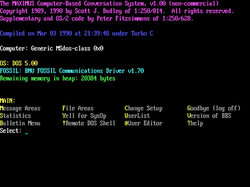
Maximus was bulletin board software, which in practice meant it was the thing standing between a modem and a stranger. Version 1.0 arrived in 1990 for MS-DOS and OS/2, written by Scott J. Dudley and sold through his company, Lanius Corporation. On DOS it reached the serial port through a FOSSIL driver, the small piece of plumbing that let one program talk to whatever modem a sysop happened to own.
What a caller saw was deliberately plain. Menus were auto generated and drawn simply in ANSI or ASCII, which made Maximus look lighter than the competition at a time when some packages were competing on decoration. That plainness was only the default setting. A sysop willing to put the hours in could rebuild the whole look, including RIP graphics for callers whose terminal programs could draw them.
The configuration model is what dates it hardest. You did not fill in a settings screen. You edited text files, then ran a compiler that turned them into the binary configuration the board actually read. Maximus shipped two languages of its own for this. MECCA handled display, with tokens for color changes and simple menu input. MEX, which arrived with version 3.0 in December 1995, was a full programming language borrowing from C and Pascal, with functions and arrays, so a sysop could write real programs that ran inside the board.
Alongside it came Squish, a mail format and the FidoNet tosser that moved messages between boards. That pairing is why Maximus boards tended to be the ones carrying serious echomail traffic: the mail side was not an afterthought bolted onto a chat system.
~ the record ~
| Born | 1990, version 1.0, for MS-DOS and OS/2 |
|---|---|
| Peak | version 3.0 in December 1995, with the MEX language |
| Killed | 31 December 1998, end of sale announced by its author |
| Lifespan | 8 years on sale |
| Made by | Scott J. Dudley, Lanius Corporation |
| Killed by | the internet, named as such in the closing notice |
~ how it actually ended ~
Dudley put up a page titled On the Future Development of Maximus, dated 31 December 1998. As of that date Lanius would no longer be selling Maximus or Squish. The reason given was short and did not pretend to be anything else: the changing marketplace, and particularly the impact of the internet. The promises attached to it were specific. Existing commercial users would keep their support. A Year 2000 compliant build would go out free to everybody, and the source code would eventually be released under the GPL. Then the closing line, which reads like somebody putting a tool down on the bench: it is time for us to move on.
I came online in that exact window, and the thing Dudley named as the reason for stopping is the thing that got me a connection in the first place. A dial-up account to the internet and a dial-up call to a board are the same modem and the same phone bill, pointed at two different ideas about where the other people are. One of those ideas was finished in 1998 and the other one had just started selling in Turkey.
~ what came after ~
The GPL release happened on 28 September 2002, with Lanius listed as the initial administrator of a SourceForge project it openly said it would not develop, and a note that the code was not officially supported. Volunteers ported it to Linux and other Unix-like systems, and a Maximus/UNIX 3.03 exists carrying a copyright line that runs from 1989 to 2003. The lanius.com domain itself went to an unrelated company.
~ leave a rose ~
an anonymous tribute. one rose per visitor per day.
@}-->-- ... roses left here
~ leave a wreath ~
a rose fades by morning. a wreath stays on this grave for good, with your name on it.
paid once through stripe. payments are handled by OÜ Lakeview, the small company that keeps rip.so running. the money pays for the hosting and the nightly digging. adopt it and the headstone reads "maintained in memory by" you. the groundskeeper plants new wreaths at the next tending, usually within a day.
» one email a week: new graves and the anniversaries of the dead. subscribe
other software: AppSurfer, Windows Genuine Advantage, Remix 3D, NESticle
also died in the 1990s: Kaypro, NESticle, WorldWideWeb (Nexus)
~ leave a note ~
visitors before you have left these graveside notes. anonymous welcome.