MAE-East
~ the obit ~
In 1998 the internet arrived at my house as a sound. You dialed, and after a while there was a page. Nothing in that experience suggested the whole arrangement leaned on a small number of specific rooms in the United States, and nothing suggested one of those rooms was under a parking lot in northern Virginia.
MAE-East started in 1992 because a group of network operators around Washington got together and decided to plug their networks into each other. The name stood for Metropolitan Area Ethernet, which is exactly what it was: an ethernet segment in an office building at 8100 Boone Boulevard in Tysons Corner, with Metropolitan Fiber Systems selling the space and UUNET supplying the reason. By February 1993 it linked four points of presence over 10 Mbps ethernet.
That same year the National Science Foundation named it one of the four original Network Access Points, which meant it stopped being an informal arrangement between neighbors and became load-bearing. When MAE-West opened in 1994 the acronym was quietly re-read as Metropolitan Area Exchange, East. The equipment moved across the street to a room in the underground garage at 1919 Gallows Road, and the number people repeated for years afterward was that roughly half of everything moving on the internet came through it.
~ the rap sheet ~
| Born | 1992, by Scott Yeager of MFS and Rick Adams of UUNET |
|---|---|
| Peak | reported to carry around half of all internet traffic in the mid-1990s |
| Killed | 2009, when the last participants had left for Equinix Ashburn |
| Lifespan | seventeen years |
| Made by | Metropolitan Fiber Systems, then WorldCom, then Verizon |
| Killed by | the exchange points it taught the industry how to build |
~ the room ~
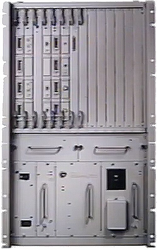
The physical facts are the part that stays with people. One floor of an office building until 1996, then a cinder-block space beneath a parking structure, filled with routers belonging to companies that competed with each other and cooled by whatever the landlord had installed. Seven DEC GigaSwitches by late 1994, shared FDDI at 100 Mbps, and a wall of fiber running between racks owned by firms with no relationship except this one.
Nobody planned it as critical infrastructure. It was a place to save money on transit, and it worked so well that it became the thing everything else depended on before anyone had decided that was acceptable. The building had no significance of its own. It was near the networks that mattered and it had space.
~ the bottleneck ~
The trouble with one place where everything meets is that it is one place where everything meets. By the mid-nineties MAE-East was congested in a way that showed up as packet loss for people in other countries who had no idea the exchange existed. Traffic between two European networks sometimes crossed the Atlantic twice to get through Virginia, because that was where the interconnection was.
The response was to make it faster and more expensive. MAE-East ATM went into production in 1998 at 155 to 622 Mbps, with WorldCom, which had bought MFS in 1996, requiring participants to buy ATM circuits alongside rack space and cross-connect fees. Frame relay access followed in 2002. Each upgrade bought a few more years and moved the exchange further from the flat, cheap thing it had been.
~ the long fade ~
The FDDI segment was closed to new customers after 1998 and switched off in February 2001. That was the end of the version anyone remembers. What continued was a commercial product sold by a carrier that had inherited it twice, first through WorldCom and then through Verizon, which still holds MAE as a trademark for exchange services.
Operations ceased in 2009. There was no announcement worth the name, because by then the participants had already spent a decade moving to gigabit ethernet exchanges further west, above all Equinix in Ashburn. Loudoun County built its data center industry on exactly that migration and now describes MAE-East's relocation as the founding event of the whole cluster. The exchange died the way a road dies when a wider one opens beside it.
~ leave a rose ~
an anonymous tribute. one rose per visitor per day.
@}-->-- ... roses left here
~ leave a wreath ~
a rose fades by morning. a wreath stays on this grave for good, with your name on it.
from $1, paid once through stripe. it keeps the graveyard running: the hosting and the nightly digging. adopt it and the headstone reads "maintained in memory by" you. the groundskeeper plants new wreaths at the next tending, usually within a day.
» one email a week: new graves and the anniversaries of the dead. subscribe
other connectivity: CyberBunker, Phantom Secure, MSN Direct, Abilene Network
also died in the 2000s: Xelibri, Yahoo! Gallery, Sony BMG XCP
~ leave a note ~
visitors before you have left these graveside notes. anonymous welcome.