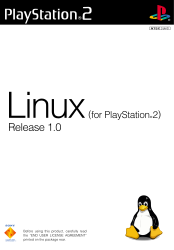
Linux for PlayStation 2
» see playstation2-linux.com as it lived, on the wayback machine
~ the obituary ~
This one never had a chance of reaching me, and not for the usual reason. The PlayStation 2 itself was everywhere here, modchips and all. The Linux kit was mail order only, sold by Sony into territories Sony picked, and where it did go on sale the supply ran out and was not replaced. There is no gray import route for something that was never in a warehouse.
Sony announced a worldwide release on 30 january 2002. Japan took orders from 13 february at 25,000 yen and got kits in april. A beta the year before had been capped at 2,000 units and ended up going out to around 7,900 because demand did not respect the cap. North America got a quiet mail-order release in late may 2002. The entire NTSC allocation of four thousand was gone within hours and Sony never made another.
What arrived was two discs, a 40 GB hard drive, a network adapter, a USB keyboard and mouse, and a cable to put the console on a VGA monitor. The operating system was built on Kondara MNU/Linux, a Japanese distribution derived from Red Hat, running a 2.2 kernel on the PS2's 32 MB of RAM. It was cramped, and the hard drive spent its life doing work that memory should have been doing.
None of which was the argument. The argument was that Sony shipped the hardware documentation with it, the Emotion Engine and the graphics synthesizer both, to anyone who bought a kit, at a time when console internals were the most closely held paperwork in the industry. You could write code against the actual silicon in the actual box under your television. That was a strange thing for a console manufacturer to sell, and it did not last.
~ the case file ~
| Born | april 2002 in Japan, at 25,000 yen |
|---|---|
| Peak | the North American allocation of 4,000 kits gone within hours |
| Killed | june 2010, when the site went to a placeholder |
| Lifespan | eight years |
| Made by | Sony Computer Entertainment |
| Killed by | Sony deciding hobbyists were a liability |
~ what it was actually for ~
Sony's stated reason was to widen the pool of people who could write for the platform, which is a real reason and probably not the only one. Console makers in that period were also managing customs and classification questions, since a machine filed as a computer is treated differently from a machine filed as a toy, and having a Linux kit on the shelf is a useful fact to be able to produce. That part is a theory rather than a documented motive, and it deserves to be labeled as one.
What it did in practice was seed a generation of console hacking. The kit handed people documented low-level access to hardware Sony would otherwise have kept sealed, and that knowledge did not politely stay inside the kit. Much of what the PS2 homebrew and emulation scene learned about the Emotion Engine came in through a door Sony opened on purpose and then spent the next decade regretting.
~ the day it died ~
The kit stopped being sold in North America in 2003 when the stock ran out. Japan and Europe carried on longer, and the community around it carried on longer still, on Sony's own forums at playstation2-linux.com.
Then on 1 april 2010 Sony pushed PlayStation 3 firmware 3.21, which removed the Install Other OS feature, the far better successor to all of this. Owners who refused the update lost the online store. Owners who took it lost the Linux install they had been running on hardware they had bought partly for that. It became a class action, which Sony settled in 2016.
Weeks later the PS2 Linux site emptied out. The Internet Archive has it serving a normal page of around 5.6 kilobytes on 24 may 2010 and a 1.1 kilobyte shell on 17 june, which is what a shutdown looks like from outside when nobody announces one. A promise was made that the forum posts and the code would be archived and published. The deadline given was november 2010. Nothing was published.
~ the funny part ~
The documentation outlived the company's interest in it. The PS2 Linux discs and the hardware manuals that shipped with them are archived and downloadable now, off the same kind of preservation sites that host the games, and a boxed kit goes for real money on eBay. The hardware still runs, because the PlayStation 2 was built to a standard consoles have not been held to since and there are over 160 million of them out there.
So the thing Sony sold is preserved and the thing Sony ran is gone. That is the usual split. What is unusual here is which part Sony chose to switch off. It was not the software and it was not the discs. It was the place where the people who bought it talked to each other.
~ leave a rose ~
an anonymous tribute. one rose per visitor per day.
@}-->-- ... roses left here
~ leave a wreath ~
a rose fades by morning. a wreath stays on this grave for good, with your name on it.
from $1, paid once through stripe. it keeps the graveyard running: the hosting and the nightly digging. adopt it and the headstone reads "maintained in memory by" you. the groundskeeper plants new wreaths at the next tending, usually within a day.
» one email a week: new graves and the anniversaries of the dead. subscribe
other gaming: Storybook Brawl, Wizardry Online, Magic: Legends, General Computer Corporation
also died in 2010-2014: RichCopy, HotFile, Symbian OS
~ leave a note ~
visitors before you have left these graveside notes. anonymous welcome.