Light L16
» see light.co as it lived, on the wayback machine
~ the eulogy ~
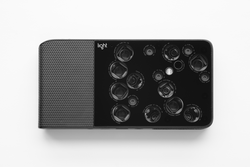
Sixteen lenses in a black slab about the size of a large phone, arranged in a pattern that looked like a mistake. Ten of them fired at once on a shutter press, each one a 13-megapixel module at one of three focal lengths, and software stitched the results into a single 52-megapixel file with depth information baked in. The promise was a camera you could put in a coat pocket that would hold its own against a DSLR, and in 2015 that was an arresting thing to say out loud.
Light was founded in 2013 in Palo Alto by Dave Grannan and Rajiv Laroia. It announced the L16 in October 2015 and opened pre-orders at $1,299, and the first production units shipped in July 2017 at a retail price of $1,699. Along the way the aperture was widened from F/2.4 to F/2.0, in December 2016, which is the sort of specification change that only happens when a product is still being argued about internally eight months before it ships.
The reviews were not kind and were not wrong. The fusion took a long time and the low light performance sat well behind the claim. Getting a finished image out at all meant running a desktop application called Lumen on a Mac or a PC after the fact. The camera was a computer that needed a second computer to finish its work, and the second computer was the part the company controlled.
Support ended at the end of 2019, which Light's support team said in those words to people who asked. By June 2020 the company had announced it was leaving consumer imaging entirely for automotive depth sensing, and the downloads page stopped listing firmware and the rendering software for the camera people had already bought.
~ the dossier ~
| Born | announced October 2015 by Light, founded 2013 in Palo Alto |
|---|---|
| Peak | $120m Series D led by the SoftBank Vision Fund, 18 July 2018 |
| Killed | support ended at the end of 2019 |
| Lifespan | 4 years from announcement, 2 years on sale |
| Made by | Light Labs Inc., founded by Dave Grannan and Rajiv Laroia |
| Killed by | a licensing business that no longer needed a camera to demonstrate it |
~ the money said something different ~
The funding history does not look like a camera company's. There was $9.7 million in June 2014, $25 million in July 2015, then $30 million in July 2016 for a running total of $64.7 million, all of it raised before anyone outside the company had held an L16. Then on 18 July 2018, a year after the camera shipped to middling reviews, the SoftBank Vision Fund led a $120 million round.
Nobody puts $120 million into a product that is being returned. What SoftBank was buying was the stack underneath it, and the proof arrived seven months later when the Nokia 9 PureView was announced with five rear cameras firing together, built on Light's technology. That phone is the L16 argument executed by somebody with a supply chain, and it is why the camera never really needed to sell well.
~ what the owners kept ~
The L16 always had a second job. It was a working demonstration of a licensing business, built at consumer scale so that phone makers could be shown rather than told, and once the showing was done the demonstration had nothing left to do.
That left a few thousand people holding a $1,699 object. The cameras still boot and still write files, and the files are the problem, because the full-resolution output has to go through Lumen and Lumen stopped being maintained. When Apple shipped macOS Big Sur the application broke, and later revisions of Catalina took it down too, so a good number of owners lost access to their own photographs through an operating system update to a machine that was not the camera. The workaround involves sideloading something like Flickr onto the camera to push images off it, which is an absurd sentence about a piece of professional equipment.
Price kept this one away from me well before geography did. The L16 reached American buyers in July 2017 and British ones in March 2018, and at $1,699 no version of it was ever going to turn up in a shop window in Ankara. What did arrive here was the Nokia 9 PureView, which people argued about at length without many of them knowing whose camera stack was sitting behind those five lenses.
~ the tractor ~
Light kept going for a while as something else. The site in mid-2022 was selling long-range depth perception from ordinary cameras, measured rather than inferred, with a field of view spec and a note about automotive component qualification. It was still carrying a hiring banner on 30 June 2022.
Wikipedia dates the end to May 2022, when John Deere acquired parts of the company and hired some of the staff. So the engineering built to put a DSLR in your pocket went into farm machinery, which is a kinder ending than most of what gets filed here. The domain did not fare as well. By 31 August 2023 light.co was serving an Indonesian online casino, and today it answers nothing at all.
~ leave a rose ~
an anonymous tribute. one rose per visitor per day.
@}-->-- ... roses left here
~ leave a wreath ~
a rose fades by morning. a wreath stays on this grave for good, with your name on it.
from $1, paid once through stripe. it keeps the graveyard running: the hosting and the nightly digging. adopt it and the headstone reads "maintained in memory by" you. the groundskeeper plants new wreaths at the next tending, usually within a day.
» one email a week: new graves and the anniversaries of the dead. subscribe
other gadgets: Stratos Card, Nextbit Robin, Real3D, Pravetz
also died in 2015-2019: Angry Birds Go!, Stratos Card, Nextbit Robin
~ leave a note ~
visitors before you have left these graveside notes. anonymous welcome.