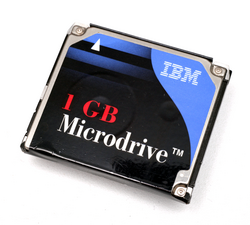
IBM Microdrive
~ the eulogy ~
There was a hard disk in the camera and it spun. That is the part to hold onto: a platter turning at thousands of revolutions a minute inside a slot designed for a chip with no moving parts in it at all. IBM announced the Microdrive on 9 September 1998 and shipped it the following June at 170 and 340 megabytes, in a package 42 by 36 millimeters and five thick, which is the CompactFlash Type II footprint exactly. The 340 went for around $475. Flash cards that year were selling eight megabytes at a time.
The idea dated to 1992 and came out of IBM's Almaden Research Center in San Jose, where Timothy Riley and Thomas Albrecht had worked through how small a disk could get before the physics stopped cooperating. What turned it into a product rather than a demonstration was the decision to wear somebody else's shape. CompactFlash Type II already existed, the slots were already cut into cameras, and a drive pretending to be a card needed no new hardware anywhere on earth. It arrived as a capacity upgrade instead of as a format.
For about four years it was the only way to carry gigabytes in a pocket. Half a gigabyte and then a full one arrived in 2000. IBM's disk business went to Hitachi Global Storage Technologies in January 2003 and the drives carried Hitachi's name from then on, reaching two and four gigabytes that year and six by 2005. Apple put a four gigabyte drive in the first iPod mini in 2004, and Seagate's competing one-inch unit went into the Rio Carbon that August. A one gigabyte Microdrive flew on two shuttle missions in 2001, mounted in a Kodak DCS 660.
I never owned one, and the reason is arithmetic rather than geography. The Microdrive answered a question you only have if you are filling a gigabyte of images in a day, which in 2002 meant a professional body with a paying assignment behind it. The cameras in my orbit were a shared compact or nothing, and the pictures that mattered showed up on a screen rather than coming off a card. A storage device priced in the hundreds to solve a volume problem stays invisible to anyone who does not have the volume.
~ the dossier ~
| Born | 9 september 1998, announced by ibm at 170 and 340 megabytes |
|---|---|
| Peak | 1999 to about 2004, the only way to carry gigabytes in a pocket |
| Killed | mid 2007, when the last one-inch line stopped |
| Lifespan | about nine years |
| Made by | ibm almaden research center, then hitachi global storage technologies |
| Killed by | flash reaching the same capacity for less money |
~ a disk in a card slot ~
The compromise that made it work is the one that made it fragile. A Microdrive is a real hard disk, a spindle and a head on an arm over a platter that has to reach speed before anything can be read. Second-generation units dropped to 3,600 rpm to hold the power draw inside what a camera battery could supply. It pulled more current than flash and took longer to wake. A knock that a memory card shrugged off could park a head into the platter.
What it bought in exchange was cost per megabyte. Magnetic storage sat on a curve flash could not touch in 1999, so the Microdrive was never competing on being better. It was competing on being twenty times larger for the same money, which is a durable advantage right up to the moment it is not.
~ the four years it won ~
Between 1999 and roughly 2004 the drive turned up anywhere somebody needed capacity in a small enclosure and could tolerate a moving part. Professional digital bodies from Nikon and Canon carried Type II slots specifically to take it. Apple's iPod mini used either a Hitachi or a Seagate one-inch drive at four gigabytes, and Nokia dropped a four gigabyte Hitachi into the N91.
The iPod mini is the odd case, because Apple had built around a CF Type II slot internally, which means the drive inside was a standard removable card sealed into a glued enclosure. Two decades later that is why a dead iPod mini can be brought back with a flash card and a screwdriver. The device outlived its own storage by being modular without meaning to be.
~ what flash did to it ~
On 7 September 2005 Apple announced the iPod nano and discontinued the mini the same day. The replacement held less and cost about the same. It had no moving parts. That one decision removed the largest single buyer a one-inch drive ever had, and it was not a judgment about Microdrives so much as a reading of where flash prices were going.
By 2006 CompactFlash cards were shipping past what the drives could reach and costing less to do it. Hitachi got an eight gigabyte model out late that year into a market that had stopped asking. Production was running at something like three thousand units a quarter by 2007, and by the middle of that year no manufacturer anywhere was still building one-inch hard disks. Nobody announced anything. The line stopped and the category closed behind it.
~ leave a rose ~
an anonymous tribute. one rose per visitor per day.
@}-->-- ... roses left here
~ leave a wreath ~
a rose fades by morning. a wreath stays on this grave for good, with your name on it.
from $1, paid once through stripe. it keeps the graveyard running: the hosting and the nightly digging. adopt it and the headstone reads "maintained in memory by" you. the groundskeeper plants new wreaths at the next tending, usually within a day.
» one email a week: new graves and the anniversaries of the dead. subscribe
other media formats: TVShowsOnDVD.com, UMD (Universal Media Disc), Indeo Video, ExtraVision
also died in the 2000s: ConSentry Networks, X.400, Xupiter
~ leave a note ~
visitors before you have left these graveside notes. anonymous welcome.