HD-MAC
~ the obit ~
In the summer of 1992 there were about seven hundred television sets in Barcelona showing the Olympic Games in high definition, set up in public halls the organizers called Eurosites. Albertville had sixty of them earlier that year for the Winter Games. Add the Seville Expo and the estimate for the entire audience that ever saw European analog HDTV comes to roughly 350,000 people, all of them standing in a room somebody else had paid for.
HD-MAC was proposed by the European Commission in 1986 as part of the Eureka 95 project, and it was a genuinely clever piece of engineering built on a premise that was already expiring. The picture was 1,250 lines at 50 fields per second with 1,152 of them visible, in 16:9, which is essentially the shape of a television you can buy today. The signal was analog video with the sound multiplexed in digitally beside it, plus a stream of decoding assistance data called DATV that told the receiver how to reassemble the picture.
The trick was compatibility. HD-MAC was engineered so that an ordinary D2-MAC receiver, the standard-definition set people already had, could decode the same broadcast and show a normal picture. To fit a high definition frame into a standard channel it threw away every other pixel in a checkerboard pattern and let the decoder interpolate the gaps back, a four-to-one reduction done entirely in the analog domain. Europe was trying to get to high definition without asking anyone to throw anything away, which was the political requirement rather than the engineering one.
Turkey got its satellite dishes in the early nineties, and they went up for a reason that had nothing to do with resolution. The private channels had started broadcasting into the country from abroad and the dish was how you received them, so a technology that Brussels was funding to deliver a sharper picture to Western European cable and satellite subscribers had no possible local meaning. There was nothing to watch on it here, and for most of Europe there was nothing to watch on it either.
~ the rap sheet ~
| Born | 1986, proposed by the European Commission under Eureka 95 |
|---|---|
| Peak | summer 1992, the Albertville and Barcelona Olympics demonstrations |
| Killed | 1993, abandoned in favor of digital |
| Lifespan | seven years, almost none of it on air |
| Made by | the European Commission, Philips, Thomson and the EBU |
| Killed by | digital broadcasting, which arrived before the law could take effect |
~ the demonstration ~
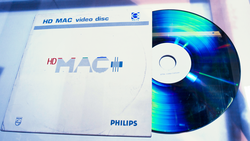
What Eureka 95 actually built was impressive and largely invisible. Cameras with 2.2 million pixel frame-transfer CCD sensors. Projection tubes throwing an image several meters wide in a public square. A consumer videocassette prototype in 1988 using metal tape in a VHS-sized shell, and a videodisc prototype that held twenty minutes a side on a 30 cm disc and ran for hours at Expo 92. Recording the raw signal at the start of the project required a one-inch reel-to-reel machine with eight video heads.
The BBC and Philips both built rigs that ganged four standard-definition digital recorders together to capture one HD stream, because the purpose-built recorder was always a year away. The archive tapes from those rigs are better than anything a viewer could have seen through an HD-MAC decoder, which is a small and permanent irony: the best surviving evidence of the format is footage that never went through it.
~ the postmortem ~
Council Directive 92/38/EEC of 11 May 1992 made HD-MAC the required standard for non-fully-digital high definition satellite transmission across the Community, and D2-MAC the required standard for widescreen below that. Brussels had decided that if the market would not converge, legislation would converge it. Then Council Decision 93/424/EEC of 22 July 1993 replaced that approach with an action plan promoting 16:9 widescreen without caring how it was delivered, which is the polite form of surrender.
The reasons were not mysterious. Spare UHF bandwidth was scarce, so terrestrial HD-MAC was never realistic and the format was confined to cable and satellite. Analog HDTV could not displace ordinary PAL and SECAM broadcasting, which meant a receiver bought you a handful of demonstration hours. The sets that could show the resolution properly had to be very large CRTs, and a very large CRT is furniture you need help moving. Directive 95/47/EC of 24 October 1995 repealed the 1992 directive outright. Eureka 95 development stopped in 1996.
~ what survived ~
Everything went to DVB, which is digital, which carries standard and high definition in the same framework, and which is what your television actually receives. The European institutions that had mandated an analog standard learned to specify a family of digital ones instead, and that second attempt worked so well it became the world default outside the Americas and Japan.
There is one odd inheritance. In 1993 Texas Instruments built a micromirror prototype at 2,048 by 1,152, a resolution chosen partly because it covered the European system, which happened to be the most demanding one anybody had specified. Digital cinema projectors still run at slightly wider-than-normal resolutions descended from that generation of chips. A standard that broadcast almost nothing to almost nobody left its fingerprint on the shape of the image in a movie theater.
~ leave a rose ~
an anonymous tribute. one rose per visitor per day.
@}-->-- ... roses left here
~ leave a wreath ~
a rose fades by morning. a wreath stays on this grave for good, with your name on it.
from $1, paid once through stripe. it keeps the graveyard running: the hosting and the nightly digging. adopt it and the headstone reads "maintained in memory by" you. the groundskeeper plants new wreaths at the next tending, usually within a day.
» one email a week: new graves and the anniversaries of the dead. subscribe
other media formats: People en Español (print), Stereo-Pak, Dark Horse Digital, Quadruplex Videotape
also died in the 1990s: EARN, American Laser Games, Pravetz
~ leave a note ~
visitors before you have left these graveside notes. anonymous welcome.