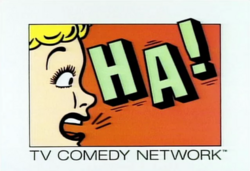
Ha!
~ the eulogy ~
Turkey got its first channel that was not the state broadcaster in 1990, uplinked from Germany because the state still held the broadcasting monopoly at home, and for a while an entire country watched a signal that had to be brought back in over a satellite. The American argument that year ran the other way. Two enormous media companies, each already operating more channels than the wire could carry, spent an estimated hundred million dollars between them on the question of which one got to own the comedy one.
HBO moved first. The Comedy Channel launched on 15 November 1989, the first 24-hour comedy service on cable, built out of stand-up clips and short segments cut in a style borrowed from music video. MTV Networks had been hearing from its own Nick at Nite research for years that a comedy format would work, and it put a rival together within weeks of HBO's announcement. Tom Freston bought fifteen years of Saturday Night Live reruns to anchor it and moved Nickelodeon's programming chief Debby Beece across to run originals. Ed Bennett was made president of the new channel while remaining president of VH-1.
Ha! went up at seven in the evening Eastern on 1 April 1990, and MTV Networks marked the date by putting the first four hours out simultaneously on the three channels it already owned. Somebody altered the Hollywood sign to read HA!llywood; the company told the trade press it had no idea who. The schedule underneath the stunt leaned on acquired network comedy rather than clips: complete ninety-minute Saturday Night Live reruns from seasons six through sixteen, SCTV, Mary Tyler Moore, Rhoda, Bob Newhart, Dick Van Dyke, Mork and Mindy, McHale's Navy and Car 54, Where Are You?.
It had a staff of 61. The Comedy Channel had fewer than 200, half of them pulled from inside HBO. Both of them were trying to sell a channel into an industry that had decided not to buy either.
~ the dossier ~
| Born | 1 April 1990, 7 p.m. Eastern, with commitments for eight million homes |
|---|---|
| Peak | About seven million subscribers, against a break-even of 25 to 30 million |
| Killed | 31 March 1991, with CTV taking the feed the next morning |
| Lifespan | 365 days |
| Made by | MTV Networks, owned by Viacom. 61 staff |
| Killed by | Cable operators who would not take sides, then a 50-50 merger |
~ peace in the valley ~
Ha! launched with 45 operators signed to some form of commitment, worth four million homes by the end of April and eight million within twelve months, a million of which came from Viacom's own cable systems. The Comedy Channel claimed six million homes and commitments for fifteen. Break-even for either of them was estimated at twenty-five to thirty million subscribers, and neither channel ever came within a factor of three of it.
The real figure was in the list of who had signed for neither. In April 1990 that was every one of the top ten operators without an ownership stake in one of the two channels: TCI, Continental, Comcast, Cox, Newhouse, Jones and Cablevision Systems, plus all but one Times Mirror system. John Malone of TCI put it plainly: nobody was going to put two comedy channels on a system, and what the industry needed was peace in the valley.
Viacom's workaround was to rent out half of a channel it already had. Operators could preempt VH-1 for twelve hours a day and run Ha! in the gap, for up to two years, after which VH-1 had to be restored to a full channel. The Ha! rate card was in single pennies per subscriber, and went up forty percent on systems where VH-1 was being preempted.
~ a list of a few hundred ~
The naming went badly enough that Fred Seibert wrote it down years afterwards. Every senior creative person at MTV Networks submitted candidates, the list reached a few hundred entries, and nobody could decide. The branding agency Fred/Alan was asked to supply something new, looked at the existing list instead, and pulled HA! off it. A trademark problem turned up at once, because HA was already Henson Associates, and Nickelodeon's Gerry Laybourne had to go and sort it out.
Fred/Alan's creative director Noel Frankel designed the mark: a comic-strip woman in mid-shriek, with three green block letters coming out of her mouth and TV COMEDY NETWORK set underneath in small capitals. The agency's house theory was that a television logo should be built with its motion already inside the composition rather than handed to a motion designer afterwards, and that any frame you froze from it should hold up as a printed graphic. It was on screen for twelve months.
The originals arrived in May. There was The Storytellers, London Underground, The Big Room, The Unnaturals, The Talent Pool, Open Audience, a British panel show called Whose Line Is It Anyway? that American television would spend another decade not knowing what to do with, and Clash!, an absurdist quiz in which nudists were set against fashion designers and librarians against noisy people, hosted by Billy Kimball with a theme by Carter Burwell. Fred Silverman, formerly president of NBC, was hired as a consultant. There were development deals with MTM and with Ron Howard's Imagine.
~ two gunslingers ~
Michael Fuchs of HBO and Frank Biondi of Viacom announced the merger at a joint press conference on 18 December 1990. No money changed hands, and it was a straight 50-50 venture. The two sides divided everything down the middle, to the point that half the press kits went out with Fuchs's photograph on top and half with Biondi's. No executive from either channel would run the merged one. A board of eight, four from each parent, hired Bob Kreek out of Fox Cable Programming instead.
The hostility behind it was real and expensive. Viacom had sued HBO's corporate parent for $2.4 billion in 1988 over the treatment of Showtime, and the case was still live on the day they shook hands. Earlier talks had collapsed on Viacom demanding management control and Time Warner demanding the lawsuit be folded into the deal. Biondi said both sides dropped those demands. Fuchs put it his own way: they had sat down and said this is crazy, they were like two gunslingers who ran out of bullets.
The money behind the surrender was mostly HBO's, because HBO is the only side that published a number. Fuchs said in March 1991 that the Comedy Channel had lost thirty-some-odd million dollars in 1990 alone, financed internally, and that HBO had still beaten its budget that year with the losses included. Larry Gerbrandt at Paul Kagan Associates put the combined outlay at about a hundred million dollars and said a comedy channel was a slam dunk while two of them were probably a technical foul. Fuchs, asked about taking half of something instead of all of it, said he would rather have half the profit of a company than all of an unprofitable venture.
~ what it turned into ~
The merged service was called Comedy TV at the announcement and was expected around 1 March 1991. The assets were scheduled to transfer on 1 January while both channels kept broadcasting, and the thing that actually launched on 1 April 1991 was named CTV: The Comedy Network, a year to the day after Ha! had started. Ha!'s last day was 31 March. The new name lasted nine weeks. Effective 1 June the channel became Comedy Central, and the reason its own spokesman gave was that CTV: The Comedy Network was cumbersome and did not roll off the tongue, with the Canadian broadcaster of the same initials a secondary concern that had expressed some unease without ever threatening to sue.
The venture then ran as Comedy Partners for twelve years, until Viacom bought out the other half in 2003. That credit still rolls at the end of shows the channel produces, several corporate owners later. The trademark on HA! The TV Comedy Network was canceled on 15 February 1999 for failure to file. The name itself survives in exactly one place, which is the ownership line on Comedy Central's trademark filings, where one of the two partners is still recorded as Viacom Hearty Ha! Ha!, LLC, a Delaware limited liability company holding a stake in a channel nobody has called that in thirty-five years.
~ leave a rose ~
an anonymous tribute. one rose per visitor per day.
@}-->-- ... roses left here
~ leave a wreath ~
a rose fades by morning. a wreath stays on this grave for good, with your name on it.
paid once through stripe. payments are handled by OÜ Lakeview, the small company that keeps rip.so running. the money pays for the hosting and the nightly digging. adopt it and the headstone reads "maintained in memory by" you. the groundskeeper plants new wreaths at the next tending, usually within a day.
» one email a week: new graves and the anniversaries of the dead. subscribe
other streaming: Vía Digital, GolfTV, CTH, TBS OnDemand
also died in the 1990s: ValuJet Airlines, The Fourth Dimension, Boston CitiNet
~ leave a note ~
visitors before you have left these graveside notes. anonymous welcome.