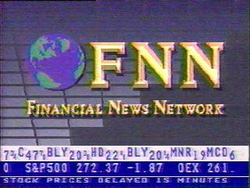
Financial News Network
~ the obituary ~
It went on the air on 30 November 1981 out of Santa Monica, with thirteen stations carrying seven hours a day. The founder was Glen H. Taylor, a former minister who had been making films for the California education department, and the idea he was selling was narrow enough to sound like a joke: put the stock market on television all day, prices crawling across the foot of the screen, and give it away to anyone with cable. Merrill Lynch was an early investor. Within a year Taylor was out, and the private money behind it came from a firm then called Biotech Capital, which would rename itself Infotechnology and put Earl Brian in charge.
It worked. On 1 April 1985 the schedule went to twenty-four hours a day, seven days a week. By 1990 the network claimed about 35 million households across 3,500 cable systems, a reach few things on American cable could match, and it employed 325 people, 190 of them in the Los Angeles studio. Reported revenue for the year ending June 1989 was $44.5 million against a net income of $3 million. Both of those numbers were wrong.
On 1 October 1990 the company announced it was in dispute with its auditors and yanked its own stock off the trading floor for several hours. The argument was about $28 million of start-up costs for a broker terminal product that the network wanted to treat as an asset and Deloitte wanted treated as a loss. Deloitte resigned that month and withdrew its previous opinions. Brian was removed as chief executive on 24 October. The loss for that fiscal year came in around $72.5 million, and what the SEC eventually described, in a complaint filed in 1993, was years of invented revenue. Equipment was sold and leased back in circles through a sister company, with fabricated serial-number lists shown to the auditors, and $17 million sat in a shell company in the British Virgin Islands. Quarterly pretax income had been overstated by as much as 483 percent.
Chapter 11 followed on 1 March 1991, filed in bankruptcy court in Manhattan. The network was by then worth more dead than alive to exactly one buyer, and after two months of courtroom bidding it went to CNBC for $154.3 million. The last day of programming was 21 May 1991. The feed was cut at 12:01 in the morning on the 22nd, and at six that same morning the channel came back as CNBC/FNN Daytime. Around 60 of the 325 employees were kept.
~ the case file ~
| Born | 30 November 1981, seven hours a day, five days a week |
|---|---|
| Peak | about 35 million cable households on 3,500 systems, and 325 staff |
| Killed | 21 May 1991, with the feed cut at 12:01am the following morning |
| Lifespan | 9 years and 172 days |
| Made by | Glen H. Taylor, with control later passing to Earl Brian's Infotechnology |
| Killed by | a $72.5 million loss year and a bankruptcy auction CNBC won at $154.3 million |
~ the crawl ~
Everything rested on the ticker, and the ticker was held together with string. Computers of the period could not ingest a full exchange feed and push it to a broadcast graphic, so the crawl carried a hand-chosen list of stocks, updated by people, running fifteen minutes behind the actual exchange. The delay was printed on screen. Somebody wrote MS-DOS software called LiveWire Professional whose only purpose was to read the numbers back off a television picture and turn them into a machine-readable file.
Ron Insana, who was there, has described what the rest of it looked like from the inside. There was no money for crews, so most interviews were phone calls covered with graphics. The stock footage of the exchange floor was reused so long that somebody from the NYSE called in to point out that a man visible in the shot had been dead for two years. Graphics failed live and the set computer vanished mid-broadcast, sometimes both together with five minutes left to fill.
None of that mattered to the thing it actually changed. Before this channel, a live quote was something you paid a broker for. Afterwards it was a thing in the corner of your living room, free, running whether you were watching or not. Insana calls it the opening move in making financial information public property, and he is right even though the numbers on the screen were a quarter of an hour stale and picked by hand.
~ three months in a bankruptcy court ~
The sale is the best-documented part of the story because the appeals went to the Second Circuit and the opinions survive. On 11 February 1991 the network agreed in principle to sell its media assets to Dow Jones and Group W for $90 million. On 22 February CNBC came over the top at $105 million with a Monday night deadline, and the board took it on the 25th. Then the Chapter 11 filing put the whole thing in front of a judge, who ordered an auction where any rival had to beat CNBC by $10 million.
Dow Jones bid $115 million, refused to hold the bid open as long as CNBC had, and was disqualified on 3 April. CNBC raised itself to $115 million unopposed and won on 16 April. The district court reversed that the next day and sent it back for a real contest. At the second auction on 7 May the Dow Jones side bid a headline $167.1 million, except that $25 million of it was a share of future revenue nobody guaranteed, and on the court's own arithmetic the comparable cash was lower than CNBC's. When Dow's banker offered to buy that revenue stream for cash the following day, the judge treated it as evidence of value rather than a new bid, reopened the floor one last time, and CNBC added $5 million.
The written order came on 10 May: $145 million in cash plus $9.3 million of assumed liabilities, with a share of any combined revenue above $227 million on top. Antitrust suits followed within the week from Dow Jones and from a bloc of states led by Illinois and Pennsylvania, and went nowhere. Dow Jones gave up around 14 May. A network reaching 35 million homes had been bought by a competitor reaching 17 million, because the larger one was insolvent and the smaller one was the only bidder left in the room.
~ what the buyer kept ~
CNBC took the subscribers and the ticker. Two days after the merger the trade press noted that the new channel had already replaced its own stock crawl with FNN's, and had integrated the on-air staff into its format, roughly 98 percent done by the second day. Mark Haines and Neil Cavuto are both in the first CNBC/FNN Daytime staff photograph. Most of the staff who were not kept were laid off, and a lot of them turned up three years later launching Bloomberg Television, which went out on the channel space FNN used to occupy.
The sports channel is the detail that sticks. It launched on 1 April 1985 as Score, to fill the overnight hours once the schedule went round the clock, and was renamed FNN: Sports in September 1989. It carried pro wrestling and a nightly call-in trivia show whose signature prize was a vacuum cleaner. It was profitable in the year the parent lost seventy-two million dollars. CNBC closed it on 19 May 1991, two days before the parent went dark, because it wanted the weekend hours for talk.
This one reached me late and sideways. The network that absorbed FNN arrived in Turkey on 16 October 2000 as CNBC-e, a joint venture with Doğuş, and for most people I knew it was not a business channel at all: it ran the markets by day and subtitled American series in the evening, which is what my generation actually watched it for. So the first version of this format I ever saw was nine years downstream of the company that invented it and on another continent, with the ticker still running along the bottom, still a habit nobody questioned, and by then no longer fifteen minutes late.
~ leave a rose ~
an anonymous tribute. one rose per visitor per day.
@}-->-- ... roses left here
~ leave a wreath ~
a rose fades by morning. a wreath stays on this grave for good, with your name on it.
paid once through stripe. payments are handled by OÜ Lakeview, the small company that keeps rip.so running. the money pays for the hosting and the nightly digging. adopt it and the headstone reads "maintained in memory by" you. the groundskeeper plants new wreaths at the next tending, usually within a day.
» one email a week: new graves and the anniversaries of the dead. subscribe
other news: Gigwise, Areamobile.de, Bajtek, TGcom
also died in the 1990s: La Cinq, World Wide Web Worm, BITNET Relay
~ leave a note ~
visitors before you have left these graveside notes. anonymous welcome.