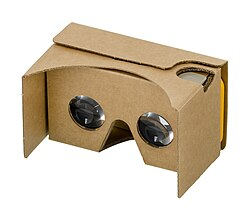
Google Cardboard
» see vr.google.com/cardboard as it lived, on the wayback machine
~ the obituary ~
cardboard was the cheapest piece of vr hardware most of us ever held. it was a flat folded piece of cardboard with two plastic biconvex lenses and a magnetic clicker on the side for input. a strip of velcro held the front flap shut. you slid an android phone into the slot and started the cardboard app. then you stuck the whole thing on your face like a child's mask.
the launch was 25 june '14 at google i/o, where every attendee got one in their swag bag as a small joke. david coz and damien henry built it during a 20-percent project at the google cultural institute in paris (the same paris office that ran the museum-scanning work). by the time the public version shipped, google had a working sdk for both android and ios. i remember the cardboard app being preinstalled on android phones in the 2015-2017 stretch.
i tried it at some point. memory is fuzzy on the exact context, probably an event giveaway or a colleague's desk. it did the thing it promised. the 3d effect actually worked, and the youtube vr app was just functional enough to watch a 360 video without throwing up. five minutes was about the limit before the lenses fogged up or the phone overheated. anyway, the magnetic clicker was the part that felt the cleverest, since it tricked any phone's magnetometer into registering a tap without bluetooth pairing.
google's design call was that you should not have to manufacture cardboard at all. the schematics were free. you could print and fold your own from a pdf or buy a branded version from google for $15. promotional ones came off the back of coca-cola and pizza hut boxes that year. by mid '17 over 160 million cardboard-enabled apps had been downloaded across the play store and the app store.
the slow death started in 2019. google opened the sdk on github and stopped active development. on 3 march '21 the google store quietly dropped the cardboard listing, ending the last channel where google itself sold the viewer. third-party clones kept shipping. the actual cardboard schematic is still online for free in 2026.
~ the case file ~
| Born | 2014-06-25 (Google I/O reveal) |
|---|---|
| Peak | by november 2019 over 15 million viewer units had shipped |
| Killed | 2021-03-03 |
| Lifespan | 6 years 8 months |
| Made by | Google (David Coz and Damien Henry at the Cultural Institute Paris) |
| Killed by | open-sourced in 2019 then walked away from |
~ how it worked ~
the optics were the entire engineering trick. two biconvex lenses at the right focal distance turned a side-by-side stereo render on a 5-inch phone display into a 90-degree field-of-view stereoscopic image. the app on the phone read the gyro and accelerometer to translate head movement into camera rotation. anyway, no positional tracking and no external sensors of any kind.
the magnetic clicker was the only input. you pulled a small magnetic ring on the side of the viewer, and the phone's magnetometer registered the field change as a single tap. that was enough for most apps, which mapped the click to "select the thing you are currently looking at". the original kit had a real magnet for this, later versions used a small capacitive lever that touched the phone screen instead.
~ the long good run ~
cardboard had the longest life of any consumer vr platform up to that point. it ran for six years and eight months from launch to the end of google-sold units, which is more than the oculus rift cv1 lifespan (2016-2019) and more than samsung gear vr (2014-2020). daydream itself (in inventory as google-daydream) only made it to three years. the difference was that cardboard had effectively no marginal cost. once google had shipped the sdk and the original schematic, the platform ran itself on third-party kits forever.
the most-distributed cardboard variant was probably the new york times' "the displaced" giveaway in november '15, which mailed roughly a million cardboard viewers to home subscribers as a one-time print-edition insert. that was the first time most americans had vr hardware in their hands. the times kept producing cardboard-formatted documentaries for several more years before giving up on the format.
~ what carried over ~
the sdk is still on github under an mit license, and a small community of hobbyists keeps cardboard-app builds working on modern android. the platform is fully dead inside google, in the sense that no google team is paid to maintain it. the last cardboard app review on the play store in 2026 mentions the app crashes on android 14.
cardboard's real legacy is the population of people who got their first vr session through it. that population was the audience the oculus quest line eventually monetized, after meta bought oculus and folded the standalone-headset vision into facebook. cardboard had given them the demo. quest delivered the upgrade path. the in-between option of phone-powered vr (daydream and gear vr) died inside a two-year window in 2019-2021. cardboard outlived them all by being too cheap to officially shut down.
~ leave a rose ~
an anonymous tribute. one rose per visitor per day.
@}-->-- ... roses left here
~ leave a wreath ~
a rose fades by morning. a wreath stays on this grave for good, with your name on it.
from $1, paid once through stripe. it keeps the graveyard running: the hosting and the nightly digging. adopt it and the headstone reads "maintained in memory by" you. the groundskeeper plants new wreaths at the next tending, usually within a day.
» one email a week: new graves and the anniversaries of the dead. subscribe
other gadgets: Itanium, Basis Peak, Palm Treo, Fitbit Force
also died in the 2020s: Ekiga, YouTube Leanback, Itanium
~ leave a note ~
visitors before you have left these graveside notes. anonymous welcome.