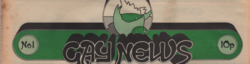
Gay News
~ the obituary ~
Sex between men over 21 had been partially decriminalized in England and Wales in 1967, the Gay Liberation Front reached London from New York in 1970, and by 1972 there was a movement with no paper. Gay News was the answer, put together by former GLF people and members of the Campaign for Homosexual Equality. The editorial collective on the first issue runs to seven names, with Richard Adams on design and Denis Lemon as editor. Below them is a list headed GAY NEWS SPECIAL FRIENDS, and among the fourteen names on it is Graham Chapman of Monty Python.
The artifact is unambiguous about how small it started. Twelve pages. Ten pence. "Gay News is published fortnightly by Gay News Limited, 19 London Street, London W2 1HL. Telephone 01-402 7805", printed by F.I.Litho Limited of 182 Pentonville Road. The contents list is one line per section and fits in a column: Speakeasy on page 3, Scotland on page 5, V.D. & Gays on page 8, Heterosexual of the Month on page 9, Personal Ads on page 11.
Those personal ads were illegal, or at least the paper had every reason to think so. One of the cover lines on issue one reports that International Times had just lost its appeal over running gay contact ads, a case that went to the House of Lords and held that such an arrangement could amount to a conspiracy to corrupt public morals. Gay News read that result and printed contact ads anyway, under a standing headline: "Love knoweth no laws."
It also got its editor arrested inside the first year, though not for that. Lemon was charged and fined for obstruction after photographing how police were behaving outside the Coleherne, the leather pub in Earls Court. In 1974 the paper was prosecuted for obscenity over a cover photograph of two men kissing, and won. Alison Hennegan, who came in as literary editor in 1977, later described the paper as the movement's debating chamber, which undersells the service desk it also ran: in September 1973 Gay News noticed how many information calls it was fielding and put out a call for somebody to organize a switchboard. The London Gay Switchboard opened six months later, on 4 March 1974, and still operates.
~ the case file ~
| Born | June 1972 in London, twelve pages at ten pence, published fortnightly by Gay News Limited |
|---|---|
| Peak | around 18,000 to 19,000 copies a fortnight, 52 pages, £450,000 turnover, 23 staff |
| Killed | 15 April 1983, when Gay News Ltd ceased trading |
| Lifespan | 10 years and 10 months |
| Made by | a collective out of the Gay Liberation Front and the Campaign for Homosexual Equality, with Denis Lemon as editor |
| Killed by | an ownership fight, not the blasphemy conviction |
~ Whitehouse v Lemon ~
The issue dated 3 June 1976 carried a poem by James Kirkup, "The Love that Dares to Speak its Name", written from the point of view of a Roman centurion at the crucifixion, with an illustration. Mary Whitehouse got hold of it that November and was granted leave on 9 December 1976 to bring a private prosecution for blasphemous libel against Gay News Ltd and against Denis Lemon by name. The indictment called it "a blasphemous libel concerning the Christian religion, namely an obscene poem and illustration vilifying Christ in his life and in his crucifixion". It is the last successful blasphemy prosecution Britain has had.
The trial opened at the Old Bailey on 4 July 1977 before Judge Alan King-Hamilton, with John Mortimer and Geoffrey Robertson defending. The jury convicted both defendants on Monday 11 July. The company was fined £1,000 and Lemon £500 with nine months' imprisonment suspended, the judge remarking that it had been touch and go whether he sent him to prison. Whitehouse's costs of £7,763 were split four-fifths against the company and one-fifth against Lemon personally.
The Court of Appeal quashed the suspended sentence on 17 March 1978 and left the conviction standing. Gay News readers voted by twenty to one to go to the Lords, who heard it and ruled on 21 February 1979 by three to two that blasphemous libel required no intention to blaspheme at all. Lord Scarman went further and argued the protection should extend to every religion rather than Christianity alone. That holding was English law until the offense was abolished in May 2008.
The Gay News Fighting Fund, opened in December 1976, raised £26,435 in benefits and donations, which covered the trial and both appeals with room to spare. One of the donations was £500 from Monty Python. Graham Chapman had been on the first issue's list of special friends five years earlier, when the paper was twelve pages long.
~ the W. H. Smith years ~
Courts were the loud problem. Distribution was the one that could actually have finished the paper. W. H. Smith controlled roughly a third of newspaper and magazine distribution in Britain through a subsidiary, and when Gay News first asked to be carried the answer was that it would not sell. In July 1975, with the readership grown, Smith agreed to take it on its London bookstalls. In January 1978 it dropped the paper after a row about Gay News coverage of the Paedophile Information Exchange, a decision that produced pickets outside branches and a scene at the company's annual general meeting. In 1982 Smith took it back, on the stated grounds that about 20,000 copies an issue now made it commercially worth stocking. Ten years of argument over whether the paper was fit to be sold, and the thing that moved Smith in the end was the circulation figure.
~ the share deal ~
During a cash crisis in 1973, Lemon had been allocated 46 of the company's 100 shares, with 33 of them said to be conditional on his staying editor. In 1979 he was allowed to buy another 49 and the condition was dropped. A paper founded by a collective was now owned by one man, and in February 1982 that man sold the lot to Robert Palmer.
A £10,000 installment on the deal fell due on 31 December 1982 and was not paid. In the February that followed, Lemon announced a fresh arrangement with Palmer on undisclosed terms, one leaked detail of which was that he would return as editor-in-chief. The staff objected publicly. Five days later Palmer said Lemon was not editor-in-chief but a consultant to a company of his own, and on Monday 7 February the appointment was withdrawn entirely. On Friday 11 February the staff's agents wrote to both men proposing to buy the paper into community ownership, and the paper printed their statement the following week. The intention was a form of ownership in which staff controlled editorial and commercial policy, with distribution of profits to individuals prevented outright. They were not seeking to buy the paper for their own profit, the statement said, "other than our wages", and they wanted it to end up "the communal possession of gay people". It came to nothing.
Gay News Ltd ceased trading on 15 April 1983, ten years and ten months after the first issue, two months short of its eleventh birthday. The title was sold on to Nigel Ostrer, who published two issues as New Gay News, then to Millivres, which folded it into Gay Times. For years afterward the masthead read Gay Times incorporating Gay News.
~ the locomotive ~
On 21 May 1983, five weeks after the company stopped trading, Britain held its first open conference on HIV and AIDS, convened by Gay News with Switchboard and the Health Education Council. Mel Rosen of Gay Men's Health Crisis in New York told the room he hoped they got very scared that day, because there was a locomotive coming down the tracks and it was leaving the United States.
The paper that had organized the conference no longer existed. The epidemic it was about would define the next decade of British gay life, and the publication best placed to report it had been wound up over an unpaid installment five weeks earlier. Two of its news staff had already left to start Capital Gay in June 1981, and that is the paper that ended up covering it.
~ leave a rose ~
an anonymous tribute. one rose per visitor per day.
@}-->-- ... roses left here
~ leave a wreath ~
a rose fades by morning. a wreath stays on this grave for good, with your name on it.
paid once through stripe. payments are handled by OÜ Lakeview, the small company that keeps rip.so running. the money pays for the hosting and the nightly digging. adopt it and the headstone reads "maintained in memory by" you. the groundskeeper plants new wreaths at the next tending, usually within a day.
» one email a week: new graves and the anniversaries of the dead. subscribe
other news: The Word, PC Leisure, Rocky Mountain Independent, Examiner.com
also died in the 1980s: Piranha Software, The Source, Sord M5
~ leave a note ~
visitors before you have left these graveside notes. anonymous welcome.