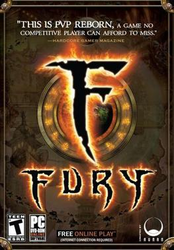
Fury
~ the eulogy ~
The whole thing fits inside ten months. Fury went on sale as a boxed retail product on 16 October 2007, and by the middle of December it had stopped charging for itself, its developer had let every employee go and the company was in voluntary administration. The servers stayed up for another eight months out of something closer to stubbornness than commerce, and then they went too.
Auran was a Brisbane studio founded in 1995 by Greg Lane and Graham Edelsten, and it had a genuine track record. Dark Reign in 1997 was a real-time strategy game people took seriously, and the Trainz series had built a small, devoted, permanent audience of the sort most developers never get. Fury was the swing at something much larger, published by Gamecock Media Group as its first title.
The design argument was sharp and, on paper, correct. Every MMO of that era buried its player-versus-player content behind dozens of hours of solo grinding, so Fury removed the grinding. There was no world to walk across and nothing to level through, only arenas. Combat ran on instant-cast spells without cooldowns, so a fight moved at the speed of a fighting game rather than a spreadsheet. The box carried a quote from Hardcore Gamer Magazine calling it PvP reborn.
In October 2007 I was twenty-three and finishing up the university years, and multiplayer in Turkey meant Counter-Strike in an internet cafe or a free private server somebody was running out of a rack. A boxed western MMO with a monthly charge on an international card was not a thing that circulated there. Fury would have had to reach me through a shelf that did not stock it and a payment method most of its potential players did not have.
~ the dossier ~
| Born | 16 october 2007, boxed at retail |
|---|---|
| Peak | a reported $13.2 million spent and a launch week in october 2007 |
| Killed | 7 august 2008, 48 hours after the announcement |
| Lifespan | ten months |
| Made by | Auran, Brisbane, published by Gamecock Media Group |
| Killed by | no viable business model, in the chief executive's own words |
~ the origin ~
It never really had one. The reviews landed at 55 on Metacritic and 53.65 percent on GameRankings, and the complaints were about execution rather than concept. GameSpot went after the poorly optimized engine and the chaos of the fights. IGN counted the skills nobody would ever use and said there was not enough game there to keep anyone past the first weeks.
Auran's response in December 2007 was to overhaul the business model in public. Fury became free to download and free to play, with an optional one-time retail fee or a monthly Immortal status for the players who wanted more. Anyone who had already paid was given Immortal for life, which was generous and which also quietly admitted that the original price had been a mistake. That same week the studio announced it had laid off all its employees, and on 17 December it entered voluntary administration with a small team kept back to continue Trainz.
~ the actual end ~
On 5 August 2008, Auran chief executive Tony Hilliam posted that the company could not find a viable business model. "We have reached our time limit to find a solution that would help us keep the Fury servers open. Sadly, no solution has been found." The servers and the website came down within forty-eight hours, which put the end on 7 August, ten months minus nine days from the retail launch.
The lesson underneath it is one that a PvP-only game cannot buy its way out of. A world-based MMO with a thin population is quiet. An arena game with a thin population has nothing in it at all, because the content is the other players, and every week of falling numbers makes the next week worse. Fury needed a crowd on day one and priced itself so that only the committed showed up. Trainz outlived it and is still being made, now by N3V Games, which means the studio's small permanent audience turned out to be worth more than its big swing.
~ leave a rose ~
an anonymous tribute. one rose per visitor per day.
@}-->-- ... roses left here
~ leave a wreath ~
a rose fades by morning. a wreath stays on this grave for good, with your name on it.
from $1, paid once through stripe. it keeps the graveyard running: the hosting and the nightly digging. adopt it and the headstone reads "maintained in memory by" you. the groundskeeper plants new wreaths at the next tending, usually within a day.
» one email a week: new graves and the anniversaries of the dead. subscribe
other gaming: PlayNET, Project Spark, Supervive, Chromehounds
also died in the 2000s: Builder.com, LinkExchange, Microsoft Fingerprint Reader
~ leave a note ~
visitors before you have left these graveside notes. anonymous welcome.