FingerWorks
» see fingerworks.com as it lived, on the wayback machine
~ the goodbye ~
FingerWorks started in 1998 in Newark, Delaware, as a company with two employees who were also its entire research department. Wayne Westerman was a doctoral student with a repetitive strain injury bad enough that typing was a problem he had to solve rather than an inconvenience he could work around. John Elias was a professor in his department. The dissertation Westerman finished in 1999 was about tracking a whole hand on a touch surface, identifying which finger was which, and treating combinations of them as commands.
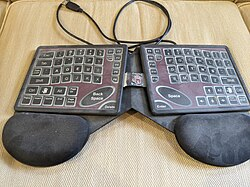
The products were the dissertation with a price tag. The TouchStream keyboards were flat slabs of sensing surface, split into two halves for the shoulders, with a printed key layout and no keys: you rested your hands on glass-smooth plastic and typed without any travel at all. Sliding four fingers scrolled. Pinching two together did what pinching two together does on every phone made since. A separate line called iGesture sold the pad on its own for people who wanted the gestures without giving up their keyboard.
It was never a consumer product and it was never sold anywhere near me. A $339 input device shipped from Delaware to a customer base defined by chronic pain is about as narrow as hardware gets, and in 2003 that was several months of a Turkish student's budget for a keyboard nobody in the country had heard of. What makes this one worth a grave is not that anyone here used it. It is that almost everyone here ended up using it, one layer down and under someone else's logo.
~ the chronicle ~
| Born | 1998 in Newark, Delaware, out of a University of Delaware doctoral project |
|---|---|
| Peak | the TouchStream keyboard line, $339 and a cult following among RSI sufferers |
| Killed | june 2005, when the company announced it was no longer in business |
| Lifespan | seven years |
| Made by | Wayne Westerman and John Elias |
| Killed by | Apple, which wanted the patents and the two people who wrote them |
~ how it landed ~
The people it worked for loved it with an intensity you rarely see in peripherals. Reviews from the RSI community read like recovery stories. The people it did not work for returned it in large numbers, because typing on a hard flat surface with no feedback is uncomfortable for most hands over a long day, and FingerWorks was honest enough about this to say publicly that the products suited heavy mousing better than heavy typing.
That is a hard business. The addressable market is people already injured, the return rate on everyone else is punishing, and the manufacturing volume is never high enough to bring the unit cost down. Seven years in, the company had a patent portfolio worth more than its sales.
~ what it became ~
Apple acquired the assets in early 2005, quietly, with Westerman and Elias coming along. In june 2005 FingerWorks announced it was no longer in business and the keyboards stopped. The iPhone was demonstrated in january 2007 with a screen you could pinch, and the multitouch trackpads followed across the Mac line.
Westerman kept filing patents at Apple for years, and his name sits on a large stack of them. When the iPad was coming, Apple took fingerworks.com offline entirely, which is its own kind of acknowledgment. There is a version of this story where a small hardware company gets bought and disappears into a big one and nothing survives. This is the other version, where the product disappears and the idea ends up in a billion pockets.
~ the long tail ~
The used market did something strange after the shutdown. TouchStream keyboards, which cost $339 new, were changing hands for well over $1,500 by 2007, because the users who depended on them had no replacement and knew it. Nobody built a successor. The patents were inside Apple, which was using them for a phone rather than for accessibility hardware, and no competitor wanted the fight.
The Victoria and Albert Museum has a TouchStream LP in its collection now, filed as design history. That is the correct place for it, but it also means the people who needed one after 2005 had to go looking on auction sites for a discontinued product, at four times the original price, with no warranty and no support, for the ability to work without pain.
~ leave a rose ~
an anonymous tribute. one rose per visitor per day.
@}-->-- ... roses left here
~ leave a wreath ~
a rose fades by morning. a wreath stays on this grave for good, with your name on it.
from $1, paid once through stripe. it keeps the graveyard running: the hosting and the nightly digging. adopt it and the headstone reads "maintained in memory by" you. the groundskeeper plants new wreaths at the next tending, usually within a day.
» one email a week: new graves and the anniversaries of the dead. subscribe
other gadgets: OQO, Compaq iPAQ, Magic Leap One, Microsoft SPOT Watch
also died in the 2000s: MSN Groups, OQO, iFilm
~ leave a note ~
visitors before you have left these graveside notes. anonymous welcome.