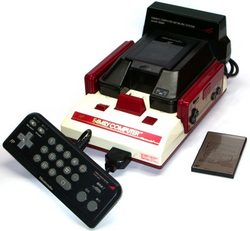
Family Computer Network System
~ the obituary ~
In September 1988 I was four years old, and a household telephone line in Turkey was something you applied for and then waited on. Using one to move money through a games console was not merely absent from where I lived. There was no surface for the idea to attach to.
In July 1987 Hiroshi Yamauchi told Masayuki Uemura, the engineer who had designed the Famicom itself, to build a service that would put live share prices on a television set and let people trade through it, working with Nomura Securities. The hardware arrived in September 1988. It was a modem unit the console sat on, with a numeric keypad for entering figures and a slot for the software card.
What ran on it was a small commercial network rather than anything to do with games. Nomura was later joined by Daiwa and Nikko. There was a banking service and a weather feed. There was also a database of game reviews sold to retailers, called Super Mario Club. Nintendo shipped 130,000 units across the life of the product. Brokerage use settled somewhere between fifteen and twenty thousand accounts, banking at around fourteen thousand, which are small numbers for Japan in 1988 and nowhere near what the plan needed.
The exception was gambling. Betting on horse races through the Japan Racing Association reached about 100,000 units and roughly 35 percent of the country's online betting, which is the only figure on the whole project that looks like a win. Everything else was competing against a telephone and losing. In 1991 the modem was discontinued and the services closed, and Uemura said afterward that this experience is what pushed Nintendo toward satellite broadcasting instead.
~ the case file ~
| Born | September 1988, in Japan and nowhere else |
|---|---|
| Peak | 100,000 units on horse betting, about 35 percent of japan's online betting |
| Killed | 1991 |
| Lifespan | three years |
| Made by | Nintendo, with Nomura Securities |
| Killed by | a telephone call to a broker being easier |
~ what yamauchi wanted ~
The strategic idea was sound enough that people are still trying it. By 1988 Nintendo had more boxes plugged into Japanese living-room televisions than any computer company had machines anywhere in the country. An install base that size is a terminal network that has already been paid for. All that was missing was a modem and a reason.
The reason is where it fell apart. A console gets bought for one purpose, and the second purpose has to beat whatever people are already doing. Nobody in 1988 found stock orders through a Famicom better than picking up a phone and saying the order out loud to a person who then confirmed it. The console offered no advantage over the telephone except that it was already in the house.
~ the horses ~
Betting was different, and the difference explains the whole product. Placing a bet meant getting to a place that took bets before it stopped taking them. The alternative to the console was not a phone call, it was a queue somewhere with a closing time attached to it.
So the numbers went where the inconvenience was worst. A third of Japan's online betting ran through a games console for a while, on a service most people remember as a curiosity. Money moves onto a network when the offline version of the same act is physically annoying, and it stays put when the offline version is fine.
~ super mario club ~
The last service standing was the one aimed at businesses. Super Mario Club was a review database for retailers, used by around three thousand shops, so a manager could look up whether a title was worth ordering. When the consumer side closed in 1991 this one kept running as the final application on the network.
That ordering is worth noticing. The service built for households died first, and the boring back-office tool sold to shops outlasted it, because a shop will pay for a thing that saves it money on stock and a household will not pay for a thing that saves it a phone call.
~ the line to the satellaview ~
Uemura's own account draws the line directly: the experience with the Famicom modem is what took Nintendo into satellite data broadcasting in April 1995. That became the Satellaview, which pushed data down to a Super Famicom over a radio signal instead of asking a household to dial anything.
Read as a first attempt rather than a failure, it holds up. Nintendo tried a dial-up console network seven years before anyone in Turkey had a modem in the house, learned that the hard part was not the hardware, and spent the next fifteen years failing at the same thing in different ways until Wi-Fi made the dialing invisible.
~ leave a rose ~
an anonymous tribute. one rose per visitor per day.
@}-->-- ... roses left here
~ leave a wreath ~
a rose fades by morning. a wreath stays on this grave for good, with your name on it.
from $1, paid once through stripe. it keeps the graveyard running: the hosting and the nightly digging. adopt it and the headstone reads "maintained in memory by" you. the groundskeeper plants new wreaths at the next tending, usually within a day.
» one email a week: new graves and the anniversaries of the dead. subscribe
other online services: TerraServer.com, HopStop, Elance, Google Flu Trends
also died in the 1990s: Ionica, Ferranti, JumpStation
~ leave a note ~
visitors before you have left these graveside notes. anonymous welcome.