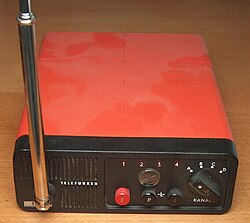
Eurosignal
~ the eulogy ~
The German transmitters were switched off on 1 april 1998, which is roughly the season I first got a modem working at home in Turkey. So the entire life of this thing happened while I was not online yet, in countries I had not been to, on a frequency band that Turkish subscribers were never offered. I know it the way you know a piece of plumbing under a city you have visited twice.
Eurosignal was a paging service run by the state post offices, starting in West Germany in 1974, France in 1975 and Switzerland in 1985. It broadcast on four channels sitting between 87.340 and 87.415 MHz, which is to say just under the bottom of the FM dial, so anyone with a normal radio and a little patience could tune to the edge and listen to other people's calls arriving as tones. That was not a leak. There was nothing in the transmission to leak.
A receiver could be assigned up to four call numbers. Someone dialed one of them, your unit beeped in the pattern matched to that number, and the entire content of the message was which of the four had gone off. What each one meant was arranged between two people beforehand, usually something like call the office or come home now. The network moved the fact of a call. Everything else lived in a private agreement that no equipment anywhere knew about.
~ the dossier ~
| Born | 1974, Deutsche Bundespost, West Germany |
|---|---|
| Peak | about 230,000 German subscribers in 1994 |
| Killed | 1 april 1998 in Germany |
| Lifespan | twenty four years |
| Made by | the European post and telecom administrations |
| Killed by | GSM handsets that could carry text |
~ how you were found ~
Coverage was national, which sounds simple until you look at how it was actually done. By 1989 Germany had been split into three broadcast zones, and the caller needed to know which one you were in before dialing, because a page sent to the wrong zone simply did not reach you. France ran across all four channels while Switzerland got by with one.
The cost argument was the pitch. Running a subscription came in at a small fraction of what a phone line cost, and the coverage of the transmitter network was wider than the FM stations sharing the band. For a doctor on call or a service engineer in a van, that was the whole product for two decades.
~ the numbers going the wrong way ~
West Germany finished 1982 with about 55,000 subscribers. By 1994 the figure was near 230,000, which is the high water mark. On 1 september 1997 there were roughly 90,000 left. The collapse took three years and it had one cause: a GSM phone in the same pocket could take the same page with a sentence attached to it, and then let you answer.
France and Switzerland stopped transmitting on 31 december 1997. Germany held on for one more quarter and closed on 1 april 1998, after twenty four years. Nobody staged anything. The tones at the edge of the FM band stopped and the band got quieter.
~ the long tail ~
German paging did not die with Eurosignal. Cityruf arrived from the Bundespost in march 1989 with actual numeric and text messages, and consumer brands like Scall and Quix filled the late 1990s with cheap pagers aimed at teenagers. They were killed by the same phone. Quix closed at the end of 2000 and TeLMI followed in january 2001, both inside three years of Eurosignal.
What survived is the shape rather than the service. A push notification on a lock screen is the same transaction, one bit of attention pulled from you by somebody who is not in the room. Eurosignal did it with an agreed beep and no way to reply, which made the caller decide in advance what was worth interrupting a person for.
~ leave a rose ~
an anonymous tribute. one rose per visitor per day.
@}-->-- ... roses left here
~ leave a wreath ~
a rose fades by morning. a wreath stays on this grave for good, with your name on it.
from $1, paid once through stripe. it keeps the graveyard running: the hosting and the nightly digging. adopt it and the headstone reads "maintained in memory by" you. the groundskeeper plants new wreaths at the next tending, usually within a day.
» one email a week: new graves and the anniversaries of the dead. subscribe
other connectivity: Spectrum Information Technologies, ihug, Unicel, mMode
also died in the 1990s: dBASE (Ashton-Tate), Supertek Computers, Hewson Consultants
~ leave a note ~
visitors before you have left these graveside notes. anonymous welcome.