DriveSpace
~ the obit ~
This utility had two names and the second one exists because of a jury. It shipped in March 1993 as DoubleSpace, inside MS-DOS 6.0, and it was the headline feature of that release: run one command and your hard disk holds roughly twice what it held before. Fifteen months later the same idea was back in the box under the name DriveSpace, and the rename had nothing to do with marketing.
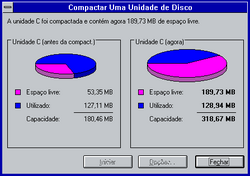
The trick was easy to describe and alarming once you understood it. DoubleSpace made a single enormous file on your real drive, named DBLSPACE.000, and compressed the entire contents of the disk into it. Then it lied about which drive was which. The real disk got remounted under a different letter, usually H:, and the file pretending to be a disk became your C:.
A driver called DBLSPACE.BIN loaded before CONFIG.SYS was read, early enough that the operating system's own files could live inside the compressed volume. That is a clever piece of bootstrapping, and it also means that when the volume file went bad the machine could not start well enough to tell you why.
By the time I had a PC at home the descendant of this was sitting in the Windows 98 system tools menu, and the received wisdom about it was already settled: leave it alone. Nobody at that end of the timeline knew that the name in the menu was the shape of a settlement. The original had been pulled out of the product by a court order in the spring of 1994, and what you were looking at five years later was the rewrite. A menu item is a bad place to keep that kind of history, so it was not kept anywhere.
~ the rap sheet ~
| Born | march 1993, as DoubleSpace in MS-DOS 6.0 |
|---|---|
| Peak | 1994 to 1998, in the box on every consumer dos and windows release |
| Killed | october 25, 2001, absent from windows xp |
| Lifespan | eight years and two names |
| Made by | microsoft, bootstrapped from code licensed off vertisoft |
| Killed by | hard drives that stopped being expensive |
~ the code microsoft had already seen ~
Stac Electronics started in Pasadena in 1983 and released Stacker in 1990, which did the same job and did it first. In 1993 Microsoft opened licensing talks with Stac and looked at Stac's code during diligence, then ended the talks and shipped DoubleSpace, which it had bootstrapped from a separate license on Vertisoft's DoubleDisk. Stac filed suit in January 1993, before MS-DOS 6.0 was even on shelves.
The verdict came in February 1994. The jury found the patents infringed and put the number at $120 million, which worked out to $5.50 for every copy of MS-DOS 6 sold. It also found for Microsoft on a counterclaim about a preload feature and sent $13.6 million back the other way. What hurt was not the money. It was the injunction, which barred Microsoft from continuing to ship what it had already shipped to millions of people.
~ three releases in fifteen months ~
MS-DOS 6.2 arrived in late 1993 with ScanDisk and a feature called DoubleGuard, both of them answers to a year of complaints about corrupted volumes and vanished files. MS-DOS 6.21 arrived in March 1994 and its entire purpose was subtraction. DoubleSpace was cut out, and anyone who wanted compression had to go and buy it from somebody else. Microsoft was selling an operating system with a hole where the headline feature used to be.
The settlement landed on 21 June 1994. Microsoft put about $39.9 million into Stac as equity and agreed to roughly $43 million more in royalties paid out over the following years, with the two companies cross-licensing their compression patents. MS-DOS 6.22 followed almost immediately, carrying the rewritten DriveSpace, which from a user's chair was indistinguishable from the version the court had removed.
~ where it stopped shipping ~
DriveSpace 2 went into Windows 95. DriveSpace 3 came with the Microsoft Plus! pack and added two heavier compression modes called HiPack and UltraPack, on an upgrade path that ran one way only. It shipped again in Windows 95 OSR2 and in Windows 98. For five years every consumer Windows Microsoft sold could compress your hard disk out of the box.
Then the reason evaporated. A 1993 hard drive cost enough per megabyte that trading CPU cycles for storage was a real bargain, and by 1999 it was not. Windows Me, in September 2000, kept DriveSpace for removable media and dropped hard disk compression. Windows XP shipped on 25 October 2001 with none of it, and the NT line it came from had never carried any of it in the first place. Stac, which won the case, renamed itself Previo and sold what was left to Altiris in 2002.
~ leave a rose ~
an anonymous tribute. one rose per visitor per day.
@}-->-- ... roses left here
~ leave a wreath ~
a rose fades by morning. a wreath stays on this grave for good, with your name on it.
paid once through stripe. payments are handled by OÜ Lakeview, the small company that keeps rip.so running. the money pays for the hosting and the nightly digging. adopt it and the headstone reads "maintained in memory by" you. the groundskeeper plants new wreaths at the next tending, usually within a day.
» one email a week: new graves and the anniversaries of the dead. subscribe
other software: Picasa, Adobe FlashPaper, Be Inc., Windows Live Writer
also died in the 2000s: Stan Lee Media, Adobe FlashPaper, Be Inc.
~ leave a note ~
visitors before you have left these graveside notes. anonymous welcome.