Daily Sketch
~ the obituary ~
Edward Hulton started it in Manchester, and the Library of Congress has the first issue dated 15 March 1909. It was a picture paper printed small, for readers the broadsheets were not written for. It stayed Conservative and populist through every owner it had. Hulton sold it to Lord Rothermere's Daily Mirror Newspapers in 1920. Rothermere sold it on to William and Gomer Berry in 1925, and it spent the next twenty-seven years inside what became Kemsley Newspapers, with the Sunday Graphic as its sister title.
In 1952 Kemsley sold it to Associated Newspapers, which already owned the Daily Mail. That is the transaction that decided how the story ended, nineteen years before it ended. For the whole of the 1950s and 1960s the Sketch chased the Daily Mirror and never caught it. The Mirror had launched in 1903 and had the market the Sketch wanted. That six-year head start is why the BBC's obituary called the Sketch Britain's oldest tabloid and not its first.
John Davies, then Secretary of State for Trade and Industry, announced the end to the House of Commons on 9 March 1971: Associated would merge the Mail and the Sketch by mid-May, and roughly 1,700 of the group's 7,500 staff were expected to go. On 3 May the Daily Mail dropped its broadsheet format for a compact one, in its seventy-fifth year, and took on a set of the Sketch's features including the Peanuts strip. Eight days later, on Tuesday 11 May, the Sketch printed for the last time. Circulation was 760,000, against 1.8 million for the Mail it was being folded into.
Almost everything that survived of this paper survived inside another one. Its last editor, David English, was handed the Daily Mail to run. Its comic strips and its readers were moved across by design. I can give you its launch date to the day only because the Library of Congress holds the serial record, which says the title began with the issue of 15 March 1909 and ceased with the issue of 1 June 1946. The paper kept printing for nearly twenty-five years after that second date, under names it had to share.
~ the case file ~
| Born | 15 March 1909 in Manchester, founded by Sir Edward Hulton |
|---|---|
| Peak | 1.3 million copies a day, no date recorded for it |
| Killed | 11 May 1971, announced in Parliament on 9 March |
| Lifespan | 62 years, six and a half of them with the Daily Graphic's name ahead of its own |
| Made by | Edward Hulton, then the Berry brothers, latterly Associated Newspapers |
| Killed by | the Daily Mirror, which it spent sixty years failing to compete with |
~ the name kept getting demoted ~
The common summary is that the Daily Sketch name vanished in 1946 and came back in 1953. The catalog records are more specific and more undignified than that. The Sketch had absorbed the Daily Graphic back in 1926, and twenty years later the owners decided the dead title was the better brand. From 1 July 1946 the masthead read Daily Graphic and Daily Sketch. Then Daily Graphic Daily Sketch from 22 June 1950, then Daily Graphic and Daily Sketch again with an ampersand from 2 September 1950.
The order flipped after 3 January 1953, giving Daily Sketch and Daily Graphic, and the plain Daily Sketch masthead did not come back until 18 September 1954. So the paper spent six and a half years with the name of a title it had swallowed printed ahead of its own, and the sequence of catalog entries recording this runs to six separate serial records for what readers experienced as one newspaper.
~ the halfpenny placard ~
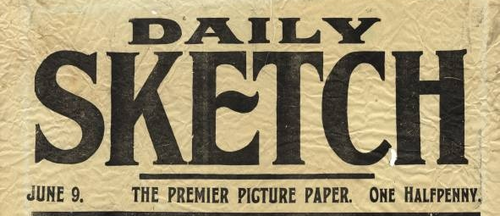
The best surviving Daily Sketch artifact is not a front page, although Wikipedia captions it as one. It is a news vendor's contents bill from June 1913, the creased card that stood outside a shop to sell that day's paper. DAILY SKETCH runs across the top. Under it, in a thin line of small capitals, sits JUNE 9. THE PREMIER PICTURE PAPER. One Halfpenny. Then the headline, in type four times the size of the slogan: FIRST MARTYR FOR VOTES FOR WOMEN, with the photograph of Emily Davison set into the left of it. The paper described itself in the smallest type on the card and charged half a penny.
~ a wrapper around the replacement ~
The last issue was a souvenir edition, and the BBC's report on the day records what was inside it: a copy of the Daily Mail, which Harmsworth Publications hoped Sketch readers would now switch to. The back page reassured them that Jean Rook and the racing tipster Gimcrack were coming across with them. So was Fred Basset. A paper that had been printing for sixty-two years spent its final edition as packaging for its own successor.
Production of those last copies was held up by an industrial dispute over how many men should be staffing the presses. The Sketch's final deadline was missed for the most Fleet Street reason available, on a print run nobody was ever going to repeat.
~ leave a rose ~
an anonymous tribute. one rose per visitor per day.
@}-->-- ... roses left here
~ leave a wreath ~
a rose fades by morning. a wreath stays on this grave for good, with your name on it.
paid once through stripe. payments are handled by OÜ Lakeview, the small company that keeps rip.so running. the money pays for the hosting and the nightly digging. adopt it and the headstone reads "maintained in memory by" you. the groundskeeper plants new wreaths at the next tending, usually within a day.
» one email a week: new graves and the anniversaries of the dead. subscribe
other news: xoJane, OpenSpace.ru, ORTF, Euskaldunon Egunkaria
also died in the pre-1980s: Radio 390, ORTF, Angry Penguins
~ leave a note ~
visitors before you have left these graveside notes. anonymous welcome.