CitySpace
~ the goodbye ~
In August 1993 I was nine years old in Turkey and five years away from my first modem. CitySpace was switched on that month at SIGGRAPH, on a cluster of Silicon Graphics Onyx Reality Engines, in a country where a handful of children were about to get the first look at a 3D world they were allowed to build themselves. There is no version of this story where I am in it, and there is no version where anybody's home computer is in it either.
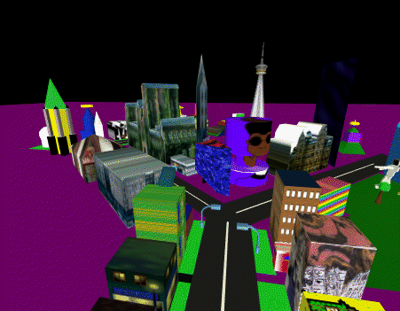
The project was run by Zane Vella as director and Coco Conn as producer, with the software written by Chris Cederwall out of the Electronic Visualization Laboratory. What it did was unusual enough that the New York Times covered it on 31 August 1993 and New Scientist came back to it three years later. The world arrived empty. Children between eight and eighteen came to workshops at the museums hosting it, learned enough 3D modeling on Macintoshes to make a building or a vehicle or a virtual toy, and then that thing became part of the city everyone else walked through.
Technically it was ahead of nearly everything. The software rendered in real time and gave avatars six degrees of motion, and the clients talked directly to each other to pass positions and graphics updates around rather than routing it all through one machine. The installations toured: the Computer Museum in Boston had it in 1993, the Exploratorium in 1994 and again in 1995, then the Ontario Science Center. In 1994 it ran inside the CAVE at the SIGGRAPH VROOM event, which was that year's showcase of what virtual reality could actually do.
It stayed alive between installations through email and CU-SeeMe, contributors in different countries sending each other avatars and buildings over a video tool that ran at a few frames per second. In 1996 it won a National Information Infrastructure award for arts and entertainment, and 1996 is also the year it stopped.
~ the chronicle ~
| Born | august 1993, launched at siggraph and written up by the new york times that month |
|---|---|
| Peak | 1994 and 1995, with installations at the exploratorium and the ontario science center, plus a showing inside the cave at siggraph '94 |
| Killed | 1996, the same year it won its nii award for arts and entertainment |
| Lifespan | 3 years |
| Made by | zane vella and coco conn, with software by chris cederwall of the electronic visualization laboratory |
| Killed by | a project shape that needed museums, supercomputers and a touring crew to exist at all |
~ how it landed ~
The claim that CitySpace was the first user-generated virtual world holds up better than most firsts do. Habitat had avatars in 1986 but Lucasfilm drew the world. The MUDs and MUSEs let you build, and building meant typing descriptions of rooms. CitySpace let an eleven-year-old model a geometry, hand it to a network, and then walk past it with other people looking at it. That is the loop every world since has been selling, arriving about a decade before the hardware to run it got cheap.
The hardware is the whole problem with calling it a success. An Onyx Reality Engine was a machine institutions bought, not people. The project existed in the gap between what graphics research could do and what a household could own, and it filled that gap by borrowing museums.
~ what got buried with it ~
What died in 1996 was the education half. CitySpace was not really a product with users, it was a workshop with a renderer attached, and the renderer was the least important part. Kids learned 3D modeling, internet communication and what it felt like to have a stranger react to something they had made, at an age when almost nobody had that experience available to them.
The virtual worlds that followed sold the opposite deal. Club Penguin and Habbo and their descendants gave children a world already built by adults, and the creativity available inside it was mostly which hat to buy. That trade made the business work and it also removed the thing CitySpace was for.
~ the funny part ~
A project that toured science museums with supercomputers, won a federal award, and got written up in the New York Times has left almost no trace on the web it helped invent. There is a Wikipedia article, a GIF of the first streets looking down from above, and a line on a virtual worlds museum's list of sunsets. No archived site, because in 1993 a virtual world did not need one.
~ leave a rose ~
an anonymous tribute. one rose per visitor per day.
@}-->-- ... roses left here
~ leave a wreath ~
a rose fades by morning. a wreath stays on this grave for good, with your name on it.
from $1, paid once through stripe. it keeps the graveyard running: the hosting and the nightly digging. adopt it and the headstone reads "maintained in memory by" you. the groundskeeper plants new wreaths at the next tending, usually within a day.
» one email a week: new graves and the anniversaries of the dead. subscribe
other kids: Herotopia, Tipeez, Kerpoof, Nanovor
also died in the 1990s: Distributed Language Translation, Magnetic Scrolls, PF.Magic
~ leave a note ~
visitors before you have left these graveside notes. anonymous welcome.